

MONTREAL, Quebec—Two former NCUA board members Friday pulled back the curtains on what goes on behind the scenes at the agency, talking about disagreements between board members, how policy is formed, and whether real regulatory relief is coming for credit unions.
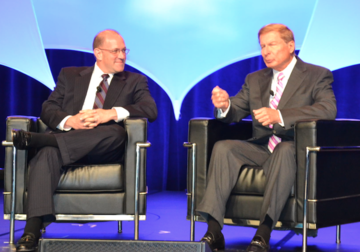
Former NCUA board members Geoff Bacino, left, and Michael Fryzel.
Former NCUA board member and Chairman Michael Fryzel, along with former board member Goeff Bacino talked about their years at NCUA in a panel discussion led by NAFCU EVP/General Counsel Carrie Hunt during the trade association’s annual meeting here.
Hunt first asked the panel for insights into public disagreements between board members, such as the recent public policy debate between Chairman Debbie Matz and Board Member Mark McWatters.
“The banter that is going on today, such as (Mark McWatters’) reference to the agency treating credit unions like ‘Victorian-era children,’ I think is good,” said Fryzel. It’s not that the two board members dislike each other, they just have different philosophies. And by expressing their differences, it generates good dialogue.”
Bacino agreed with Fryzel, saying, “In the end, it’s not personal. Sometimes, too, you get caught off guard by reporter and make a snappy comment . . .,” added Bacino, who sees the current disagreement between Matz and McWatters as healthy for the agency “as long as it does not get in the way of doing business.”
In response to a question from Hunt regarding how the agency forms policies, Bacino emphasized that the board must recognize that they run the agency.
“Sometime board members can lose sight of that,” said Bacino, who currently manages a credit union association and also does public policy work in Washington with his own firm, Bacino & Associates, referring to efforts by agency staff to influence policy and decisions. “The staff know board members’ terms are limited, and they know they have been at NCUA longer than the board member. They know they can wait a board member out if they have disagreements.”
Fyzel agreed with Bacino, but stressed that the chairman runs the agency. “The chairman sets the direction on what regulations are considered, what staff changes will be made, and what information is disseminated to other board members.”
Fryzel held the chairman title for a year, including during some of the toughest times surrounding the corporate crisis five years ago. He is now in private practice as an attorney in Chicago.
Fryzel stressed that it is the role of the chairman to make sure policy information is passed along quickly to the other board members.
“It’s the chairman’s job to make sure the board is well informed and can vote effectively,” said Fryzel. "What sometimes happens is that information does not get filtered down fast enough. So this is where collaboration and cooperation between board members is important.”
Hunt also pressed the two former NCUA board members on whether CUs can expect any real regulatory relief from NCUA in the near future.
“True regulatory relief is not when you say to credit unions ‘We will make this change, but then you have to do this,'” noted Fryzel, saying that is only shifting the burden.
He added that he hopes the regulatory relief measures outlined by Matz at the NAFCU meeting one day earlier are effective. “We will have to wait and see how all this filters out.”
Bacino pointed out that “talk is cheap. We have heard about regulatory relief from the start of the year, and we want to make sure that this is not just some slide on a PowerPoint. Credit unions need real regulatory relief.”