MADISON, Wis.–More than 300,000 Americans joined credit unions during January, while loan balances were up nearly 11% and savings was up 6% on a seasonally adjusted basis, according to the latest Trends Report from CUNA Mutual Group.
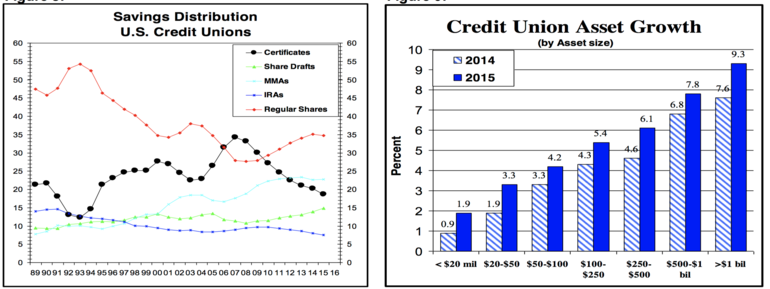
January saw a mini refinance boom at credit unions, while 2015 saw every credit union asset size category report aster asset growth than in 2014—but the largest CUs grew nearly four times faster than the smallest.
Here’s a look at various components of the overall CU community balance sheet, with any commentary provided by CUNA Mutual Group. The Trends Report is based on data gathered by CUNA.
Total Lending
Credit union loan balances rose 0.6% in January, slightly better than the 0.5% pace reported in January 2015, and 10.4% during the last 12 months. Credit union seasonally-adjusted annualized loan growth reached 10.9% in January 2016, the fastest pace since September 2014.
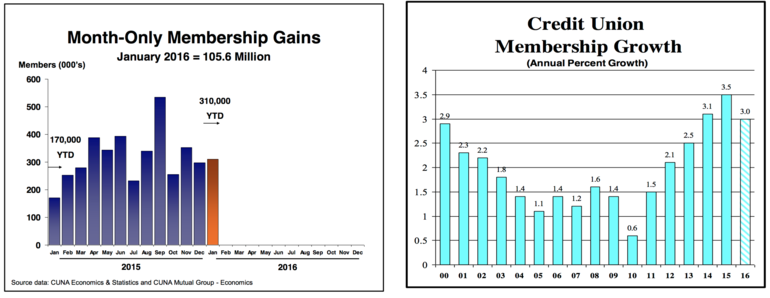
“That means this latest credit cycle boom has not yet reached its apex and looks capable of exceeding the duration of the two-year credit boom of 2004-2005,” said CUNA Mutual. “Why may this credit boom be more sustainable? Three words: faster membership growth. Credit union membership growth during the last two years has exceeded 3% compared to only 1% annual membership growth in 2004-2005. Credit unions today can increase loan balances not only with existing members, but also with many new members discovering for the first time all the quality financial products and services of a full service modern day credit union.”
Credit Union Consumer Installment Credit (CUCIC)
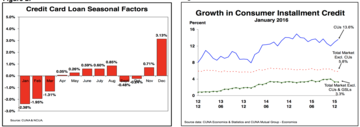
Credit union consumer installment credit balances (auto, credit card and other unsecured loans) rose 1.2% in January, twice the 0.6% pace set in January 2015, due to strong auto lending off-setting falling credit card balances. January’s credit card loan seasonal factors are typically the most negative of the year at -2.38%. Credit union consumer installment credit grew 13.6% during the last year, bucking the downward trend of the total market excluding credit unions, which grew only 5.8%.
Vehicle Loans
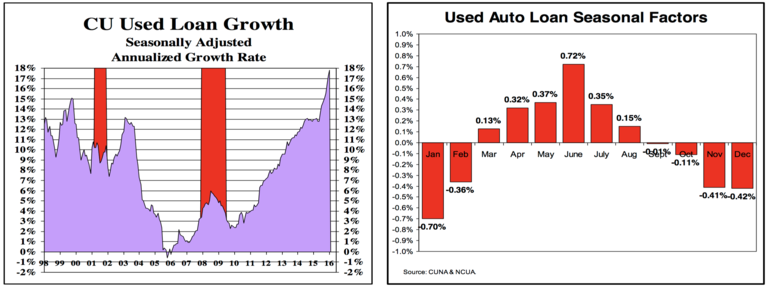
Credit union used auto loan balances rose 1.3% in January, faster than the 0.8% pace set in January 2015, and were up 13.5% during the last 12 months. But on a seasonally-adjusted annualized basis, used auto loan balances rose at a very robust 17.8% in January, a rapid acceleration from just six months ago and the fastest pace since January 1997.
“Auto sales should reach their peak in 2017 at 18.2 million units as most pent up demand from the Great Recession becomes satiated. Factors supporting auto sales include: attractive discounting, low gas prices, ample access to credit, low debt burdens, strong job growth, and growing hourly earnings,” the Trends Report analysis states.
Mortgages/Real-Estate Secured
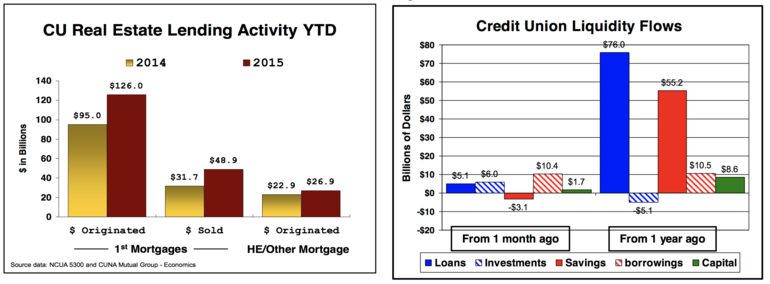
Credit union first mortgage originations reached a record $126 billion in 2015, a 33% increase over the $95 billion in originations in 2014. Credit unions then proceeded to sell of 39% of those originations into the secondary market, a higher percentage than the 33.3% in 2014. The stage is set for another strong year of credit union first mortgage growth as rising purchase activity offsets slower refinance business, CUNA Mutual noted.
The contract interest rate on a 30-year, fixed-rate conventional home mortgage fell to 3.87% in January, from 3.96% in December, but higher than the 3.71% reported in January 2015. “The drop in mortgage rates created a mini refinance boom at credit unions in the first quarter, which is keeping the record origination volume set in 2015 continuing into 2016,” CUNA Mutual said. “Expect mortgage interest rates to remain below 4% through the first half of the year as the Federal Reserve waits until summer to resume their rate normalization policy.”
Surplus Funds (Cash + Investments)
Credit union borrowings grew $10.4 billion in January, in part to take advantage of a recent riskless arbitrage profit opportunity. In December 2015, the Federal Reserve increased the interest rate paid on excess reserves to 0.50%. This created an arbitrage opportunity whereby financial institutions can borrow funds in the short term interbank credit markets at a lower interest rate, say 0.35%, and deposit the funds into their regional Federal Reserve Bank account earning 0.50%.
Borrowings as a percent of assets reached 4.2% in January, up from 3.3% in December 2015, and the highest borrowing ratio since December 2009. But this is still below the record high set in January 2009 during the height of the financial crisis when credit union borrowings made up 4.9% of their balance sheets. With loan growth expected to outpace savings growth in 2016, expect credit unions to depend more on borrowings to meet rising loan demand, CUNA Mutual is projecting.
Savings and Assets
Credit union savings balances fell -0.3% in January, below the 0.9% gain reported in January 2015, due to a surge in post-holiday consumer spending. The distribution of credit union savings tilted further away from certificates and toward share drafts in 2015, as credit union members awaited an increase in the fed funds interest rate, and soon thereafter credit union share certificate interest rates. Every credit union asset size category reported faster asset growth in 2015 as compared to 2014, with the largest credit unions growing four times faster than the smallest credit unions.
Capital and Other Key Measures
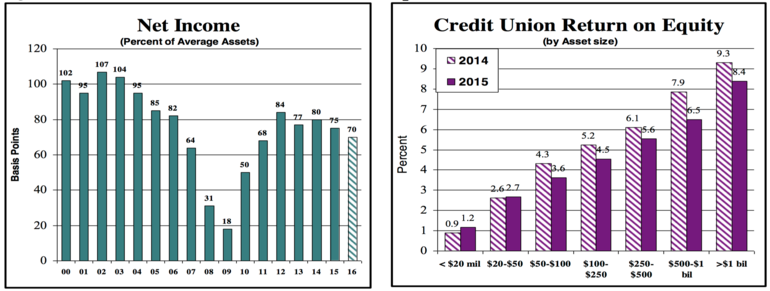
The credit union industry’s net income to average asset ratio, return on assets, fell to 0.75% in 2015, from 0.80% in 2014, below the 1% long run average. A three basis point increase in net interest margins was more than offset by a six basis point increase in loan loss provision expense. Credit unions with $1 billion in assets or greater increased their loan loss provisions by 9 basis points, moving from 0.30% of average assets in 2014 to 0.39% in 2015.
Return on equity, ROE, ratios fell for many credit unions in 2015 due to the aforementioned lower return on asset ratios. The ROE ratio is one of the more important credit union metrics because it determines the long run sustainable asset growth rate. For example, billion dollar credit unions reported ROE ratios of 8.4%. This indicates their assets can grow 8.4% while maintaining a constant capital-to-asset ratio. If nominal GDP grows 4.5% over the long run, then to maintain market share, credit union assets need to grow 4.5%, which necessitates an ROE ratio of 4.5%.
Credit Unions & Members
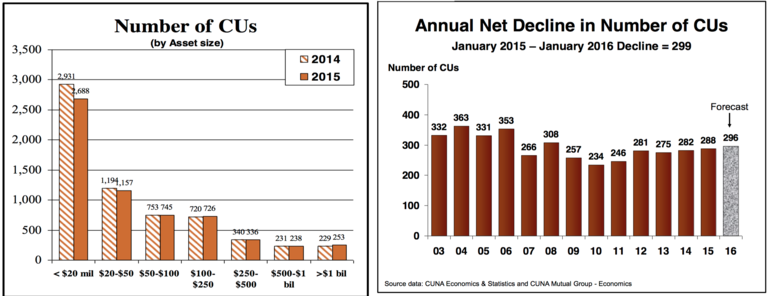
As of January 2016, CUNA estimates 6,198 credit unions are in operation, down 299 from January 2015 (Figure 12). Year-end 2015 NCUA call report data shows 253 credit unions with assets in excess of $1 billion who held 58.1% of the credit union system assets and 60.4% of the loans while making up only 4.1% of all credit unions. This is up from 229 billion-dollar credit unions in 2014, holding 55.0% of assets and 57.2% of loans. The median asset size of a U.S. credit union rose to $26.8 million in 2015, a 9.4% increase from the $24.5 million set back in 2014.
Credit unions added 310,000 memberships in January, almost twice the 170,000 gain recorded in January 2015, due to strong credit demand and robust job growth. Total credit union memberships reached 105.6 million in January 2016. In percentage terms, credit union memberships rose 0.29% in January and 4.0% during the last 12 months. With the economy expected to add another 2.4 million jobs in 2016, credit unions should expect membership growth to exceed 3% in 2016.
The full Trends Report can be found in the CUToday.info Vault here.