

WASHINGTON–A new analysis released by the American Bankers Association suggests some credit unions are overspending on marketing and that the CU tax exemption is not showing up in more advantageous rates.
The analysis, by Dan Brown, economist and senior director in ABA’s Office of the Chief Economist, and Robert Flock, VP in ABA’s Office of Strategic Engagement, said “certain subset” of credit unions have capitalized on membership rule changes of the last 25 years, and that includes mass market advertising targeting millions of potential new members.
“From PenFed Credit Union’s partnership with Dulles International Airport and Mountain America Credit Union’s naming rights to Arizona State University’s football stadium to Jovia Financial Credit Union’s 2024 Super Bowl ad, credit unions have launched expensive marketing campaigns going after deposits, loans, and other services,” the two authors stated. “While assets of banks with more than $1 billion in assets have grown by 80% over the last decade, marketing efforts by credit unions over $1 billion in assets have fueled their 127% increase in assets during that same period.”
After reviewing changes in FOM rules, including what the ABA called “substantially watered down credit union membership criteria,” since the 1990s and noting that more than 1,000 CUs have moved to a community charter since 1996, the ABA said its analysis found credit unions with more than $1 billion in assets on average have more than doubled their potential membership pool since 2011.
Regulatory Changes Drive Spikes
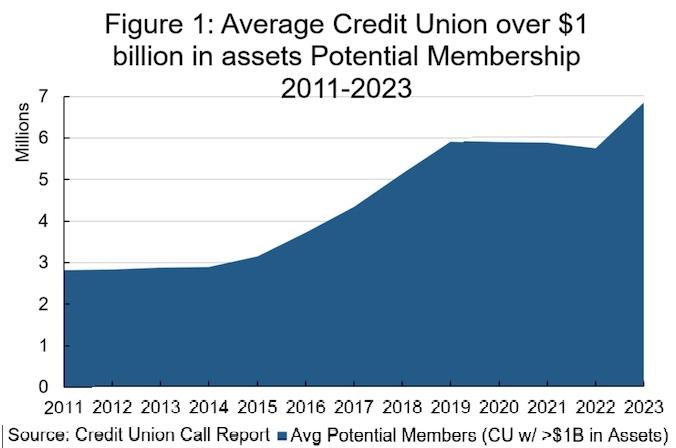
“Spikes also seem to occur following key regulatory changes, such as the 2015 chartering and field of membership rule that enabled federal credit unions to add 12 categories of associational groups to membership eligibility, and a 2021 rule that relaxed geography proximity requirements,” the analysis states. “Finally, in 2023, there were three credit unions that submitted figures over 335 million for potential membership, meaning they believed the entire U.S. population was eligible for membership.”
Aftermath of CUMAA
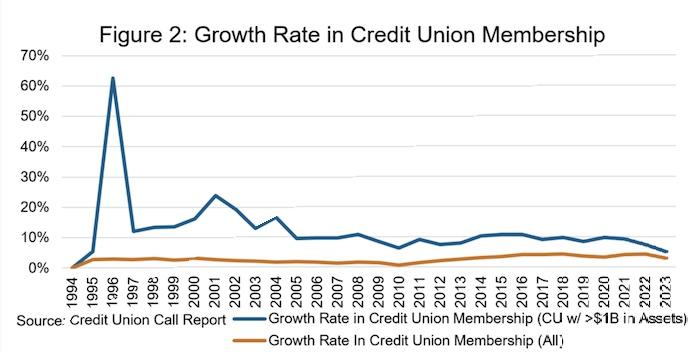
According to the ABA, credit unions that have prioritized growth “have far outpaced their cooperative brethren” in acquiring members, as the chart above shows. As shown in the chart, the spike in the mid-1990s is related to the fight to get the Credit Union Membership Access Act passed.
“Not only have credit unions with over $1 billion in assets significantly increased their assets since these changes, their asset growth also surpasses that of the banking industry,” the ABA said. “…The growth in assets of banks and credit unions with more than $1 billion in assets. These credit unions have grown over 120% in just nine years compared to 80% by banks with over $1 billion in assets in the same timeframe. And changes in membership criteria are only part of the story. To grow members and assets at this rate, advertising plays a pivotal role.”
‘Endless Ads’
To that end, the ABA said the naming rights deals, marquee sports event sponsorship and university partnership have led to “endless ads” by credit unions that are “hard to ignore.”
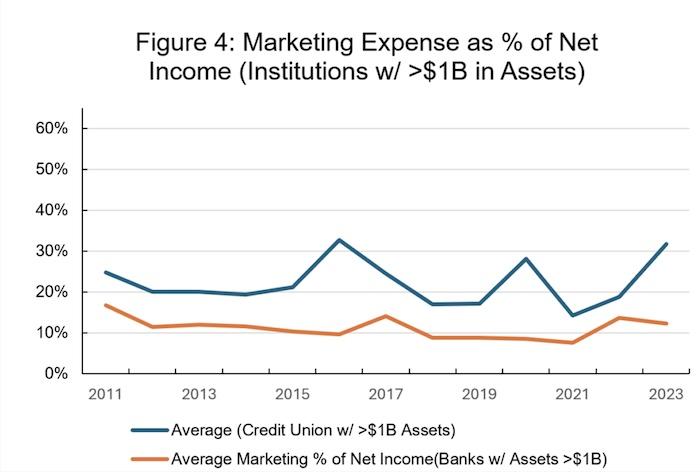
“In fact, on a proportional basis, credit unions with over $1 billion in assets, which are not-for-profit entities that do not pay taxes, spend significantly more on marketing than similarly sized banks,” the ABA said. “Taking numbers from the FDIC and NCUA call reports, shows the proportional marketing spending by both banks and credit unions with over $1 billion in assets. We compare advertising as a percent of net interest expense based on a 2017 article from S&P Global Market Intelligence that first flagged the noticeable uptick in advertising….The trend has continued, and credit unions with over $1 billion in assets proportionately spend significantly more on marketing than banks with over $1 billion in assets.”
Additional Findings
The ABA said it found:
- The average credit union with more than $1 billion in assets has more than tripled its marketing spending, from $1.4 million in 2011 to roughly $4.4 million in 2023.
- Navy Federal — America’s largest credit union — has more than quadrupled its marketing spending in the last 12 years, from $43.2 million in 2011 to almost $196 million in 2023, the ABA said.
- America First FCU had one of the largest percent increases in marketing, increasing its marketing spending from just over $4 million in 2011 to $32.8 million in 2023.
‘No Rate Advantage’
“One of the more interesting wrinkles behind credit union marketing is that while these institutions do not pay taxes and are not subject to fair lending regulations like the Community Reinvestment Act, they should in theory offer better rates on loans and deposits,” the ABA authors wrote. “If they were doing so, there would be little need for such substantial marketing efforts.”
However, research examining household survey data provides evidence that the majority of the credit union tax subsidy is being diverted away from the intended beneficiaries. Contrary to the impetus for the Federal Credit Union Act, the paper also notes that low-income individuals “have become less (rather than more) likely to use the services of a credit union: the average credit union member has similar or even higher income than the average bank customer. And if rates offered by credit unions are much closer to those offered by banks, there is a clearer need to advertise.”