

By Ray Birch
LAKE FOREST, Ill.— Where are overdraft prices headed now? Not lower. After 12 straight quarters of declines, the downward trend in overdraft fees has finally come to a halt.
The national average overdraft price is $18.66 and has remained unchanged since the beginning of 2025, Moebs $ervices reported.
“This is extremely significant,” said J.V. Proesel, president of Moebs $ervices. “This marks the end of an unprecedented three-year period of declining overdraft prices.”
Proesel told CUToday.info the stabilization of prices—which began a sharp decline at the start of the COVID pandemic—is due to a number of political and economic reasons.
“The price drop was caused by the unique culmination of political, regulatory and market forces applying pressure at the same time to banks and credit unions,” Proesel said. “Big banks got particularly hit hard on the regulatory and political front in the last Administration. The big banks lowering overdraft fees and eliminating NSF fees drove the national headlines, which caused many community financial institutions to follow suit. Under the Trump Administration the regulatory and political pressure has disappeared virtually overnight.”
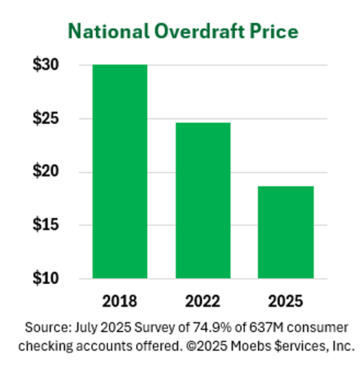
But Proesel does not see overdraft prices increasing or reverting to former price levels.
“This is good for credit unions and banks that prefer stability,” he said. “I think we can expect these prices to remain stable for the next few years. However, there are two exceptions to this:
- “The regulations at the Federal level have eased substantially. Regulations at the state level have not. There is a dichotomy of red vs. blue states in regulatory approaches and consumer protection laws. For example, California implementing $14 overdraft price restrictions starting Jan. 1, 2026.
- “There will always be competition with lower fees. This free-market approach will keep prices competitive and low. The market has already baked fintechs into the overdraft equation. However, I know many credit unions that are looking to lower fees further to $15 or less. The purpose is to go after market share, drive volume and also prepare for a potential return of overdraft regulations post Trump era. The political pendulum eventually will swing back.”
Drop Began In 2021
Moebs $ervices, a private economic research firm, statistically collects and analyzes fee prices quarterly for 75% of the 637 million consumer checking market. Overdraft prices started to decrease in 2021 during COVID, Proesel noted.
“This period witnessed the rapid emergence of fintechs offering ‘feeless checking’ services. At the same time Wall Street banks were under heavy pressure from outspoken critics in Congress and the Consumer Financial Protection Bureau,” he explained. “This unique combination of regulatory, political, and market forces pressured big banks, followed by community banks and credit unions, to quickly lower overdraft prices.”
Proesel reminded that overdraft services provide a budgeting tool for nearly 50 million consumers annually to cover short-term cash needs. These same consumers have been struggling with rising living costs, stagnant wages, unemployment, and housing challenges.

J.V. Proesel
“Middle class households are feeling the financial strain from the economy tightening and they will be getting no relief from overdrafts,” said Proesel.
Moebs $ervices data shows overdraft limits are starting to shrink.
“The average overdraft limit was $500 for 25 years but recently jumped up to $800. There are early signs the average overdraft limit is settling around $800,” Proesel explained. “Stagnant prices and stalled limits are the overdraft squeeze from both sides. The American consumer is not the only one feeling the financial strain; financial institutions have been searching for new ways to increase bottom lines in 2025.”
While the pricing competition is easing up a bit and the regulatory and political pressure at the Federal level have disappeared, now is not the time to back off actively repricing and marketing overdraft services, insisted Proesel.
“The environment is ripe for community banks and credit unions to expand overdraft value to their customers and members. Low prices and higher, tiered overdraft limits underwritten by risk will dominate checking in 2026. Overdrafts are no longer taboo and buried in the footnotes,” he said. “Overdraft prices are a leading marketing tool to gain more checking users. Just ask CapitalOne, Bank of America, or Walmart. The period of price decreases was a good thing for overdraft service users and providers. Smart credit unions will take advantage of the market price stabilization to lower prices further and stay one step ahead of the competition.”