

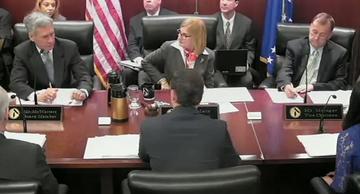
L-R: Mark McWatters, Debbie Matz, Rick Metsger
ALEXANDRIA, Va.–Never has a 3-0 vote been so divided.
While all members of the NCUA board voted in favor of the agency’s revised Member Business Lending proposal, the vote only came after strong disagreements and bickering between not just NCUA Chairman Debbie Matz and board member Mark McWatters—who often clash—but this time Vice Chairman Rick Metsger was also involved.
Both Matz and Metsger challenged the timing of a proposal made by McWatters, with Matz ultimately calling McWatters’ request “meritless” and then later saying it might not have been an issue at all if he were on-site at NCUA’s offices more than three days each month.
At the center of the disagreement were comments made by McWatters when it was his turn to take the floor after the NCUA board had heard from agency staff on various components of the MBL proposal (see related story).
Consistent With Congressional Intent?
McWatters, an attorney and law professor, questioned representatives of NCUA’s Office of General Counsel over whether any of the more than 3,000 comment letters the agency received questioned whether NCUA had authority under the Federal Credit Union Act to make changes to its MBL rules. McWatters said some letters had “concerns about whether the rule was consistent with congressional intent and credit union mission.”
McWatters said that more than a week ahead of the board meeting he had asked to see a copy of the legal opinion NCUA had gotten on the question of the MBL proposal and the FCU Act and had been told that there was not one available.
“The reason I requested it is that with most of our rules there isn’t a legal opinion,” said McWatters. “But here we have a lot of people saying that maybe we exceeded our authority. So it seemed to me we should be on the record with a legal opinion. That will be coming after the board action. That is highly unorthodox, as you know. This puts me in a quandary. If a legal opinion is rendered afterward, it will not be part of the public record. That causes me some degree of pause here, that we have a substantial number of commenters questioning the legal authority, and our legal opinion will not be part of the record. As a lawyer, that puts me in an awkward position. To mitigate that I have spent quite a bit of time with the general counsel and assistant general counsel quizzing them hard on this issue, and I feel the Office of General Counsel opinion is we are in compliance with the law. So I want to state that for the record that we have done our diligence on the issue.”
McWatters added that in his opinion it is “poor governance to have the opinion follow the board vote and even more problematic with the opinion is not part of the record itself.”
McWatters then turned his questioning to NCUA Director of Examination and Insurance Larry Fazio over the rights of state regulators’ to promulgate their own member business lending rules and whether NCUA was overriding those rights. He acknowledged that he understands that as the insurer, NCUA is responsible for writing the checks in the event of any losses.
Not Identical, But Sufficient
McWatters specifically pressed Fazio over language around which credit unions are exempt from the rules and whether the way the proposal is written doesn’t suggest that a certain floor or minimum set of standards are in place. He questioned whether wording couldn’t be changed to “covers in all material respects” with respect to how a state might fashion its own MBL rule.
“Does it have to be exactly identical?” asked McWatters.
“It doesn’t have to be exactly identical, it has to be sufficient,” responded Fazio. “It has to address what we consider the core risk management standards.”
McWatters than put forward the suggestion that a state proviso could cover all the core risk management principles and also with the FCU Act?
“That’s the intent,” said Fazio.
McWatters said he was “troubled” that someone giving the NCUA proposal a narrow reading might see an “absolute floor” in the proposal but not read the risk management piece.
It was that issue and what McWatters said were his efforts to have his concerns addressed that the strong disagreement began among the board members. McWatters said his office had voiced his concerns more than one week earlier and “we got nowhere on this. I think we could have worked out some language that captures exactly (Fazio’s) intent” but that also gives the state regulators some leeway in MBL rules.
“This again puts me in another awkward situation, because I am a believer in state’s rights. I’m a believer that all the wisdom on MBL does not just come out of this office, and that the people in flyover country might have good ideas,” said McWatters, adding that a rigid rule leads to a “chilling effect.”
'Regulating For A Hypothetical'
In response, Matz said the MBL rule and preamble were both written by the agency’s Office of General Counsel, as was the Board Action Memorandum, “So I think it’s fair to say they believe it is in compliance with the FCU Act. On this issue of states coming up with some proposal that might be different than ours, I know we have talked in the past of not regulating for one or two instances, this is regulating for a hypothetical that might never occur.”
Matz added that safety and soundness is always a concern, but the rule is not meant to stifle state regulators, with whom the agency has worked on the rule.
The fact that McWatters’ proposal for a language change was not considered was due to the fact it was not made until 6 p.m. on Wednesday, Feb. 18, the night before the board meeting.
“Getting a rule change at six at night after all this has been printed—that train has left the station,” said Matz. “My staff was not included in those discussions and (after
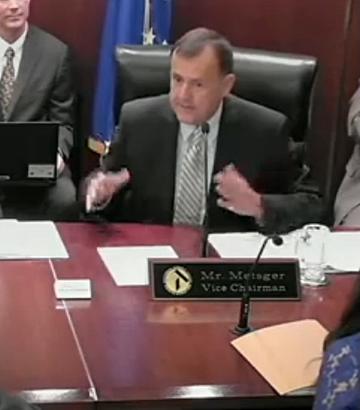
Rick Metsger
learning of it) we thought it was meritless, so it was not included.”
McWatters responded by noting that as a practicing attorney six at night is “the middle of the day,” and further said his proposed change involved “maybe half a sentence” in a proposal that is 138 pages long.
Two Issues
McWatters then said he would be voting in favor of the proposal, but he still wanted to make two points:
- That is is “regrettable” that the board did not get a legal opinion from NCUA’s OGC prior to the vote, calling it the “opposite of good governance.”
- The final MBL rule should permit state chartered CUs to qualify for an exemption if that state has a rule in place that mitigates risk and complies with the FCU Act.
“Regrettably, the final MBL rule essentially preempts states from developing their own MBL rules,” said McWatters. “NCUA should acknowledge that more than one approach to safety and soundness related to MBL exists. In reality, a rule touted as regulatory relief by NCUA may work to the contrary to the day-to-day operations of state charters that engage in member business lending.”
'I Cannot Talk To You'
While he typically has not waded into disagreements between Matz and McWatters, Vice Chairman Metsger spoke directly to McWatters, saying, “You said you had a change. I might support that change. I don’t know; my office never received that change. I was in the office until 6:30 last night. (Senior Policy Advisor Michael) Radway was in the office until 8. I shared my changes with your office on Feb. 5.”
McWatters: “I cannot talk to you. It violates federal law.”
Both Matz and Metsger quickly noted that their respective staffs can all speak with one another.
“I understand that,” said McWatters.
“Apparently not,” answered Matz.
“You talk about things that aren’t being shared, but gosh dangit, I’m not going to be supportive if It’s not shared with me,” said Metsger (click here for Metsger's prepared remarks).
In reference to the fact McWatters has continued to live in the Dallas area while serving on the NCUA Board, Matz added, “Perhaps if you came more than three days month and got your briefing more than two days in advance, perhaps you would have more time,” said Matz before calling for a vote on the proposal.