

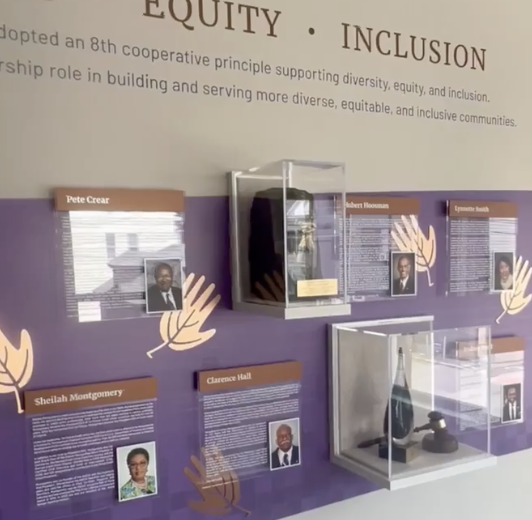
MANCHESTER, N.H.–America’s Credit Union Museum has formally unveiled its African American Voices in the Credit Union Movement exhibit.
The exhibit was created in conjunction with the African American Credit Union Coalition, whose CEO, Renee Sattiewhite, was among those on hand for the event at the Museum, which is located inside the home that served as the offices of the first credit union in the United States, St. Mary’s Bank.
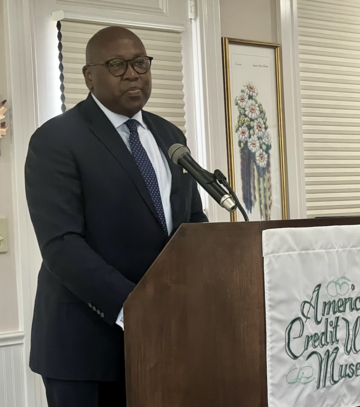
Rodney Hood
Also on hand were representative from credit unions in Africa who were in the U.S. for the World Credit Union Conference, which is taking place about an hour away in Boston.
Offering the keynote event at the unveiling Rodney Hood, former chairman of NCUA and the first African American to lead any federal financial regulatory agency.
Hood said the exhibit is an opportunity to “showcase the remarkable contributions” by African Americans to the cooperative movement.
Seen in the Faces
In looking at all the faces to be seen in the museum, Hood said, “I see strength. I see intelligence. I see compassion. I see the capacity for work. I see determination. I see a sense of responsibility. And I see a recognition of community and how our lives are all bound together and how working together in concert we can build something far greater than ourselves.”
Just a decade after St. Mary’s Bank began operating officially in 1909, Hood noted that in his home state of North Carolina in 1918, Thomas B. Patterson of Rowan County organized 22 farmers to found Piedmont Credit Union, a model that would spread across the Tarheel State as 13 more African-American CUs would be chartered in the following years.
By 1944, said Hood, there were 136 African American credit union in the United States.
The Story of Principles
“Without any doubt if you follow the credit union movement’s history you'll be reading a story of expanding opportunity again based on the tenets and principles of people helping people,” Hood said.
He noted that what was true a century ago, that many Americans had trouble gaining access to capital, including low-income families, working class families, farmers and small business owners, and that remains true today, with credit unions often the only resource available to them.
“This is a story about people helping people in their local communities,” Hood said. “It is important to note (that credit unions grew not from) government mandate and not by government fiat; instead they grew from something that we all know in this room very well-- from a grassroots movement of people who were forgotten but who did not want to be left behind anymore, and the movement continues to grow to this day.”
Hood said there remain many people and communities that are underserved and overlooked and he encouraged credit unions to reach out to them.
The ‘Promise’
“Every step growth of the credit union system is about the promise of people helping people and using assets to help people in their communities,” Hood said. “I am convinced if we remain true to the tenets of the credit union movement we can meet challenges and seize opportunities as we look to bring people into the financial mainstream…It is going to entail us continuing to roll up our sleeves and galvanize as America has shown time and time again. Once one starts to climb the economic ladder there is no telling how far that individual can climb.”
Praise for AACUC’s Work
Hood praised AACUC’s Sattiewhite for the work she is doing and for the initiatives the organization has developed, including a Small CU Summit, leadership development programs, mentorship, cross-cultural exchange programs, a DEI Leadership Academy, and more, and for “following up with actual tangible results.”