

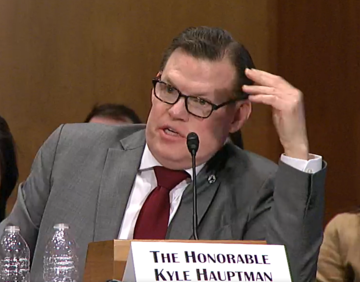
WASHINGTON— NCUA Chairman Kyle Hauptman used his appearance before the Senate Banking Committee Thursday to draw a sharp line between rulemaking and enforcement, telling lawmakers NCUA has formally codified a policy rejecting “regulation by enforcement” and is undertaking a sweeping review of its own rulebook — even as it advances stablecoin regulations under the GENIUS Act framework.
In his semiannual testimony alongside fellow prudential regulators, Hauptman said the nation’s roughly 4,300 credit unions, holding approximately $2 trillion in assets and serving more than half of U.S. adults, remain safe and sound, with healthy capital levels and moderate growth. He stressed that NCUA’s role as both regulator and deposit insurer makes it counterproductive to set policy through enforcement actions rather than through transparent rulemaking or guidance.
Hauptman said the newly codified policy makes clear that enforcement actions should not be used to establish new standards and that fines or press releases should not serve as de facto regulatory guidance. He framed the move as a matter of basic fairness and predictability, arguing that regulated institutions should know the rules before penalties are imposed. While noting NCUA has not historically relied heavily on enforcement-driven policymaking, he said formalizing the policy makes it more durable and harder to reverse.
Beyond enforcement philosophy, Hauptman pointed to what he described as a “spring cleaning” at the agency. Launched in December, NCUA’s deregulation project is reviewing existing rules to eliminate those deemed obsolete, duplicative or unnecessarily burdensome. He said 21 notices of proposed rulemaking are currently open for comment, with additional proposals recently closed, as part of a broader effort to right-size the agency and sharpen its focus on safety and soundness while fostering innovation.
On digital assets, Hauptman said NCUA has already issued a proposed rule governing the application process for stablecoin issuers and is developing additional standards tied to the GENIUS Act. He characterized dollar-denominated stablecoins as a modernization of the payments system that could expand consumer benefits while also increasing demand for U.S. Treasuries and reinforcing the dollar’s role as the world’s reserve currency — a strategic advantage he suggested policymakers should not take for granted.
Hauptman told lawmakers his written testimony details NCUA’s internal restructuring and broader efforts to empower credit unions, positioning the agency as both a prudential supervisor and a catalyst for responsible innovation in financial services.
Regulators Face Sharp Questions On Debanking, Crypto, Liquidity
The three other federal regulators testifying Thursday were Federal Reserve Vice Chair for Supervision Michelle W. Bowman, FDIC Chairman Travis Hill, and OCC Comptroller Jonathan Gould.
During Q&A, banking regulators were grilled over alleged debanking practices and steps taken to ensure a Silcon Valley crisis does not happen again. Overall, the panel fielded questions about deposit flight due to cryptocurrency, examiner practices, housing affordability, cyber risk and liquidity requirements.
Hauptman, who faced comparatively fewer pointed questions than the banking regulators, encountered a challenging line of questioning from Sen. Ruben Gallego (D-AZ). Gallego noted NCUA has historically required credit unions to report fee income data because it serves the public interest. He pointed out that last year, under Hauptman’s direction, the agency stopped publicly publishing income generated by overdraft and insufficient funds fees, and asked why that decision was made.
Hauptman responded that the specific publication of overdraft income data had only existed for one year, covering four quarters out of the agency’s entire history.
Gallego pressed further, asking what the logic was behind reversing the practice. Hauptman replied that overdraft income was already captured within total fee income data and said there are many ways such information can be further broken down. He added that, similar to publicly traded companies, data can always be segmented in more detail.
Sen. Catherine Marie Cortez Masto (D-NV) asked the panel about officials within the Treasury Department possibly weighing an executive order or similar action that would require financial institutions to collect customers’ citizenship information — potentially including passports or other proof of citizenship — both for new account holders and existing customers.
“Would this impact consumers ability to now have safe reliable money in a bank?” Masto asked.
“It strikes me as a hypothetical,” Hauptman responded. “But we'll certainly deal with anything that comes down the pike—EO or bills.”
Sen. Lisa Blunt Rochester (D-DE) addressed the Credit Union Board Modernization Act, which she sponsors. Hauptman pointed out credit unions find it “odd” Congress and NCUA are not required to meet every month and CUs are.
The Credit Union Board Modernization Act would amend the Federal Credit Union Act to change how often federal credit union boards of directors must meet. Instead of a one-size-fits-all monthly requirement for every credit union, the bill ties board meeting frequency to institution age and performance.
The Defense Credit Union Council responded.
“As Chief Advocacy Officer for the Defense Credit Union Council, I applaud Senator Lisa Blunt Rochester for bringing up her and Senator Bill Hagerty's Credit Union Board Modernization Act, a thoughtful, bipartisan proposal to modernize key aspects of the federal credit union charter and strengthen the ability of credit unions to serve their members. Eliminating the requirement that a credit union board meets formally every month is just common sense legislation,” said Jason Stverak.
For decades, America’s credit unions, especially those serving the defense and veteran communities, have provided essential financial services with a member-first focus, Stverak said.
“However, outdated regulatory structures have increasingly limited our ability to innovate, compete, and effectively support the financial readiness of service members and their families,” he said.
Stverak emphasized the Board Modernization Act represents a “commonsense” step forward.
“By updating supervisory frameworks, enhancing operational flexibility, and reducing unnecessary regulatory burdens, this legislation will help credit unions continue to deliver affordable financial products and services across the nation,” Stverak said. “DCUC looks forward to working with Senator Blunt Rochester, Senator Hagerty, and members of Congress from both sides of the aisle to advance this legislation.”