PHILADELPHIA — Credit unions have dramatically expanded their footprint across Pennsylvania, New Jersey, and Delaware over the past two decades, overtaking small banks in assets and consumer lending—but new research from the Federal Reserve Bank of Philadelphia raises fresh questions about how effectively that growth has translated into service for lower-income communities.
The findings come from The Growth of the Credit Union Sector and Its Implications in the Third District States, a December 2025 research brief by Lei Ding, a community development research officer at the Philadelphia Fed.
The study examines lending, branch placement, and mortgage outcomes for credit unions and banks from 2004 through 2024, drawing on Call Report, HMDA, and branch-location data.
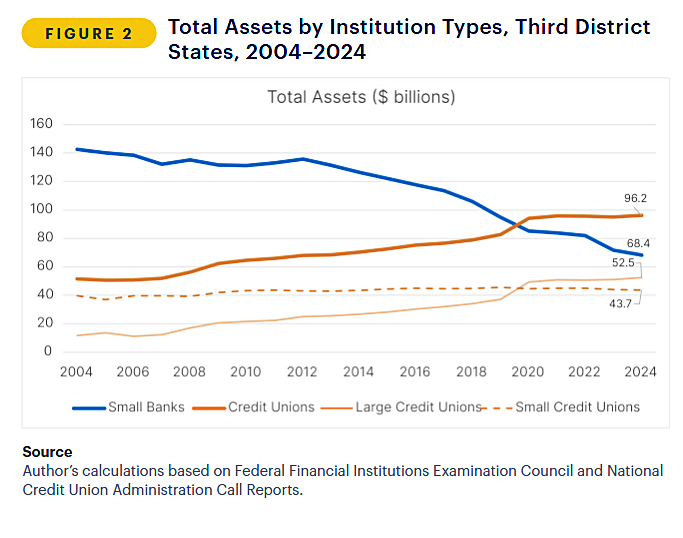
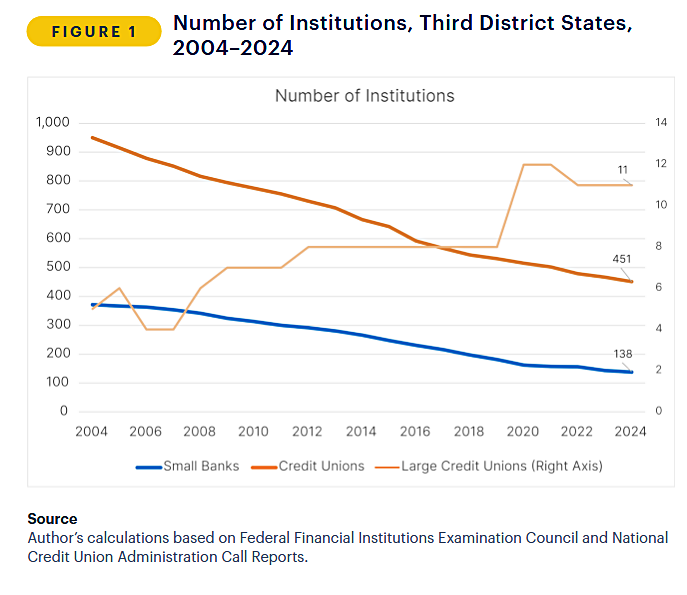
Ding finds that inflation-adjusted lending by credit unions in the Third District surged 122.7% over the period, while assets grew 86.9%, driven largely by the rise of large, multigroup institutions. By contrast, total assets at small banks declined more than 50%, and credit unions surpassed small banks in aggregate assets in the region in 2020.
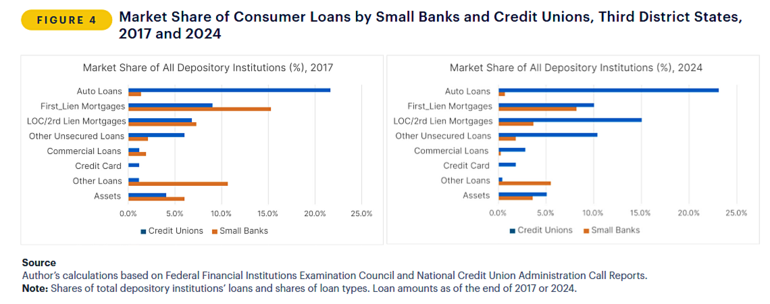
That growth has reshaped lending markets. Credit unions significantly expanded beyond their traditional strongholds in auto and residential real estate lending and moved aggressively into commercial lending following regulatory changes in 2017. From 2017 to 2024, commercial lending by credit unions in the region rose 132.2%, while small banks’ commercial loan volumes fell nearly 86%, effectively ceding market share to both credit unions and large banks.
The report also confirms that credit unions maintain a stronger physical presence in low- and moderate-income (LMI) neighborhoods than banks. As of mid-2024, about 27.2% of credit union branches in the Third District were located in LMI census tracts, compared with 20.7% for banks overall. However, credit unions have still reduced their branch footprint in those communities over time, and the decline has been steeper than that seen at small banks.
Challenging Findings
Where the findings become more challenging for the movement is mortgage lending. Using HMDA data from 2019 to 2023, Ding finds that credit unions originated a smaller share of home purchase mortgages in LMI neighborhoods than small banks and posted significantly higher mortgage denial rates, particularly in LMI and majority-people-of-color communities. In 2023, credit unions denied 26.6% of purchase mortgage applications in LMI tracts, compared with 8.0% for small banks.
Low-income designated credit unions (LICUs) performed better than other credit unions in LMI communities but still lagged small banks in serving low-income borrowers overall. The report notes that higher denial rates do not appear to be explained by lower applicant incomes or larger loan requests, and may be influenced by product mix, including lower use of FHA and VA loans in LMI areas.
At the same time, credit unions originated a slightly higher share of mortgages in majority-minority neighborhoods and to minority borrowers than small banks, suggesting a more nuanced lending profile than critics often acknowledge. Still, denial rates in those communities were two to three times higher than at small banks, reinforcing concerns raised in prior NCUA research.
Ding concludes that while credit unions are playing an increasingly important role in consumer and small-business finance—particularly as small banks retreat—their expanding scale warrants closer scrutiny. As credit unions continue to grow beyond their traditional niche, the report argues, their performance in serving underserved borrowers will remain central to debates over tax status, regulatory parity, and the cooperative mission itself.