

ALEXANDRIA, Va.–The NCUA board has voted 3-0 to put out for comment a proposal on executive compensation plans for certain CU executives. But board member Mark McWatters made clear his vote in favor was only because it is for a proposal, not a final rule.
The comment period will now be open through July 22. The 500-page rule is available on NCUA’s website. A full copy of all three board members’ statements on the proposal can be found here.
During his remarks, McWatters outlined number of points he wants to see addressed and clarifications made before the exec compensation and incentive plan is put forward as a rule. When that happens, its status may be iffy, as NCUA Board Chairman Debbie Matz is stepping down at month’s end, meaning that when the rule comes back for a vote a two-member NCUA board could mean a 1-1 vote (although it’s unlikely a proposed rule ever would get to the point of a board vote in that scenario).
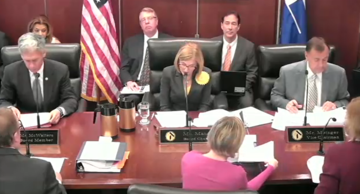
NCUA staff speak to NCUA board about proposal on executive compensation.
Now five years in the making, the proposal is the result of section 956 of the Dodd-Frank Act and is part of the fallout from the financial crisis, in which some huge incentive packages at banks and Wall Street firms were blamed in part for contributing to that crisis. The proposal is designed to put an end to incentive-based compensation that encourage inappropriate risk taking that could lead to a material loss for a financial institution.
NCUA is one of a half-dozen federal regulators all working on similar proposals—in April 2011 the agencies published a joint proposed rule that to date has led to more than 10,000 comment letters—which are primarily aimed at significantly larger institutions. Dodd-Frank sets three asset tiers for the compensation rules, with no CUs falling in Level 3, one CU (Navy Federal) falling in Level 2, and 258 CUs falling into Level 3 (institutions above $1 billion in assets).
The proposal, as Matz stressed in a Q&A, does not require that an individual’s compensation and incentive plan be disclosed, nor is individual compensation subject to review by an examiner.
Other Aspects of Proposal
In comments to the board, NCUA staff said the proposal is not designed to be a rigid plan and that every covered CU will be expected to tailor its own plan to its size and risk model.
NCUA’s proposal calls for effective governance in supporting the proposal, including requiring boards or a board committee to be directly involved in setting the overall compensation and incentive plan. Credit unions would need to document and maintain records of such plans for seven years.
“It’s been very difficult to develop a rule that meets the mandate of the law and at the same time is focused and fair,” said Matz.
Saying she wanted to underscore a number of “facts” around the proposal,” Matz noted:
- The law requires NCUA to develop the rule with other regulators, but the interagency rule will not affect the vast majority of credit unions. Just 4% of all CUs are above $1 billion in assets.
- Even in the 4% of CUs, the proposed rule will not affect any base salaries and base benefits.
- Credit unions will not have to change existing plans for remaining life of the plans. The proposal is not retroactive.
- The proposed rule would not affect any new plans until 18 months after a final rule is passed.
- NCUA’s rule differs from other regulators because as not-for-profits CUs are covered by different rules from the IRS. CUs will be allowed to adjust plans due to the unique tax treatment.
McWatters Raises Issues
In his comments to the NCUA board meeting, McWatters read into the record a statement in which he raised a number of questions and offered comment. McWatters also said that his office had not received the updated version of the proposal until April 6, and as a result he urged that more time be given to review the plan.
“I do not think we should rush to vote on this today, and instead we should bring it back to the board next month or the month after; just long enough for us to analyze it as carefully as we should,” McWatters said.
Among the concerns and issues raised by McWatters:
- McWatters said section 956 of Dodd Frank gives NCUA the option of creating rules or guidelines, and he urged the agency to instead issue the latter.
- He noted he is not aware of CUs that extensively engage in the types of compensation practices section 956 seeks to address, and he asked how the agency might modify the proposal to minimize the opportunity for examiners to micromanage CU compensation packages.
- He urged greater simplification of the rules being proposed.
- He asked whether the proposal articulates exactly what are permissible compensation and incentive packages.
- He said definitions should be provided for what is “inappropriate risk taking” and “excessive compensation.” “How should NCUA take to implement such broad-based and arguably ambiguous rules?” McWatters asked.
- He expressed concern that the proposed rule requires the boards at covered CUs to approve incentive-based plans, which subjects them, as volunteers, to greater scrutiny and review. He urged NCUA provide “safe harbor guidance.”
- He asked if it would be possible to simplify the document maintenance and retention requirement for certain CUs.
McWatters said he did not dissent on the vote because NCUA is behind schedule and it is just a proposal being put out for comment. But he said in the final rule he wants to see addressed the points he raised.
Being 'Held Accountable'
During his comments, NCUA Vice Chairman Rick Metsger said, “Congress, and the American people, want senior executives at large financial institutions held accountable if their desire for personal enrichment leads to decision-making that results in material losses to the institution or our deposit insurance funds.
“Now as we all know, credit unions were not a primary cause of the financial crisis. They were primarily victims, which is why the NCUA took the lead in becoming the first financial institutions regulator to sue the Wall Street Banks whose actions led to the crisis,” he continued. “Our aggressive actions in court have recovered more than $3.1 billion from the Wall Street Banks that did so much to hurt main street and American middle class families.
“At the same time we must acknowledge that excessive incentive-based compensation has contributed to the failures of some corporate and natural person credit unions,” added Metsger. “A prime example of this problem is the failure of the Cal State 9 Credit Union – whose losses cost the Share Insurance Fund more than $170 million.”
Metsger also noted that for many state-chartered CUs, which must already fill out IRS form 990, the proposal may actually make compliance less burdensome.
Referring to the point made by McWatters, Metsger said he “looks forward” to taking sufficient time to review all the comments and the reworked proposal that is put forward as a rule.