

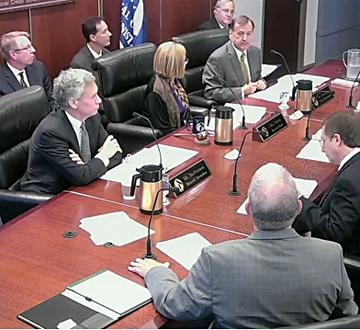
L-R: Mark McWatters, Debbie Matz, Rick Metsger
ALEXANDRIA, Va.—The NCUA board Thursday, in addition to other actions, addressed CLF bridge loans, civil money penalties and FOM relief.
Corporate CLF Bridge Loans
The board, by 3-0 vote, approved a final rule allowing natural-person CUs to obtain a CLF bridge loan through a corporate credit union. The rule provides corporate credit unions incentives to make bridge loans of up to 10 days for credit unions awaiting approved funding from NCUA's Central Liquidity Facility.
Matz said this rule was well received by credit unions, with no changes to the proposal suggested by the movement.
“CLF bridge lending is a win for corporate credit unions providing a valuable service to their members, and it’s a win for consumer credit unions receiving liquidity immediately,” Matz said.
Matz stated that CLF bridge loans should not count against corporate credit unions’ unsecured lending cap nor against their capital ratio.
“These final changes will ensure that corporates will be able to make as many CLF bridge loans as their members need, without unintended consequences,” Matz said.
Board Member Rick Metsger said the rule emphasizes how the agency is listening to credit unions.
“In the two years I’ve been on the board this is the fourth time that commenters on the rule have suggested things to us that we couldn’t do at that moment,” Metsger said. “But we took that seriously. We listen to those, and while we may not be able to do that at that moment that should not restrain you from coming back with some broader ideas.”
NAFCU stated that it welcomes NCUA excluding Central Liquidity Facility related bridge loans from the aggregate unsecured lending cap on loans to one borrower by corporate credit unions.
"By extension, this move will have a positive impact on natural person credit unions,” said NAFCU Director of Regulatory Affairs Alicia Nealon.
Statutory Inflation Of Civil Money Penalties
By a 3-0 vote, the board approved adjusting civil money penalties for inflation every four years, as required by the Federal Credit Union Act.
Matz pointed out that NCUA views the civil money penalties as a “last resort,” and uses the fines as an incentive for credit unions not to file late Call Reports.
Since the agency began charging the penalties, late Call Report filings have fallen from about 1,100 a quarter to 15.
Matz reminded that NCUA has never charged the maximum civil money penalty and assured the agency does not intend to asses that type of fine.
“The average civil money penalty for a late Call Report is less than five hundred dollars. So those fines are working as we intended, as a deterrent and not a punishment,” Matz said.
FOM Relief Proposal
Matt Biliouris, deputy director of NCUA’s Office of Consumer Protection, who is leading NCUA’s Field of Membership Working Group, reported that a comprehensive FOM relief proposal should be presented in the coming months.
Biliouris said that through feedback from the Field of Membership Suggestions e-mailbox, written letters, staff consultations, and public outreach meetings, the Working Group now has a “fairly stable set of options for consideration—options that would provide an appropriate level of reduced regulatory burden and sound public policy.”
Biliouris said ideas and suggestions stretch across three main categories—statutory changes subject to Congressional action, regulatory action the NCUA board can take to modify field of membership requirements, and suggestions received to help create efficiencies with how NCUA processes field of membership expansion requests.
Biliouris said a number of comments focused on NCUA improving transparency and efficiency in the FOM application process and that the group is now building business requirements to enhance the current system.
“An ideal long-term outcome of such system improvements will not only allow credit unions to upload documents in support of their requests, but will also provide a means for credit unions to self-check the status of their requests throughout the review process,” Biliouris explained.
Turning to options for regulatory changes, Biliouris said the group is looking at several comment categories, focusing on issues regarding what constitutes a well-defined local community or rural district, requirements for adding select groups to a multiple common bond charter and how we identify areas as underserved by other financial institutions.