

WASHINGTON–Dixies FCU President and CEO Scott Eagerton testified before Congress that the “overwhelming tidal wave” of regulations, especially in the wake of the Dodd-Frank Act, is hurting credit unions and, as a result, their members.
Testifying on behalf of NAFCU, Eagerton told the House Small Business Subcommittee hearing titled "Financing Main Street: How Dodd-Frank is Crippling Small Lenders and Access to Capital,” that a number of changes must take place.
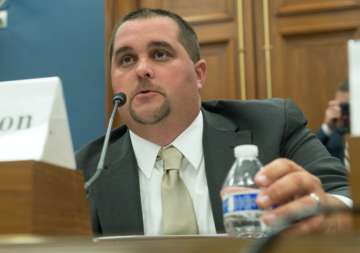
Scott Eagerton testifies before House subcommittee.
In his written testimony Eagerton reiterated a point that has been stressed by credit unions: that they were not responsible for the financial crisis yet have been drowning in new regulations aimed at those who were responsible ever since. He said that in the five years since passage of the Act "we have witnessed large banks grow and small banks and credit unions disappear."
"At Dixies FCU, our compliance costs have risen five-fold since 2009, from about $20,000 a year to $100,000 annually," Eagerton said. The $41-million Dixies FCU is based in Darlington, S.C., and serves 7,000 members.
Eagerton also called on NCUA to move to an 18-month exam cycle for healthy, well-run credit unions, saying the move would cut costs and burdens for credit unions. He further urged all regulatory agencies to coordinate with each other.
"With numerous new rulemakings coming from regulators, coordination between the agencies is more important than ever and can help ease burdens," said Eagerton.
In addition, Eagerton:
- Expressed support for the NAFCU-backed "Financial Product Safety Commission Act of 2015" (H.R. 1266), which would replace the director of the CFPB with a bipartisan, five-person commission.
- Discussed how new regulations from CFPB have had unintended consequences in the lending market. "In particular, the ability-to-repay, qualified mortgage and mortgage servicing rules have required credit unions of various sizes and complexities to make major investments, and incur significant expenses," he said.
- Recommended that CFPB use its legal authority to exempt credit unions from various rulemakings; amend Regulation E to allow financial institutions to truncate account numbers on periodic statements; expand the threshold for the safe harbor from the definition of "remittance transfer provider" to ensure that a meaningful safe harbor is established; limit the changes to the Home Mortgage Disclosure Act (HMDA) data set to information mandated by the Dodd-Frank Act; and make improvements to the integrated disclosures rule under the Truth in Lending Act (TILA) and Real Estate Settlement Procedures Act (RESPA) and the Qualified Mortgage (QM) standard.
- Urged Congress to support the "Risk-Based Capital Study Act of 2015" (H.R. 2769), introduced by Reps. Stephen Fincher (R-TN), Denny Heck (D-WA), and Bill Posey (R-FL). "This NAFCU-backed legislation will stop NCUA from moving forward with their second risk-based capital proposal until completing and delivering to Congress a thorough study addressing NCUA's legal authority, the proposal's impact on credit union lending, capital requirements for credit unions compared to other financial institutions, and more," says Eagerton.