

WASHINGTON—The chief operating officer at Great Lakes Credit Union told a House committee it has been able to use artificial intelligence (AI) to create “remarkable” results in areas such as member services and career paths.
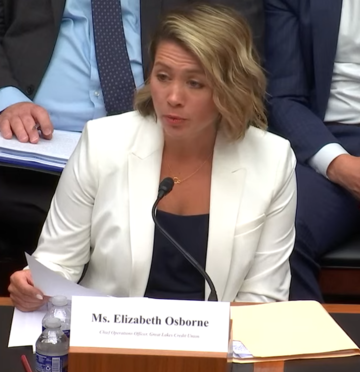
Elizabeth Osborne, COO of $1.7-billion GLCU in Bannockburn, Ill., testified before the hearing that reviewed AI applications in financial services and housing industries.
“AI is an important tool for credit unions, and it helps us enhance service to our members and provide services that economies of scale may not otherwise allow,” Osborne told the committee.
Osborne shared GLCU’s introduction of Olive, a call center bot that leverages conversational AI to route calls, conduct phone banking transactions and decrease member wait times.
Osborne said Great Laes CU had launched Olive with the goal to provide members with an enhanced, easy-to-use, voice enabled virtual system.
What Olive Can Do
“Olive is able to handle a wide range of member inquiries and requests, such as account balance transaction history, transfers between accounts, and more,” Osborne said. “All of is available 24/7 through multiple channels, including phone and chat.”
The COO told the committee that since the introduction of olive, GLCU has realized “remarkable results” in terms of member satisfaction, member call center performance and employee engagement.
“For example, Olive consistently handles over 60% of total inbound calls during business hours and over 75% of all calls after business hours,” Osborne said. “This is compared to a less than 25% handling rate with our previous telephone banking solution, which did not include AI technology. Olive has increased the number of calls fully serviced by the virtual assistant by over 200% since launch.”
Effect on Employees
Osborne said AI has also had an effect on employees.
“An inherent benefit of Olive is the technology has elevated the job description level for call center agents,” she said. “Their role is moving from providing transactional support from members to providing more consultative advisory support. This shift has resulted in a higher pay grade for staff and a better career path for our call center employees.”
Necessary to Compete
Osborne also addressed that credit unions will need to have access to AI technologies to successfully compete with larger financial institutions and fintech firms. For example, she pointed to other AI technologies GLCU is currently exploring, including Microsoft Power Automate, which automates repetitive, manual tasks, saves time and resources, reduces errors and delays, and increases productivity and accuracy. Osborne pointed out that “many existing laws are technology-agnostic and still apply” to emerging AI tools. She highlighted the broad applicability of consumer financial protection laws and anti-discrimination rules, regardless of whether the decisions are being made by a human or AI technology. “Credit unions like mine are committed to using AI safely, securely, and with the goal of helping members meet their financial needs. AI enables credit unions to compete more efficiently with larger banks and non-bank companies in the financial services arena,” Osborne said. “AI has not altered credit unions’ historical role as relationship lenders committed to maintaining a close bond with the communities they serve.”The full recording of the hearing is available on the House Financial Services Committee website.