

MADISON, Wis.–Lending at credit unions slowed again in June, but a new forecast sees lower mortgage rates and increasing home sales ahead, while on the other side of the balance sheet significant changes in the distribution of deposits continues to take place.
All of this is occurring while at the same time the current pace of membership growth is at its slowest pace since 2011, according to TruStage’s newest Trends Report.
Here’s a look at how credit unions performed by category through June, according to the TruStage Trends Report analysis authored by its chief economist, Steven Rick.
Total Credit Union Lending
Credit union loan balances rose 0.5% in June, less than the 0.7% pace set in June 2023, as higher loan interest rates “curtail credit demand,” the report stated.
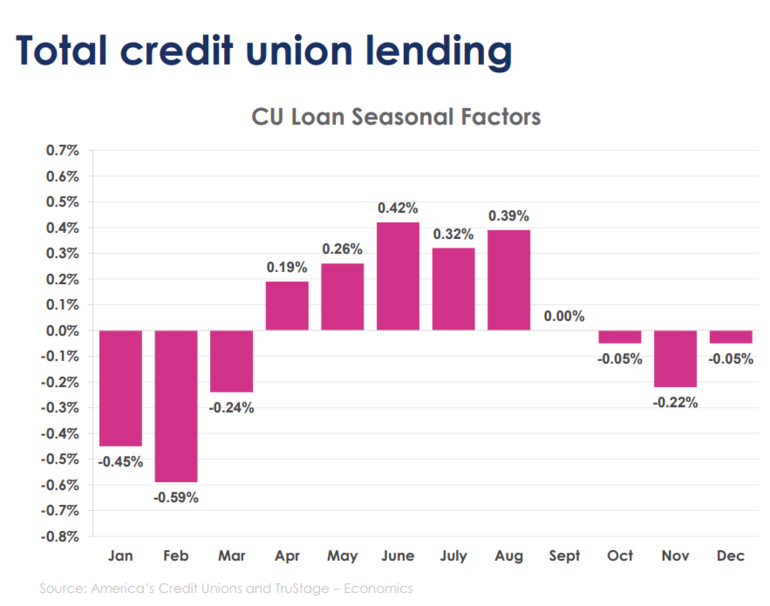
“June is typically the strongest month for credit union loan growth with seasonal factors adding 0.42% to the underlying trend growth rate,” the Trends Report notes. “Much of the monthly growth in June was due to second mortgage lending increasing 3.7%, adjustable-rate mortgage lending increasing 3.0%, home equity lending increasing 1.3%, and credit card lending increasing 0.8%. The strong credit union lending season runs from April through August. After that, the loan seasonal factors turn negative for the rest of the year.”
According to the Trends Report, during the last 12 months, credit union loan balances increased only 3.9%, which is below the 7% long- run annual loan growth rate.
The Loan Forecast
“And loan growth has slowed even further recently. Credit union loan balances grew at a 3.0% seasonally-adjusted, annualized growth rate in June, less than half the 6.6% pace set in June 2023,” Rick wrote in his analysis. “We are forecasting below-trend credit union loan growth for this year and 2025 (3% in 2024 and 5% in 2025) due to high loan interest rates on new loans, strong competition from finance companies, higher debt servicing costs on existing adjustable-rate loans, the resumption of student loan payments, and the exhaustion of stimulus/pandemic related ‘excess savings’ that could have been used for loan downpayments.”
Consumer Installment Credit
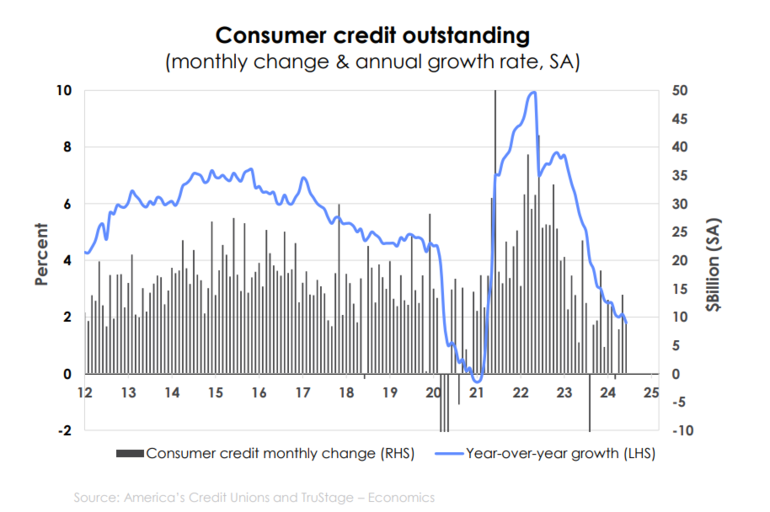
Credit union consumer installment credit loan balances (auto, credit card and other unsecured loans) rose 0.4% in June, a deceleration from the 0.8% pace set in June 2023, the Trends Report states.
“During the last 12 months, credit union consumer installment credit grew 1.3%, less than the total market excluding credit unions and government student loans at 3.2%,” the report notes. “Tighter lending standards have weighed on revolving credit (credit cards & HELOC) more so than nonrevolving credit. Nearly one in four financial institutions tightened lending standards for credit cards in the second quarter of 2024, according to the Senior Loan Officer Opinion Survey.
“Going forward into 2025, expect consumer credit growth to accelerate as the Federal Reserve lowers interest rates 100 basis points in 2024, and 200 basis points in 2025, and the labor market continues to generate robust job growth,” the forecast added.
Vehicle Loans
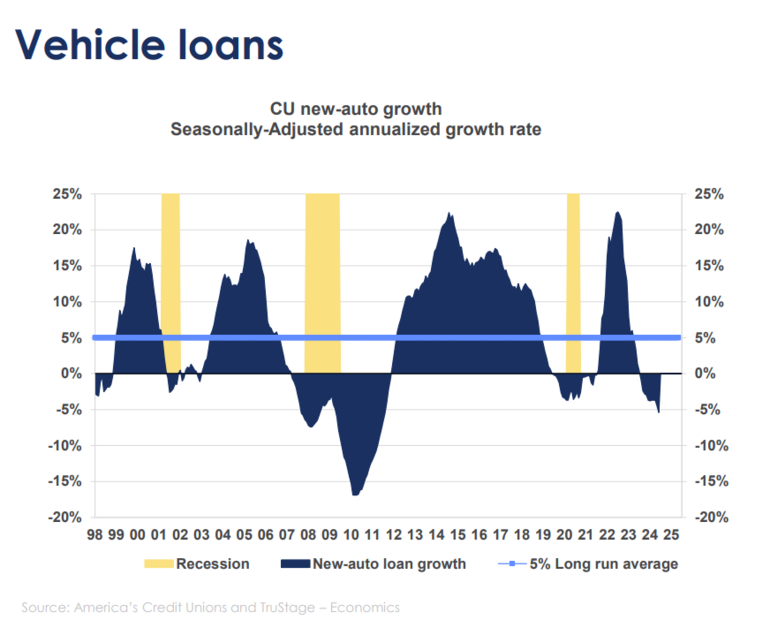
According to the new Trends Report, credit union new-auto loan balances fell 0.2% in June, a big drop compared to the 0.5% gain reported in June 2023.
“Higher interest rates and increased competitive pressure from captive finance companies has reduced new-auto lending at credit unions. On a seasonally-adjusted annual rate, new-auto loan balances fell 5.4% in June, the lowest pace since the August 2011,” Rick stated. “New-auto loan balances fell 3.4% year to date, significantly below the 1.8% increase reported during the first six months of 2023, and below the 8% long-run average expected during a heathy labor market. The month of June is historically in the beginning of the May through October new-auto lending season, so we can hope auto lending picks up during the next few months…High interest rates will ensure that new vehicle sales remain below the 16.5 million long-term equilibrium until 2025…Falling interest rates in the fourth quarter of 2024, should boost consumer demand and sales during the next few years.”
Real Estate Information
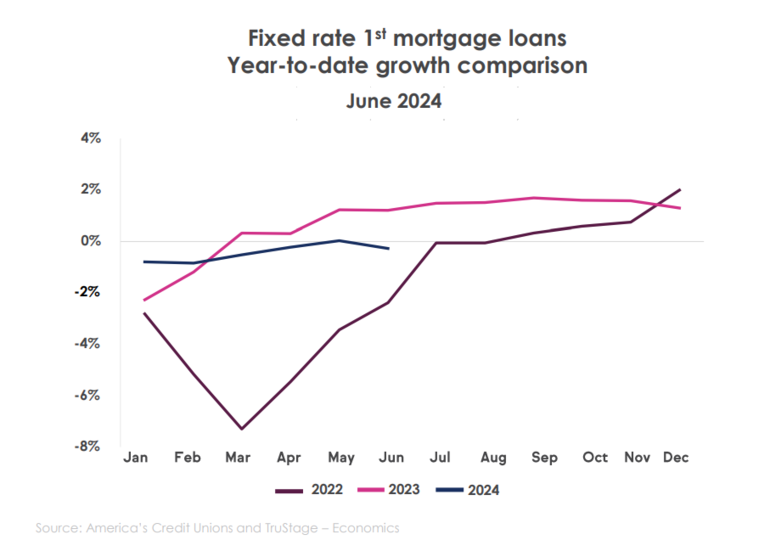
Credit union fixed-rate first mortgage loan balances fell 0.3% in June, which was below the -0.2% reported in June 2023, according to the Trends Report.
A year-to-date growth comparison shows a -0.3% growth rate during the first half of 2024, which was down when compared to 1.2% gain reported in 2023. Credit unions now hold $592 billion of first mortgages on their books, which are 4.1% of the entire U.S. mortgage market, down from 4.8% in June 2021,” the Trends Report states.
“The contract interest rate on a 30-year fixed-rate conventional home mortgage was 6.92% in June, down from 7.06% in May but up from 6.71% reported in June 2023,” Rick stated in his forecast. “Expect mortgage interest rates to fall to 5.9% by the end of 2024, as the Federal Reserve drops short-term interest rates one percentage point.
“As the Federal Reserve loosens monetary policy in the coming months, mortgage rates will fall and homes for sale will increase,” the forecast adds. “Even though lower interest rates will increase housing demand, housing supply should increase more as those homeowners who can no longer postpone plans to move finally list their properties. This should slow home price appreciation in the coming months and years.”
Savings & Assets
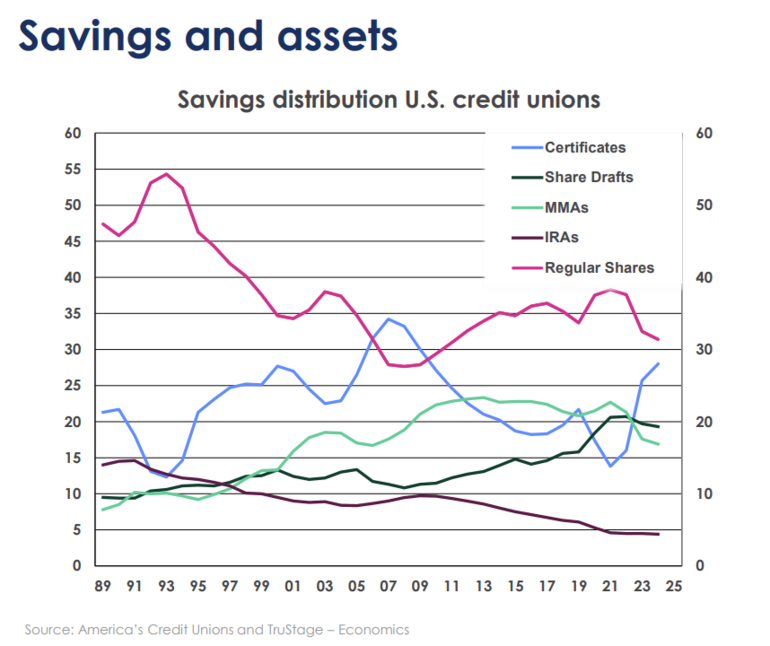
The new Trends Report shows that through June credit union savings balances rose at a 2.9% seasonally-adjusted, annualized growth rate in June, significantly better than the -3.2% pace set in June 2023, but still below the 7% long run average.
“Deposit growth remains below trend due to high inflation forcing some members to withdraw savings to purchase necessities and funds leaving credit unions for alternate savings products paying higher interest rates,” the Trends Report states.
It further notes share drafts, regular shares and money market deposit accounts all declined in June, while certificate of deposits grew 1.6%. During the last 12 months, share draft balances declined 2.8%, regular shares balances fell 7.2% and money market account balances fell 6.5%. Meanwhile, certificate of deposit balances rose a remarkable 34.5%, the report adds.
According to Rick’s analysis, the disparity in savings account growth rates has significantly changed the distribution of credit union deposits over the last two years. In 2021, share certificate balances make up only 13.8% of all credit union saving deposits.
“By June 2024, this percentage share more than doubled to 28%, the highest since 2009,” the analysis states. “This shift from low cost ‘core deposits’ to higher cost certificate of deposits has increased credit union’s average cost of funds to 1.84% in the first quarter of 2024, up from 1.05% in Q1 2023. With the Federal Reserve expected to lower short-term interest rates by 100 basis points this year, expect this shift in the mix of deposits to slow.”
Equity and Other Key Measures
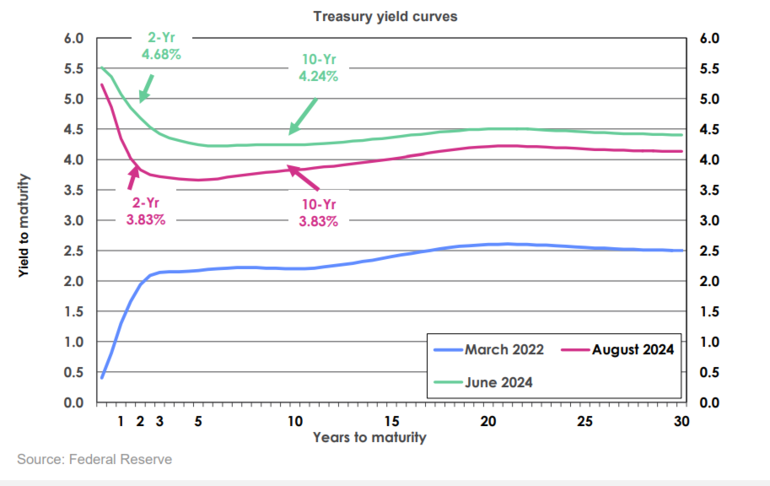
As the Trends Report notes, the Treasury yield curve has shifted down over the last two months, especially in the 1-to-10-year portion of the yield curve.
“Interest rates on the two-year Treasury note fell 85 basis points to 3.83% in August from 4.68% in June, while the 10-year Treasury note interest rate fell 41 basis points to 3.83% from 4.2%,” the analysis states. “This rate decline has eliminated the inversion of the yield curve between the two-year and 10-year Treasury interest rates. Normally an inverted yield curve would put downward pressure on credit unions’ net interest margins as the business of buying money short term and selling money long term becomes less lucrative as credit union cost of funds rises faster than asset yields.”
Rate Reduction Coming
Rick further noted that the markets are now pricing in a 100 basis point decline in the federal funds interest rate in the second half of 2024, and another 200 basis points in 2025. “We expect the yield curve to become un-inverted in the first half of 2025, which should help boost credit union net interest margins if they have more rate sensitive liabilities than rate sensitive assets.
“Credit union loan-to-share ratios rose to 83.8% in June, up from 83.4% one month earlier, and up from 83.3% in June 2023,” the analysis continues. “The recent cyclical low of 68.6% occurred during April 2021, the lowest since April 2013. Expect loan-to-share ratios to continue to rise for the rest of the year as loan growth outpaces savings growth.”
Credit Unions & Members
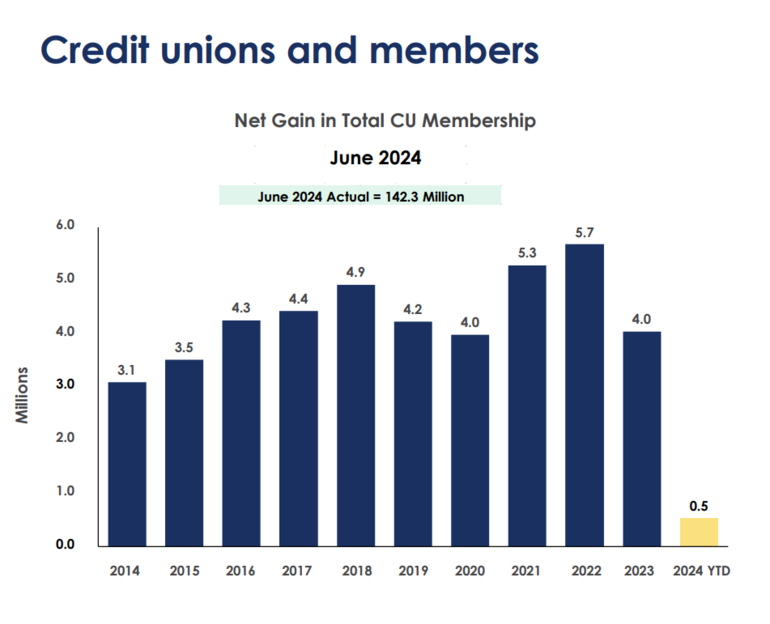
According to the Trends Report analysis, credit union memberships grew 60,000 in June, or 0.04%, down from June 2023, when the movement added 318,000 memberships at an increase of 0.23%. The membership gain year-to-date slowed to 0.533 million, down from 2.479 million for the similar period in 2023. Credit union memberships grew 2.094 million during the year ending in June 2024, the Trends Report adds.
Total credit union memberships have surpassed 142.3 million and are expected to reach over 144 million by the fourth quarter of 2024. Weak loan growth and slowing job creation are two factors weighing on credit union membership growth.
Credit union memberships grew at a 0.1% seasonally-adjusted, annualized growth rate in June, slower than the record-setting 4.5% pace of the last few years.
“The current pace is the slowest since February 2011. Expect credit union memberships to grow 1.5% in 2024 and 1.8% in 2025,” the report forecasts.