

WASHINGTON—As credit unions battle to protect their tax exemption, a new study from America’s Credit Unions uncovers a staggering cost consumers could face if it disappears.

Jim Nussle
The report, by Robert M. Feinberg of American University and Douglas Meade of the Interindustry Economic Research Fund, reveals the loss of the credit union tax-exemption would result in direct losses to consumers of $234.6 billion over ten years.
The losses would be due to both increased loan interest payments and reduced deposit interest received by bank and credit union members alike, the report states, calling its final number “conservative.”
“A reduction in credit union market presence would hurt all consumers,” the study says.
“The presence of credit unions in local consumer lending markets has a significant positive impact on both bank customers and credit union members for both loans and deposits. Consumers saved and earned approximately $23 billion per year over the past decade in direct benefits thanks to the presence of credit unions in financial markets. These benefits are unlikely to occur without the federal tax exemption granted to the credit union industry,” the report states.
The study suggests the loss of the credit union tax-exemption would have far-reaching consequences for the overall economy.
“There are even larger consequences to the overall economy,” the study explains. “In the absence of the federal tax exemption, reduced purchasing power by bank and credit union members would lead to reduced consumer spending in other sectors of the economy. The reduced purchasing power in the U.S. economy resulting from a $13.8 billion annual loss of personal income would reduce consumer spending by about $24.2 billion per year over the next decade (in 2024 dollars). This would result in a reduction in GDP of approximately $26.6 billion per year and employment losses of roughly 82,000 jobs per year. Model results incorporate the elimination of preferential loan and deposit rates for credit union members as well as the effect on bank consumers of reducing the market share of credit unions.”
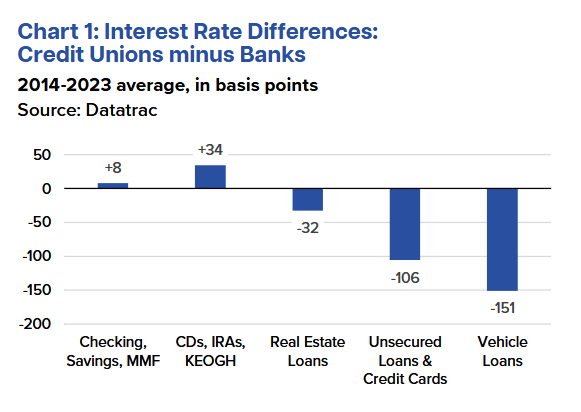
'Real Impact' Of CU Difference
“For 90 years, credit unions have stood the test of time because of the measurable results they bring to communities across the country – many who have been left behind by the banks with few alternatives that are safe, insured, and regulated,” said America’s Credit Unions President/CEO Jim Nussle. “This study proves the real impact of the credit union difference, with higher interest rates for savings, checking, and money market accounts while providing the lowest rates on real estate and auto loans. Access to these offerings is the difference between success and failure when it comes to everyday American's ability to achieve their American Dream. That's what credit unions do.
“As 6,000 credit union advocates descend on Capitol Hill next week, they are well aware of the bank lobby trying to counter and dissuade the stories and messages from 140 million Americans who chose credit unions as their financial institution,” continued Nussle. “What the banks won’t tell lawmakers is that removing the credit union tax status will significantly hamper the economic prosperity of our country over the next decade with the price tag of $33 billion in lost tax revenue, our GDP will be reduced by $266 billion, and 822,000 jobs will be lost. Bottom line: if credit unions weren’t in the market, Americans would lose billions over the next decade and the most vulnerable and underserved communities would have little to no access to financial services to help them achieve their best lives.”