MADISON, Wis. – The CUNA board has opted not to accept recommendations made by a task force and voted to make no change in the current membership structure in which a credit union belongs to both its state league and CUNA itself. Moreover, the CUNA board has also opted to maintain its current 24-member size.
The vote follows a report by the System Structure and Government Task Force that recommended credit unions be offered a choice of membership in CUNA and/or a league, and that the CUNA board structure be streamlined to 15 members, with two classes based on the proportion of total CU memberships, each with six CU directors, and one class of directors comprised of three league presidents.
The CUNA board met this week to discuss the report’s recommendations.
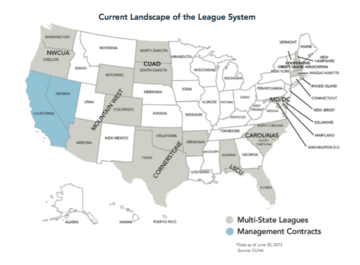
That task force also recommended enhanced cooperation and interdependence with the leagues in the delivery of advocacy for credit unions, which the CUNA board said it is acting upon.
In its report the task force said it discussed the idea of recommending a new brand for the CUNA/league System and that it sees “considerable value” in the unifying and messaging benefits of a shared identity. “However, since CUNA has already adopted the America’s Credit Unions brand in its external communications, and many leagues have similar initiatives, the Task Force believes that the issue is already being considered, and no further recommendations are necessary,” the report recommended. The CUNA board took no action on messaging or branding.
The task force engaged the independent firm Reach Research to conduct in-depth surveys of credit unions to garner feedback, and hosted focus groups, as well.
Genesis of Task Force
The task force was launched in 2014 while Bill Cheney was CEO of CUNA and at a time of ongoing consolidation among both credit unions and leagues themselves. Jim Blaine, the high-profile president/CEO of the country’s second-largest credit union, North Carolina’s State Employee’s Credit Union (SECU), also helped to shine a light on the CUNA structure after publicly questioning why his credit union had to belong to both the league and the national organization, rather than just one or the other.
“Although there is a strong desire for effective advocacy from credit unions of all sizes, credit unions’ needs, expectations and perceptions of the System vary by size,” the task force report states. “Rather than trying to be all things to all credit unions, the System will need to tailor services to meet the needs of both smaller and larger credit unions.”
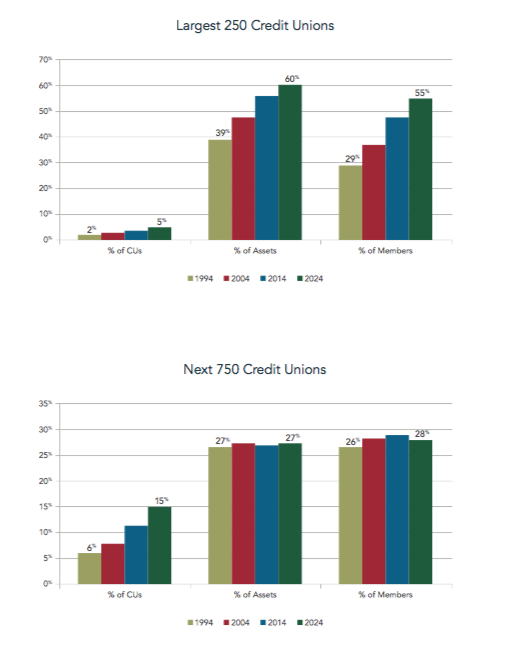
The task force’s report cites analysis that the number of CUs will shrink to fewer than 5,000 by the year 2025 and includes further analysis of how the share of CU assets will change by asset size (see charts, below).
The task force is chaired by Tom Dorety, president and CEO of Suncoast Credit Union in Tampa.
“The board, after thorough review and consideration of the Task Force recommendations, voted to adopt resolutions that will enhance advocacy efforts on behalf of CUNA’s member credit unions by strengthening the close partnership between CUNA and the Leagues,” said CUNA in a statement. “The Board believes the most effective advocacy model for credit unions is one in which credit unions are members of both their League and CUNA. As a result, the Board took action to preserve the current membership structure.”
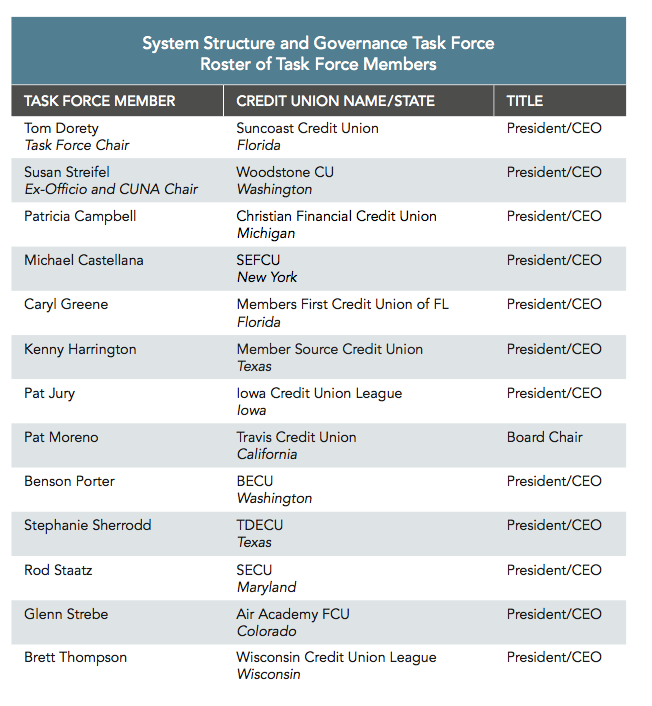
The 13-member task force, the members of which are in the chart at the bottom of this story, said it concluded advocacy should be CUNA’s top priority, and noted CUNA’s Advocacy Department has already put several changes in place. The board’s Advocacy Committee, formerly known as the Government Affairs Committee, will have “expanded reach and scope beyond its predecessor committee, including an enhanced subcommittee structure designed to optimize CUNA’s advocacy effectiveness,” CUNA said.
CUNA last altered its board in 1996 following recommendations made as part of its “Renewal Project.”
Statements From Chair
The CUNA board voted to refer other Task Force recommendations regarding its nomination process and governance policies to an ad hoc committee to be appointed by CUNA Chairwoman Susan Streifel, the CEO of Woodstone Credit Union in Washington.
“While the board did not adopt all of the task force’s specific recommendations, we embrace what we consider to be the central conclusion of the report: Advocacy must be at the heart of CUNA’s purpose. In order to be the most effective national advocacy organization, CUNA and league interdependence is essential,” Streifel said in a statement released by CUNA. “As any representative organization must, CUNA recognizes that constant innovation and improvement is essential to best serve our membership most effectively, powerfully and nimbly. The board looks forward to working with CUNA management to continue to innovate how we operate so that we are always best-positioned to advance the interests of our credit union members.”
As for the decision not to change the current structure of CUNA’s board, Streifel said, “We believe the current Board size is effective and reflects the enormous range of geographies, asset sizes and distinct needs of our member credit unions. The committee will look at the board’s nominating process and governance policies and report back to the board with any suggested amendments.”
In its report, the task force called on the state leagues to take actions similar to its recommendations.
CUNA President/CEO Jim Nussle issued a statement saying the trade association will develop and implement plans to ensure interdependence and strengthen CUNA’s advocacy power.
“A more unified CUNA/league system will enable us to be an even more strategically focused and efficient organization. We understand our members’ demands for value, and we will be focused on delivering results,” Nussle said. “Well-planned and well-executed strategic changes will transform CUNA into an even more inclusive and accountable association.”
Unrelated to the task force’s work, CUNA is reportedly also conducting a review of its management structure and personnel that was launched by Nussle after he was named CEO.
A copy of the Task Force’s report can be found in CUToday.info’s Free Vault here.