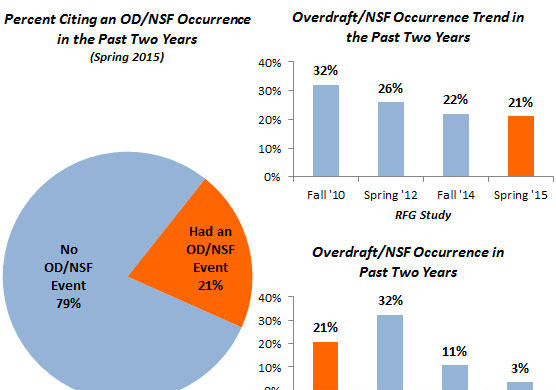
LOMBARD, Ill.—A new study shows that compared to recent years, fewer consumers are overdrawing their checking accounts.
The percentage of consumers overdrawing their accounts fell to 21% in the spring of 2015, down from 22% in the fall 2014, according to Raddon Financial Group’s National Consumer Research. In fact, overdraft occurrences have steadily fallen in the last several years—from 26% of consumers in the spring of 2012, and 32% in the fall of 2010.
Pat Bator, in the latest edition of The Raddon Report, said the research shows a disproportionate number of lower-balance checking account users–typically younger consumers–account for the largest percentage of OD occurrences, with 65% of their overdraft or NSF events occurring at the point of purchase. Yet, the research also shows 71% of consumers who overdrew their checking account did so only one to three times in the past two years.
“The drop in the number of consumers who reported an overdraft or NSF occurrence since 2010 can be attributed to a change in how some consumers handle their checking and debit accounts,” said Bator. “Lower-balance checking users are more likely to have modified their behavior by regularly checking their account balances online, adding an overdraft protection feature to their accounts, being more careful about making their checkbook entries, keeping more money in their checking accounts, using cash more often, and/or receiving email or text alerts for low account balances.”
However, Bator said 66% of consumers report they have not changed their behavior at all.
“These consumers are more likely to be higher-balance checking account users who, because of the balances they keep in their account, have little or no concerns with overdraft or NSF fee avoidance,” he said.
Bator added that consumers are “clearly not running” to their financial institutions to obtain overdraft coverage on their checking accounts.
“Half of consumers do not know if the institutions they use even offer courtesy check coverage,” Bator said. “Further, just a fourth of all consumers have opted in to enable their financial institution to cover overdrafts. These consumers do so because they wish to avoid having a transaction declined, need overdraft coverage for emergency cash-flow purposes, and/or they do not intend to overdraft but the coverage costs nothing if they do not use it.”