

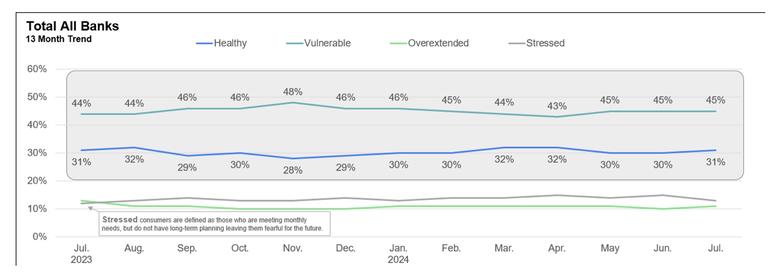
TROY, Mich.–A new J.D. Power survey has found that while the percentage of U.S. bank customers who are financially healthy has remained steady, the overall level of concern regarding inflation has fallen sharply.
“This implies consumers are finding workarounds for higher consumer prices,” J.D. Power said in releasing its findings. “Unfortunately for banks, it seems that customers are finding these workarounds without the benefit of using the personal financial management tools they’ve developed to provide this type of guidance. Customers say they find these tools clunky and hard to interpret, which represents a missed opportunity for banks to provide valuable insights to the customers that need them the most.”
The Findings
Among the findings reported by J.D. Power:
Financial Health Largely Flat as Inflation Concerns Wane
- The number of customers who are financially healthy remains steady at 31%, while 45% of bank customers fall into the vulnerable category.
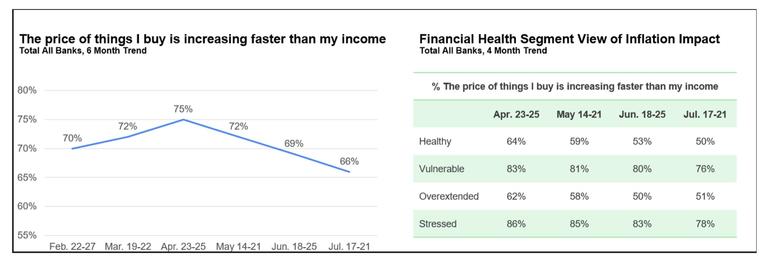
- For a third consecutive month, the number of bank customers who say that the cost of goods is increasing faster than their income decreased. Nearly two-thirds (66%) of customers say they are struggling to keep up with the cost of goods, which is the lowest level this calendar year by far.
Management Tools Come Up Short
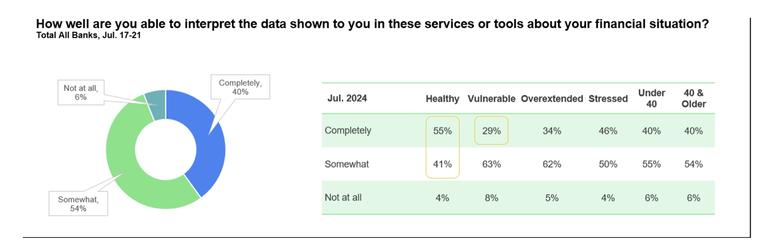
“As customers acclimate to higher prices, banks have tried to offer personal financial management tools for support,” J.D. Power said. “Unfortunately, many are finding these tools to not be particularly helpful. In fact, just 40% of customers say that they completely understand the data presented to them in their bank’s personal financial management tool. That leaves an interpretation gap for more than half of users, one that widens as financial health status declines.”
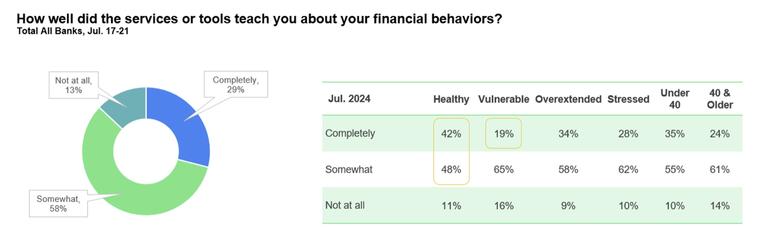
When asked specifically if personal financial management tools helped teach them about their money management behaviors:
- Just 29% said they completely understand their spending habits thanks to these tools.
- That rate drops to 19% for vulnerable customers.
“What’s more, customers are finding these tools to be too passive,” J.D. Power reported. “Just 39% of customers said that their bank’s management service prompts them with advice to make an immediate change to their financial activity to improve their situations, while only 36% said the tools took action on their behalf (i.e., putting more money into savings or setting up a proposed budget).”
Opportunity to ‘Intervene’
J.D. Power said that “while the easing anxiety over inflation is certainly worth celebrating,” the fact that most customers’ financial health has not changed is an “indication that these modest improvements may not be sustainable.”
“Simply growing numb to higher consumer goods isn’t the same as bolstering a customer’s finances, and that’s where most banks have an opportunity to intervene,” according to J.D. Power. “Personal financial management tools can be a game-changing solution for customers, particularly those searching for some relief. But if the data and insights provided aren’t digestible to the customer, there is no way to make them actionable.”
J.D. Power said it found customers are expressing a willingness to try these tools and have clear preference on what they want them to look like.
‘Must Find a Way’
“Banks must find a way to make the solutions not only easier to understand, but more proactive to help customers take key steps toward better financial health. Banks that can do this stand to build trust and forge valuable relationships with their customers,” J.D. Power said.
The full study can be found here.