

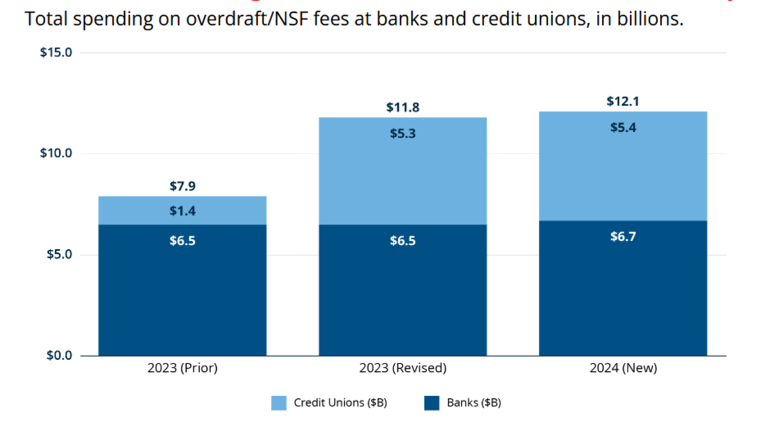
CHICAGO—Consumers spent $12.1 billion on overdraft and NSF fees in 2024, according to a new study that also shows CU members are paying more OD fees than small bank account holders and credit unions are slower to drop OD charges than banks.
The data, from the Financial Health Network (FHN), shows those expenditures are approximately 48% more than the company previously thought and that CUs are grabbing a big share of the total overdraft fee market.
“Our prior estimates understated the total amount of overdraft and NSF fees by approximately $3.8 billion. Based on the newly available data, we now estimate the fees paid by credit union members in 2023 reflect 45% of total overdraft and NSF fees, rather than the 18% we previously estimated,” FHN said.
As CUToday.info reported, beginning with the first quarter of 2024, NCUA began requiring credit unions with over $1 billion in assets to report overdraft and NSF fee revenue as separate line items in their quarterly filings – the first reporting of its kind for credit unions.
As CUToday.info also reported, NCUA Board Chairman Kyle Hauptman announced during America’s Credit Unions Governmental Affairs Conference that NCUA will no longer publish overdraft and non-sufficient fund fee income for individual credit unions. That decision led the two Democratic members of the NCUA board—Todd Harper and Tanya Otsuka— to issue statements opposing the decision.
The Financial Health Network said it has analyzed credit union reports for the four quarters of 2024 to gain a more precise understanding of the total overdraft and NSF fees paid by consumers each year.
“With these revised figures, we now estimate that consumers paid $11.8 billion dollars in overdraft and NSF fees in 2023 and $12.1 billion in 2024, compared with our previous 2023 estimate of $7.9 billion,” the organization said. “Previous models, which were developed without comprehensive and up-to-date credit union data, understated these costs – and the whole overdraft/NSF picture – by nearly $4 billion. Our updated analysis estimates that consumers paid $5.4 billion in overdraft and NSF fees at credit unions in 2024, up from $5.3 in 2023.”
Bank Reporting
Since 2015, federal banking agencies have required banks with more than $1 billion in assets to include a line item for overdraft and NSF fee revenue in their quarterly filings.
“There was no comparable requirement for credit unions. As a result, no public and authoritative data on the overdraft and NSF fees paid by credit union members or by customers of banks with less than $1 billion in assets were available,” FHN said.
To estimate the amount of those fees, researchers and analysts have relied on data collected by the Consumer Financial Protection Bureau in 2015 covering 25% of credit unions and 60% of small banks, FHN noted.
“That data established an initial estimate of overdraft/NSF fees collected by small banks and credit unions, respectively,” FHN said.
Using those data and the public reports of larger banks from 2015 to 2019, FHN noted that the CFPB estimated credit union members paid $2.37 billion in overdraft and NSF fees and customers of small banks paid $1.13 billion in 2019. This accounted for 15% and 7% of total overdraft and NSF fees, respectively.
The Financial Health Network’s annual FinHealth Spend Report has used the CFPB’s 2019 estimate of credit union and small banks’ overdraft/NSF fees as the starting point for estimating fees paid by credit union members each year, as well as to estimate the total amount that all consumers pay in overdraft/NSF fees each year, the organization explained.
New Trends
“However, rather than assuming the percentage of overdraft/NSF revenue attributable to these institutions has held constant since 2019 – as the CFPB has done in its subsequent estimates – we assumed that the overdraft/NSF fee revenue of credit unions and small banks followed the same trend as the smallest banks included in the publicly reported data (those with $1 billion to $5 billion in assets),” FHN said.
Based on this approach, the FinHealth Spend Report 2024 estimated that in 2023, consumers paid $7.9 billion in overdraft/NSF fees, with 82% attributable to overdraft/NSF fees at banks and 18% attributable to overdraft/NSF fees at credit unions.
FHN addressed the decision by NCUA to end the required OD/NSF reporting.
“Given this change, only one year's worth of authoritative data for 445 credit unions will be available – providing an important snapshot of the fees charged across the market,” FHN said. “While these credit unions represent only around 10% of credit unions nationwide, they collectively account for approximately three-quarters of credit union members and approximately 80% of the assets and deposits held by all credit unions as of the fourth quarter of 2024.”
In contrast, the data the CFPB had collected in 2015, and on which it based its subsequent estimates, covered only six credit unions with assets above $1 billion, FHN noted.
“The new data implies that the CFPB may have underestimated the share of overdraft and NSF fees attributable to credit unions in 2019. At the same time, the share of overdraft/NSF revenue attributable to credit unions since 2019 has likely increased, since between 2021 and 2023, most large banks either made significant reforms to how they charge overdraft or NSF fees or lowered their overdraft fees,” FHN said.
“Although some credit unions have taken similar steps – for example, BECU, the nation’s fifth largest credit union, lowered its overdraft fee to $10 in 2022 – credit unions have generally been slower to make changes,” FHN said. “For instance, of the banks with over $10 billion in assets, almost two-thirds stopped charging NSF fees by the third quarter of 2023 – including 27 of the top 30 recipients of overdraft/NSF fees in 2021. In contrast, only four of the 20 credit unions with assets above $10 billion stopped charging NSF fees between 2021 and the third quarter of 2023.”
As CUToday.info has reported, a number of credit unions have dropped their OD charges to $5 or eliminated the fee.
The Financial Health Network said it now estimates that in 2024, consumers of “very large financial institutions,” defined as banks and credit unions with over $10 billion in assets, paid $5.2 billion in overdraft fees. Of that amount, credit union members paid an estimated $735 million, or 14%.
CFPB OD Rule
“The overdraft rule the CFPB issued in December would cover these large financial institutions and require them either to lower their overdraft fees or to follow stricter guidelines for their overdraft programs. The prior underestimation of total credit union overdraft and NSF fees demonstrates the limitations of working with incomplete data. Our previous approach – like the CFPB’s approach – relied on reasonable assumptions and the best available data to avoid overestimating the market. However, this approach also risked understating the full cost and financial impact on consumers,” FHN said.
The newly available data highlight the “ongoing significance” of overdraft fees on consumer financial health, reinforcing the need for more comprehensive and granular data to fully capture the costs of financial services on U.S. households, FHN concluded.
Methodology
FHN said it defines overdraft/NSF fees as fees charged for having insufficient funds in one’s checking account to pay for a purchase or charge. This includes an overdraft fee charged if the bank covered the item, or an NSF fee or bounced check fee if the bank returned the item as unpaid.
Data sources: The revised FinHealth Spend estimates are based on call report data from the Federal Financial Institutions Examination Council (FFIEC) Central Data Repository (2023-2024); National Credit Union Administration (NCUA) Aggregate Financial Performance Reports (FPRs) (2023-2024); and National Credit Union Administration (NCUA) Call Reports (2024, last accessed March 11, 2025).
The analysis includes overdraft/NSF fee estimates for large banks and large credit unions (assets over $1 billion) and estimates for small banks and small credit unions (less than $1 billion in assets).