

ST. PETERSBURG, Fla.—Instead of saving for a rainy day, it appears consumers are actually spending in advance of potential rainy days, Velera reported.
In July, growth in consumer spending continued to rise, led by the Goods sector, with overall debit activity posting the second-highest month of growth in purchases for 2025, behind January, according to the August 2025 edition of the Velera Payments Index.
Buoyed by early back-to-school spending, Amazon Prime Day and the competing Walmart and Target sale events, the Goods sector accounted for over a third of the growth in debit purchases and over half of the growth in credit purchases – just as many of the revised tariffs on imported goods began to take effect on Aug. 7.
“The ripple effects of tariff policy and inflationary pressure are beginning to show in consumer behavior. We’re seeing a shift towards essential purchases, cautious discretionary spending and early stockpiling — especially among younger consumers,” said Brian Caldarelli, executive vice president and chief administrative officer, Velera. “These patterns reflect a growing sensitivity to economic signals and a desire to get ahead of potential cost increases. For credit unions, staying attuned to these shifts is critical to supporting members through uncertainty and maintaining relevance in a rapidly changing environment.”
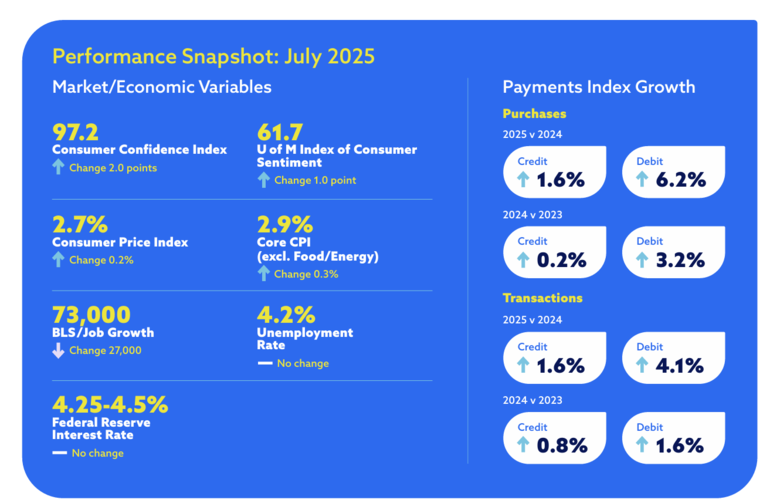
Key takeaways for August include:
- Growth picked up for debit and remained slow for credit in July. Debit purchases were up 6.2%, with the Goods and Money sectors contributing more than two-thirds of growth. Credit purchases were up 1.6%, with the Goods and Services sectors accounting for the entire increase. Insurance premiums continued to drive growth in the Services sector. For July, debit transactions were up 4.1% and credit transactions were up 1.6%.
- The 12-month cumulative CPI through July remained the same at 2.7%, with a 0.2% increase in July. The Shelter index accounted for most of the increase in July. Core inflation, which excludes Food and Energy, was up 0.3% at 3.1% for July. The Core CPI results showed more inflationary pressures, including goods stemming from tariffs.
- There are signs of shifting consumer spending, influenced by the economic uncertainty in the market. Debit activity continued to drive consumer spending across the Goods sector for most merchants, with large retailers, wholesale clubs and automotive sales showing the most notable growth. While a smaller percentage of activity, discretionary spending was most impacted in the Travel and Entertainment categories.
The full report is available for download here.