

WASHINGTON—Small issuers had no voice during Tuesday’s Senate Judiciary Committee hearing focused on the proposed Credit Card Competition Act (CCCA). However, the legislation, according to Washington insiders, gained no traction.
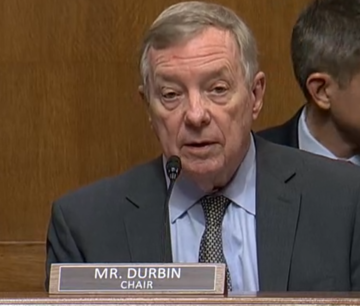
During the meeting Visa and Mastercard executives were grilled by committee members. The CCCA, sponsored by Sens. Dick Durbin (D-Il) and Roger Marshall (R-KS), hasn’t gathered many additional cosponsors this year, insiders noted.
And additional support did not seem to be gained Tuesday, noted Jason Stverak, Defense Credit Union Council (DCUC) chief advocacy officer. Stverak told CUToday.info that Durbin’s and Marshall’s efforts Tuesday to advance the legislation did not succeed.
“I do not believe there was any movement on the topic,” Stverak said.
But what does concern Stverak, and Washington CU advocate John McKechnie, is the Committee failing to consider any input from smaller financial institutions.
“It was very telling that the Committee did not want to hear from any smaller financial institutions, like credit unions,” said Stverak. “Before the hearing, DCUC contacted the Committee to offer our insights. But our request—and apparently requests from many other small issuers—was met with silence.”
McKechnie told CUToday.info the credit card fee issue deserved a much fuller hearing than it received Tuesday.
“Unfortunately, the Committee leadership didn’t want to hear from credit unions or other smaller financial institutions about the possible impact of price controls on consumer payment options, data security or the enormous benefits the retail industry receives from the current system,” McKechnie said.
America’s Credit Unions Chief Advocacy Officer Carrie Hunt said it’s "disappointing" there was a hearing for the Big Box Bailout bill without inviting input from credit unions that will be negatively impacted by the proposed changes.
"The Senate Judiciary Committee has no jurisdiction over this issue, and without proper perspectives this was an ineffective use of Congress’ time," Hunt said. "We will continue to fight against the Big Box Bailout bill and other attempted changes to the interchange system that will benefit merchants at the expense of consumers and credit unions.”

John McKechnie
Visa And Mastercard Execs Grilled
During the hearing, Committee leaders grilled executives from Visa and Mastercard.
“I’m not sure how I’ll come out, but you’re having a hard time convincing me that the fees are set to the advantage of the consumer,” South Carolina Republican Sen. Lindsey Graham said during the hearing, according to Payments Dive.
Another Republican, Sen. John Kennedy from Louisiana, grilled Visa representative Bill Sheedy, a senior advisor to CEO Ryan McInerney, as to why his boss was too busy to appear himself to testify before the committee. He warned Sheedy, and Mastercard’s representative, Linda Kirkpatrick, who is president of the Americas, that if they don’t find a way to restructure the system to reduce fees for merchants, Congress will step in, Payments Dive reported.
“You need to sit down and work this out because if you don’t, Congress is going to do something,” Kennedy said. “The high prices in this country are gutting the American people like fish.”
DCUC Sends Letter To House

Jason Stverak
Separately, DCUC sent a letter to House leaders urging the House to exclude the CCCA from any version of the National Defense Authorization Act (NDAA).
“The CCCA poses significant risks to military servicemembers, veterans, and their families by undermining the critical support defense credit unions provide,” Stverak wrote.
In the letter, DCUC highlighted several reasons for its opposition to the CCCA and the risks the legislation would pose to America’s consumers, especially military and veteran families. DCUC emphasized how the CCCA threatens to undermine the “critical financial services defense credit unions provide to military communities, veterans, and retirees.”
DCUC also highlighted how veterans and fixed-income retirees would face increased costs for financial services and a potential loss of key programs like VA home loans, which are critical for transitioning to civilian life, DCUC said.
DCUC stressed how including the CCCA in the NDAA “misaligns” with the legislation’s core mission of supporting national defense and military welfare, setting a “concerning” legislative precedent.
Stverak added how research studies from the Kansas City Federal Reserve and the Electronic Payments Coalition show that similar policies abroad led to higher consumer fees and reduced credit access, with minimal savings passed to consumers.
“For years, DCUC has stressed the unintended consequences of the CCCA, and unnecessary studies attached to proposed CCCA legislation, to both houses of Congress,” said Anthony Hernandez, DCUC president/CEO. “We’ve seen with research how the CCCA would greatly impact our military and veteran communities, threatening the financial readiness and quality of life for those who serve our nation. DCUC will continue to urge House and Senate leaders to prioritize the needs of these important communities by ensuring the CCCA is excluded from the NDAA.”