

MADISON, Wis.— While credit unions may have struggled with loan growth this year, a new forecast suggests balances will be stronger in 2025.
TruStage’s latest Trends Report calls for CU loan growth to rise to 6% in 2025, up from 3% in 2024.
Overall, credit union loan balances rose 0.4% in August, less than the 0.7% pace set in August 2023, as higher loan interest rates and tight credit union liquidity curtailed credit demand and supply, according to TruStage’s October Trends Report, which is based on data through August.
Here’s a look at how credit unions performed by category, with analysis by TruStage Chief Economist Steve Rick.
Total Lending
Much of the monthly growth in August was due to second mortgage lending increasing 2.4%, home equity lending increasing 1.4%, unsecured personal loans increasing 1.2%, the report states.
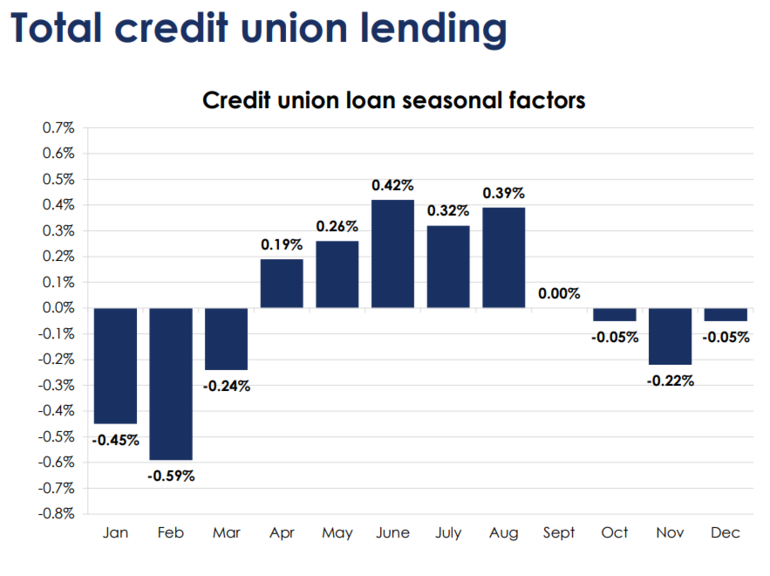
“The strong credit union lending season of April through August is now over as loan seasonal factors turn negative for the rest of the year. During the last 12 months, credit union loan balances increased a relatively weak 3.5%, which is half the 7% long-run annual loan growth rate. But loan growth has slowed even further recently,” Rick said.
Credit union loan balances grew at a 1.8% seasonally-adjusted, annualized growth rate in August, the slowest pace since July of 2011.
“So, expect loan balances to rise only 3% in 2024. We are forecasting 6% credit union loan growth for 2025, due to faster deposit growth next year, lower loan interest rates on new loans, a shift in consumer spending from services back to goods and rising consumer confidence,” Rick stated.
Consumer Installment Credit
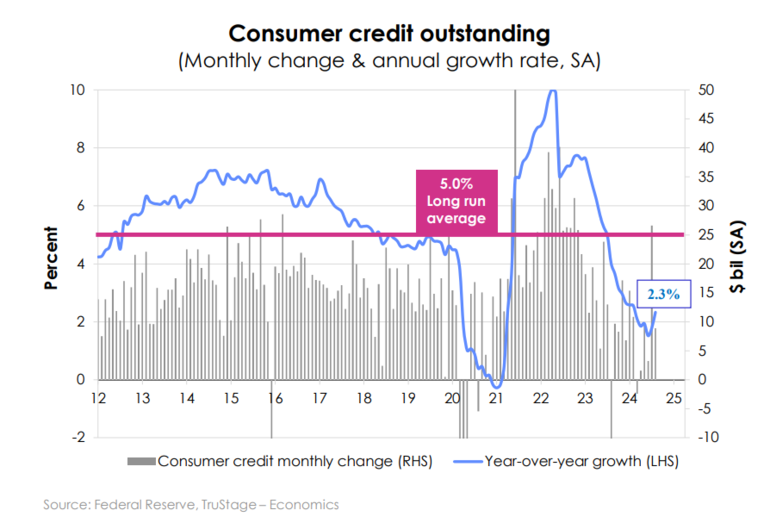
Credit union consumer installment credit loan balances (auto, credit card and other unsecured loans) rose 0.3% in August, a deceleration from the 0.4% pace set in August 2023. During the last 12 months, credit union consumer installment credit fell 0.1%, the first decline since the fall of 2011, and below the total market excluding credit unions and government student loans which rose 2.4%. According to the Federal Reserve, consumer credit outstanding for all lenders rose only $8.9 billion in August, below the $15 billion long run monthly average growth; non-revolving credit (large loans such as automobile and student loans) rose $10.3 billion while revolving credit (credit cards and home equity lines of credit) fell $1.4 billion.
The decline in revolving credit was due to lower gas prices and borrowers trying to pay down high-interest rate debt. Consumer credit outstanding is rising only 2.3% year-over-year, below the 5% long run average.
“This slowdown in credit creation is one of the ‘long and variable lags of monetary policy’ the Federal Reserve Chairman Jerome Powell likes to mention at his press conferences. Less loan creation leads to less spending and therefore less price pressure. This will create disinflation as the inflation rate falls to the Fed’s target of 2%. Going forward, expect consumer credit growth to accelerate into 2025, as consumer demand picks up, lower interest rates make debt more attractive and credit union liquidity pressures subside,” Rick said.
Vehicle Loans
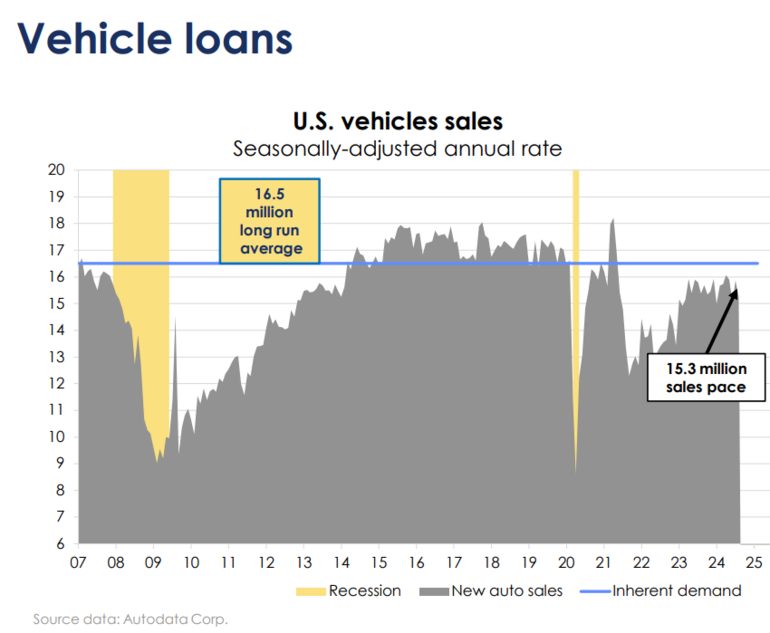
Vehicle sales fell in August to a 15.3 million unit seasonally-adjusted, annualized sales rate, which is down 4% from July, but no change from August 2023, when 15.3 million units were also sold. New vehicle sales are still well below the 16.5 million pre-pandemic level considered to be the market equilibrium.
“Consumers seem to be holding out for better deals despite higher auto inventories and improving affordability. High auto loan rates will ensure that new-vehicle sales remain below the 16.5 million pace through 2025,” Rick explained.
New vehicle sales are then expected to surpass 16.5 million in the first quarter of 2026, when the Federal Funds interest rate is expected to fall to its neutral rate of 2.8%. An increase in inventories and purchase incentives has enhanced affordability for borrowers recently.
The Cox Automotive/Moody’s Analytic Vehicle Affordability Index has improved 13% during the past 20 months. Affordability will improve further as auto interest rates follow those of the Federal Reserve’s target rate, albeit with a lag. Credit union new-auto loan balances fell 0.6% in August, below the 0.1% gain set in August 2023. And new-auto loan balances declined 7.2% in August on a seasonally-adjusted annualized rate, the slowest pace since 2011. With auto loan interest rates now in the 6.5-8% range, auto demand is being curtailed. Auto loan supply is also being restrained as credit unions’ auto loan delinquency and charge offs rates are up 33% and 50%, respectively, during the last year. This has led some credit unions to tighten credit standards and increase the percentage of loan applicants denied, the report states.
Real Estate Information
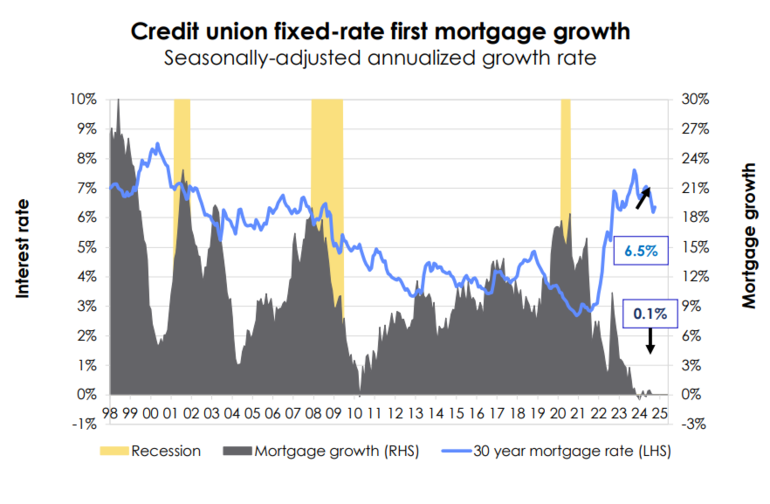
Credit union fixed-rate, first mortgage loan balances rose 0.5% in August, better than the 0.01% pace reported in August 2023. When comparing year-to-date growth, fixed-rate first mortgage balances rose 0.3%, below the 1.5% reported during the first eight months of 2023. The jump in mortgage loan balances is due to the fall in interest rates. The contract interest rate on a 30-year, fixed-rate conventional home mortgage fell to 6.5% in August, from 6.8% in July, and below the 7.0% reported in August 2023.
Home prices rose 0.3% in August, according to the S&P Core Logic Case-Shiller Home Price Index and rose 4.2% year-over-year despite the worst housing affordability in almost 40 years. In the five years preceding the pandemic the average monthly price appreciation was just over 0.4%. Demand for homes is weak amid extremely low housing affordability and existing home sales are near their lowest level since the Great Financial Crisis. High interest rates have reduced housing demand to recessionary lows, but a simultaneous reduction in housing supply is keeping home prices from declining. Current homeowners have a strong incentive to stay in their homes because of the large spread between the effective mortgage rate and the current mortgage rate. The effective mortgage rate, which is the average rate on all outstanding mortgages, is almost 350 basis points below the current mortgage rate. Following years of higher-than-average home price growth, the housing market appears overvalued. So, expect home price appreciation to slow below the 4% long run average in 2025, the report states.
Savings And Assets
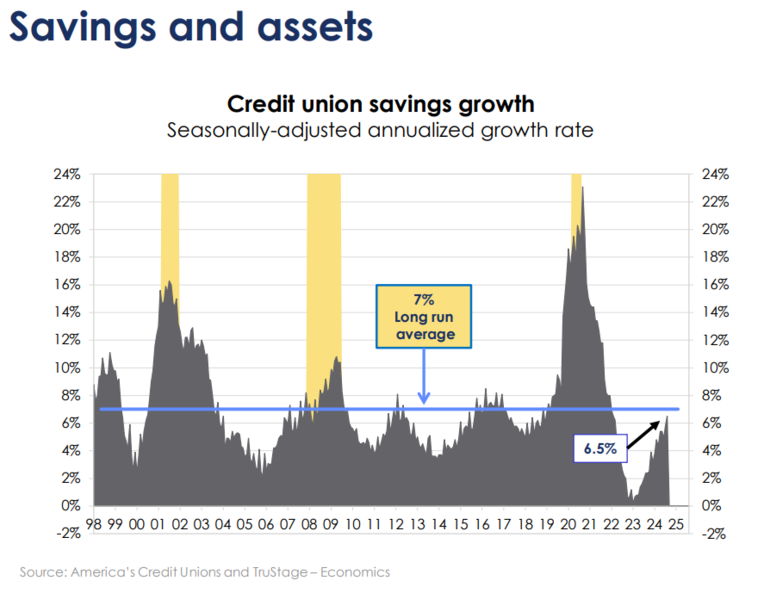
Credit union savings balances rose 1.2% in August, above the 0.2% gain in balances reported in August 2023.
“August is normally one of the weakest months of the year for savings growth due to seasonal factors (vacation spending and auto loan down payments) typically shaving off 0.33% from the underlying trend growth rates. During the first eight months of the year, credit union deposits rose $75 billion, up from the $13.6 billion increase reported during the first eight months of 2023. Savings balances grew at a 6.5% seasonally-adjusted, annualized growth rate in August,” Rick said.
Credit union deposit growth is approaching its 7% long run trend as the excess savings accumulated during the COVID-19 pandemic has now been depleted and real incomes are rising as wage growth outpaces the rate of inflation. Moreover, the personal savings rate (personal savings as a percentage of disposable personal income) has increased to 5% in August, up from 3.1% in August of 2022.
“We expect savings balances to grow 5% in 2024, and 7% in 2025. Credit union members demand for share certificates is exceptionally strong due to high short-term market interest rates. Share certificate balances are up 17% ($82 billion)during the first eight months of this year, reaching a record $572 billion. During the same time share draft balances rose only $9 billion, regular share balances fell $14.3 billion and money market account balances fell $3 billion,” Rick said.
Equity And Other Key Measures
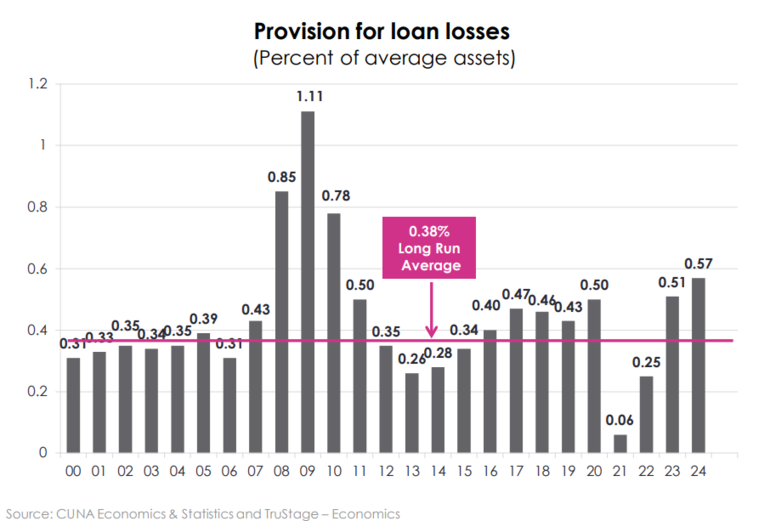
Credit union provisions for loan losses, as a percent of assets, rose to 0.57% in the second quarter of 2024 from 0.44% set in the second quarter of 2023, and the 0.51% set for all of 2023. Historically, credit unions set aside 38 cents for every $100 in assets to account for loan losses. This surge in provisions was one factor reducing credit union return-on-assets ratio from 0.77% in the second quarter of 2023, to 0.71% in the second quarter of 2024.
Provisions are rising this year as net loan charge offs rise above their 0.50% long run trend rate. Net loan charge offs to average loans rose to 0.78% in the second quarter, 44% higher than the 0.54% set in the second quarter of 2023.
Many credit union members are experiencing financial difficulties due to five factors. First, high inflation over the last three years reduced many members real (inflation adjusted) incomes and therefore reduced the purchasing power of their incomes. Second, higher interest rates are squeezing consumers who may have variable rate debt by raising their debt service costs. Third, high rents, gas prices and auto insurance has reduced funds available for debt servicing. Fourth, the resumption of student loan payments has squeezed young borrowers' budgets. And finally, many credit union members have exhausted any “excess savings” they may have accumulated during the COVID-19 pandemic. These factors will continue to increase loan charge offs and provisions for loan losses during the next year, the report states.
Credit Unions And Members
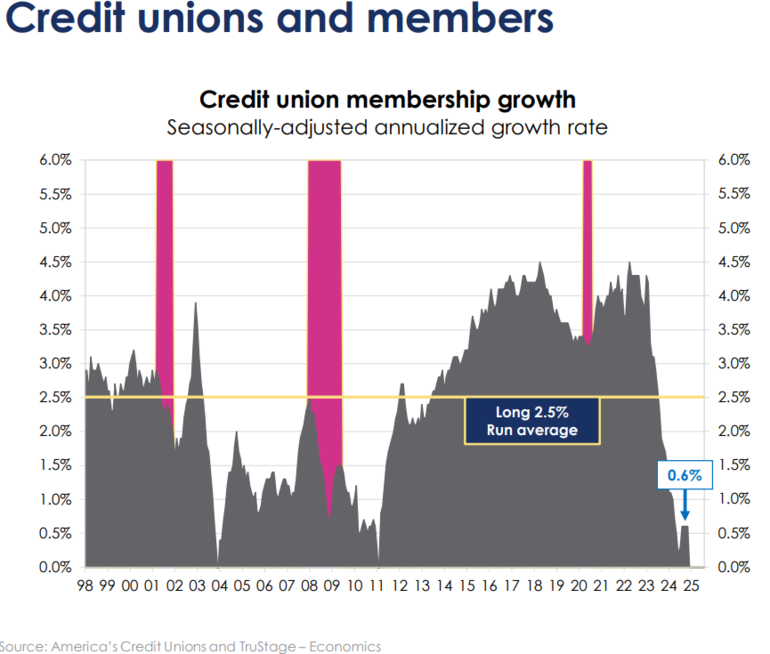
Credit union memberships rose by 156,000 in August, or 0.1%, below the 264,000 new members, or 0.2%, added in August 2023. This has pushed credit union memberships to over 142.6 million. Year-to-date credit union memberships rose 0.6%, below the 2.4% pace in the similar time in 2023. Slower loan growth is the major factor contributing to the membership growth slowdown. Memberships grew at a 0.6% seasonally-adjusted, annualized growth rate August a deceleration from the 2.3% pace reported in 2023, and below the 2.5% long run average. The slowdown in credit union membership growth to 0.6% is due to the negative growth in consumer installment credit. During the last 12 months credit union consumer installment credit balances fell 0.1%. The last time consumer installment credit experienced negative annual growth was in 2010, and 2011, and membership growth was also around 0.6%. The recent pace of 0.6% is still faster than the overall U.S. population growth rate of 0.4%. Therefore, credit unions are still picking up market share from banks and other depository institutions, the report concludes.