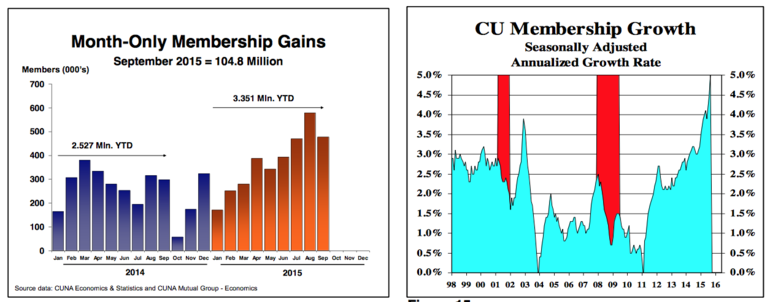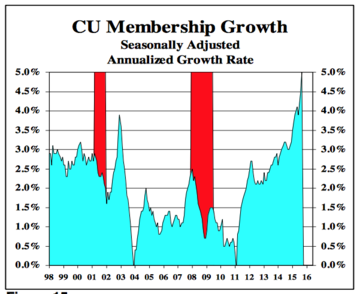
MADISON, Wis.–Credit unions added more than 1.5 million new members during the third quarter of 2015, the fastest growth quarter in credit union history and significantly above the 808,000 added in the third quarter of 2014, according to CUNA Mutual’s latest Trends Report.
But is all that member growth affecting member satisfaction with credit unions? At least one new analysis suggests that may be the case. Consumer satisfaction with credit unions has declined and is rated just barely ahead of that at small and regional banks in the latest American Customer Satisfaction Index, as CUToday.info reported here.
The Trends Report also offered a forecast for the pace of increases in mortgage rates during 2016, as well as insights into the shrinking number of banks and credit unions and what that consolidation means for the marketplace.
Surging demand for credit was the major driver for the upwelling in membership, said CUNA Mutual Group. Credit union loan balances increased $26.2 billion in the third quarter, above the $22.1 billion in the third quarter of 2014. Also driving membership gains was the 513,000 new jobs added to the U.S. economy in the third quarter. Credit union memberships rose 477,000 in September, or 0.46%, much better than the 297,000 new members, or 0.30%, added in September 2014, the company said in its analysis.
Credit union memberships grew at a 5% seasonally adjusted annualized growth rate in September – the fastest pace in 25 years.
In other data released as part of the Trends Report for September 2015:
Total Lending
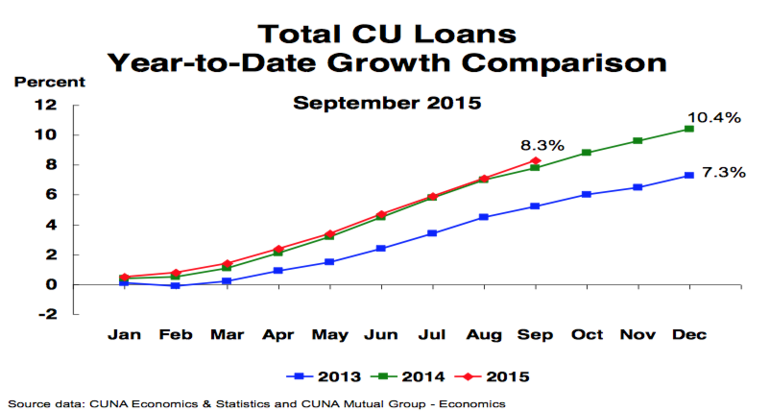
Credit union loan balances rose 1.2% in September, faster than the 0.8% pace reported in September 2014. Driving overall loan growth was strong growth in fixed-rate first mortgages (2.6%), new-auto loans (2.1%), and used-auto loans (1.3%). “Historically, seasonal factors have little to no effect on September loan growth numbers, so the pace of loan growth is being driven only by underlying economic trends. So despite falling stock prices, weak income growth and anemic job creation in September, credit union members shrugged off the bad news and kept borrowing and spending,” CUNA Mutual said. “Based on current trends, credit union lending growth could hit 11% this year, the fastest annual pace since 2005. We expect loan growth to slow to around 10% in 2016.”
Credit Union Consumer Installment Credit
Credit union consumer installment credit loan balances (auto, credit card and other unsecured loans) rose 1.0% in September, faster than the 0.2% pace set in September 2014. According to the Federal Reserve, outstanding consumer credit rose a surprisingly large $28.9 billion for all lenders in September, with balances up 7.1% over the last year. “Consumer confidence is rising due to strong job growth, rising wages and improved household wealth from rising stock and home prices,” said CUNA Mutual in its analysis.
Vehicle Loans
Credit union new auto loan balances rose 2.1% in September, better than the 1.8% pace set in September 2014, which is the fastest monthly pace since October of 2014. New auto loan balances rose 18.5% during the last 12 months, faster than the 14.2% increase in used auto loans. Total auto loan balances rose 15.8% since September 2014, a re- acceleration of the annual growth rate compared to the last few months.
Vehicle sales rose to a new recovery high of 18.2 million units seasonally-adjusted annualized sales rate in September, up from 17.8 million in August and above the 16.4 million sales pace set in September 2014. “This was the highest sales pace since July 2005 when large incentives fueled sales,” noted CUNA Mutual. “Rising stock prices in October and November should support auto sales since stock sales are often used for vehicle purchases. Moreover, the strengthening construction sector and low gas prices should support the light trucks sales for the next year.”
Real Estate-Secured Lending
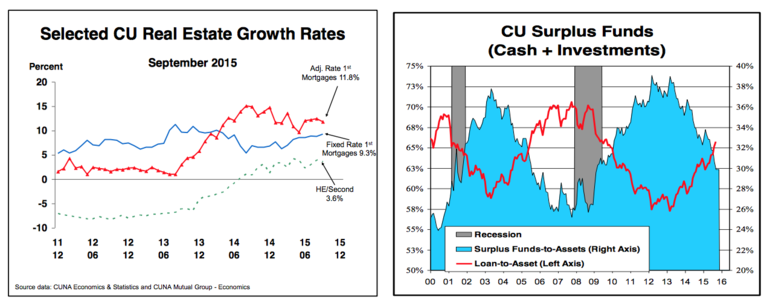
Credit union fixed-rate first mortgage loan balances grew a strong 2.6% in September, greater than the 2% pace set in September 2014, due to existing-home sales surging 4.7%, said CUNA Mutual. “However, during the last year, fixed-rate loan balances grew slower than adjustable-rate loan balances. The acceleration of adjustable-rate mortgage loan balance growth is symptomatic of credit unions believing the Federal Reserve will raise interest rates soon and are therefore altering their asset mix to have more variable rates.”
Home equity lending dropped 1% in September, significantly below the 0.6% gain in September 2014, the Trends Report stated.
“We expect the 30-year mortgage interest rate to increase 15 basis points each quarter during the next year, reaching 4.5% by year-end 2016,” CUNA Mutual forecast. “We don’t expect the interest rate rise to have a significant negative impact on housing demand due to the still historically low level of interest rates in 2016. Rising interest rates will lead to a pullback in refinancing applications, but improving consumer balance sheets and tightening labor market conditions should boost purchase activity.”
Surplus Funds (Cash + Investments)
Credit union liquidity fell to the lowest level since February 2009 in September. Credit union surplus funds as a percent of assets declined to 29.9% in September, according to the CUNA Mutual analysis, down from 32.9% one year earlier, due to loan growth outpacing savings growth. With savings balances only rising a modest $1.8 billion, credit unions liquidated $8.8 billion in surplus funds to fund a $9-billion increase in loans and to pay down $0.5 billion in wholesale borrowings. Loans rose to 66% of assets in September, the highest level since September 2009, the Trends Report stated.
Savings And Assets
Credit union savings balances rose 0.2% in September, greater than the -0.8% loss in balances reported in September 2014. Savings balances rose 5.7% during the last 12 months due to the windfall gain from falling gas prices, rising credit union memberships and stronger job growth, CUNA Mutual said.
“Credit union cost of funds is expected to rise in 2016 as the Federal Reserve raises the Fed Funds interest rate. Credit unions will follow suit and raise interest rates on share certificates and money market accounts similar to what they did in 1994 and 2004,” the analysis suggested.
Capital and Other Key Measures
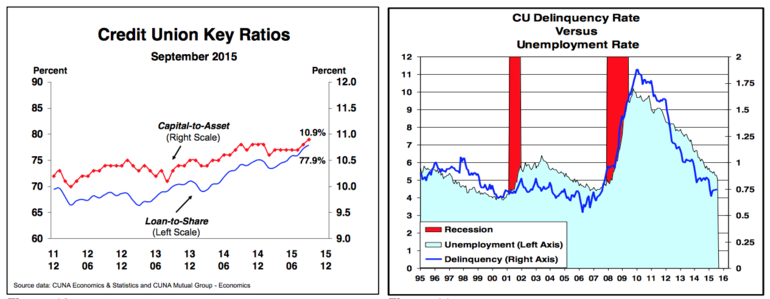
The credit union system’s capital-to-asset ratio rose to 10.9% in September, up from 10.8% in September 2014, as the growth in capital (7.5%) exceeded the growth in assets (6.4%).
The loan delinquency rate (loans two or more months delinquent as a percent of total loans outstanding) fell to 0.73% in September, down from 0.85% in September 2014.
Credit Unions and Members
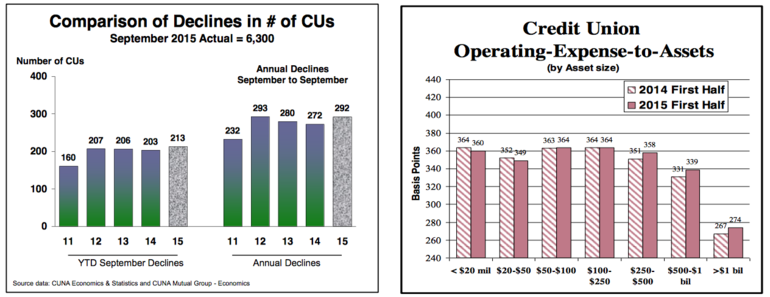
As of September 2015, CUNA estimates 6,300 credit unions were in operation, down 292 from September 2014, the Trends Report stated. Year-to-date the number of credit unions fell by 213, slightly faster than the 203 reported in the first nine months of 2014.
“The pace of consolidation is increasing in both the credit union and banking industries. The number of FDIC-insured banks fell by 308 during the last 12 months ending in June 2015. This leaves a grand total of 6,348 banks in operation. This consolidation is eliminating the excess capacity in the financial services space, cutting duplication of operating costs, culling layers of overlapping management and allowing for scale to squeeze better deals from suppliers. This consolidation trend will lead to larger and more efficient depository institutions and a more competitive financial services industry,” CUNA Mutual said.
The full report is available here.