

ST. PETERSBURG, Fla.–Concerns around CU relevancy and balance sheets, as well as strategies that are common among peer group-leading CUs, were shared during the Defense CU Council’s annual meeting here.
The advice and observations were offered by Robert Perry, principal with ALM First, and Jon Jeffreys, president/CEO of Callahan & Associates during a session that was moderated by Tony Hernandez, president and CEO of DCUC.
Here’s a look at what was discussed:
Hernandez: What are your top three industry concerns?
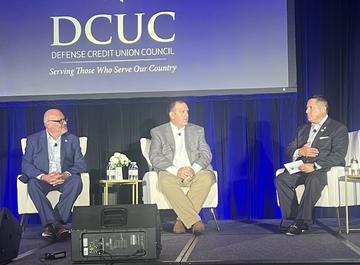
From left; Robert Perry, Jon Jeffries and Tony Hernandez
Jeffries: The first is relevance. How do we make sure that we're staying relevant with members? The second is leadership and thinking about the organization of the future, because that's evolving. And then the third part is what's the state of the American consumer. I think people are struggling. I think the COVID money has run out and people are stretched thin, wo what does that mean for deposits, delinquencies? It has effects on our business.
Perry: I think about the need for talent in the industry. In the financial crisis a lot of people left the industry and a lot of young people came into the industry and had very little experience. I have people working for me that even their 30s all they had ever seen was interest rates of about 25 basis points. This is the first time they've ever really lived in a real market, So, building talent, training talent, bringing people into the industry.
I think relevance is very important, too. You see fintech and technology companies and other financial institutions that have big spend budgets, I’ve heard a lot of young people (who) want an app and if it doesn't do what they want right now they just get rid of it.
And I think about asset pricing and profitability. You see the big change in non-maturity deposits…With interest rates so low for so long there was very little incentive from depositors to buy CDs or have any type of term deposit…Then COVID happened.
The interesting thing from a modeling perspective as a risk manager is that there's a big difference between some core deposits and other core deposits. I think some of the risk management systems and the long data trend lulled institutions into thinking that some of this money was a lot longer than it really was. It created odd incentives for asset pricing and purchases of securities. Silicon Valley Bank, for example, took in a $500 million deposit from Roku and then they put it in their held to maturity (category) and bought 30-year bonds. That money was out the door in six months.
Jeffries: Who is responsible for deposits? That is one of the things that more credit unions are starting to look at. It’s not just a finance thing, not just a retail thing, it’s everything. As we think about talent that’s one thing credit unions should ponder: What does a chief deposit officer look like?
Hernandez: How much of a problem is it to recruit and develop talent?
Jeffries: It’s Always a challenge, but I think the advantage we have is we do good work. (Many people) want to make as much money as they can as fast can. At a credit union, you can make a reasonable salary, have a good life for your family, and make a difference in the place where you live.
I hate to make it that binary, but those credit unions that tell that story about the difference they make can find people. We have amazing opportunities for the right types of people.
Hernandez: What keeps you up at night?
Perry: I think is critical for the management team to know who's in charge of the policy and that the management team are all on the same page so that when they get together they can define what is successful in this institution. The lending folks, the finance folks all need to agree on the modeling and the pricing in a disciplined way so that that discipline doesn't fall away.
(Perry shared with the audience graphics showing many CUs had underpriced auto loans even as rates were rising. Many CUs are also starting to see defaults in some portfolios, such as auto and credit cards.)
Jeffries: The big one again is how do we make sure we’re relevant. If you think about one of the things that COVID taught us it is that now anything you want can be delivered to your front door or put in your trunk. The consumer expectation is changing. How do we make sure that that we are changing along with it?
One of the things we put together a couple of years ago is we were looking at credit unions that appeared to be growing faster than others. We looked to see if there was any sort of commonality to their playbooks and we put together this framework we call the strategic growth framework.
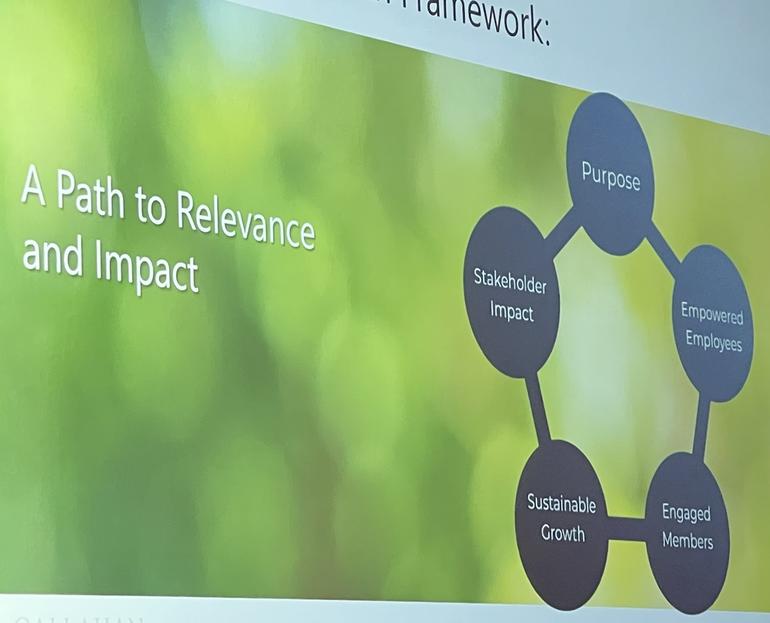
They had a really clear purpose. If you take care of your stakeholders, your members, your employees, your community, that should reinforce your purpose. It’s a really simple framework but I think that when implemented it gives credence to the path for relevancy,