

ST. PETERSBURG, Fla.–It isn’t just credit unions that are feeling the squeeze on resources, state regulators are, as well, according to one person.
A perspective on that issue at the Defense Credit Union Council’s annual meeting here was given by Brian Knight, president and CEO of the National Association of State Credit Union Supervisors (NASCUS).
Knight shared his views and an update during a panel discussion that was moderated by Tony Hernandez, CEO of Defense Credit Union Council.
Here’s a look at what was discussed:
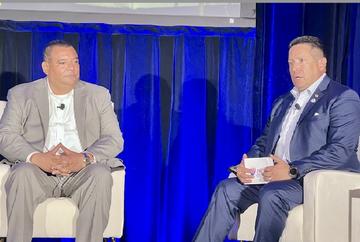
Brian Knight (L) with Tony Hernandez
Hernandez: What is happening at NASCUS?
Knight: I want to redirect a lot of NASCUS’ energy and resources back out to the states and state regulatory agencies. From my perspective as I look out over the state system, as I often say we could lose the entire state system in Washington due to a variety of issues, but we’re not going to win it in Washington. I want the state agencies to be the gold standard and to provide an environment in which state credit unions can thrive.
I want them to be aware of and considering the latest ideas and trends in regulation and supervision and help them understand the same thing with the credit union industry.
There is this dramatic transformational change going on worldwide in financial services, and one of the things we talked about is we’re not 100% sure we know very clearly what the role of the depository institution is versus what it going to be years from now. Some of those walls and boundaries are coming down. We need to be seeing those issues, understanding them, and thinking about what they're going to mean for the financial system.
Hernandez: How can we integrate with NASCUS?
Knight: NASCUS does have a blind spot on some of those kind of micro-service, member-focused issues, and our regulators are very much interested in hearing that and understanding that.
We are constantly looking for further ways to communicate and collaborate and to interact…The feedback from you lets us know when we are missing those issues that are critical to your membership and, more importantly, critical to our credit union members.
Hernandez: Broadly, at the state level, what are your top three issues?
Knight: First, it’s ensuring that all of the states are in a system that has the understanding and the resources to adjust to what is a transforming the financial services sector, whether you're talking about fintech or artificial intelligence. We want to make sure our state agencies are aware of those so that they can think about them and make informed decisions.
A second one would be looking at state supervision and state regulation and whether it’s properly calibrated for this moment in time. You can have 46 agencies that look at that and come to different conclusions as to what the best calibration is, but again, ensuring that they at least have an understanding of what’s occurring is critical.
Third, state regulators, like credit unions, have resource limitations and they’re being asked to do more and more with the same resources in supervision. How can you implement technology? How can you implement different academic approaches to accomplish the critical mission ensuring the safety and soundness?
We're all in that cooperative movement and we all suffer for the sins of our sisters and brothers. Regulators are the gatekeepers of that.