

ST. PETERSBURG, Fla.–There is a lot of information available to help defense credit unions better understand military households in order to improve relevance and retention, according to one person.
Speaking to the Defense Credit Union Council’s annual conference, Edgar Hernandez, senior manager-multicultural business strategy with TruStage, urged CUs to “look at signals and data to understand where the consumer is going and has been to help credit union s make better decisions.”
And while DEI has “become a four-letter word to some,” Hernandez said to him it means dialogue, empathy and intentionality, all three of which are critical to making connections and growing the credit union.
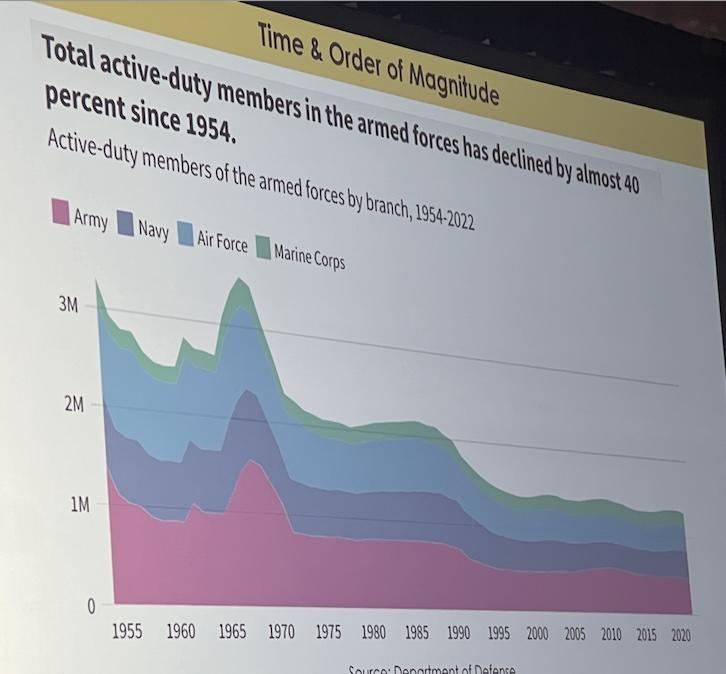
Telling his audience that “data tells us a story,” Hernandez shared data showing the ongoing decline in people who have served in the military, which today includes about 1.5 million people. More than 40% of people in the military come from five states: California, Texas, Florida, Georgia and New York, he said.
And where are military bases and facilities located? One way to know is to look at the locations of check-cashers and payday lenders and their prevalence in counties with high numbers of military.
Hernandez said those so-called “alternative services” providers outnumber CU locations five to one in those areas.
He shared insights into what credit unions need to know according to The Who, The What, The How and the Where.
The Who
After sharing a graphic showing changes in population diversity in the U.S., Hernandez said, “It’s important to note these trends. The face of your credit union is changing. If you don’t remain relevant, people will say ‘They don’t know me and I’m going to go someplace else, even though they charge 200% interest rates they understand me.’”
Similar diversity changes are taking place in the military he said, sharing graphics showing how diversity differs by military branch.
Edgar Hernandez
In addition, he noted females are increasingly represented in the military, comprising about 17% of the military population.
Additional Data Points
Other data points shared by Hernandez:
- A lot of young folks 25 and younger are in the Marine Corps, which also has lot of Latinos.
- Veterans are slightly more likely to be married than non-veterans, but they are also two times more likely to be divorced.
- Male veterans are 2.4 times more likely to be living alone than male non-veterans.
- More veterans live in a one-family house (detached), which is about 10% higher than non-veterans. “They have a better living conditions, which is good, but they also are two times more likely to have disabilities than non-veterans,” said Hernandez.
- Most veterans are likely to have a high school degree and are 40% more likely to have an associate’s degree.
- About one in four veterans earn between $100,000-$149,000, while one in four officers currently on duty earn between $50,000 and $74,000.
- The top occupations of veterans are in transportation, managers, manufacturing, police and fire, construction, technology.
The What
The “what” piece of the data, said Hernandez, is all about the tactical and what a credit union is going to promote.
He cited a TruStage study of 10,000 consumers that asked about financial worries and found differences according to race/ethnicity and by generation.
“We found Asians are most worried about inflation and health care. Blacks were worried about those same elements and others. Hispanics are worried about having enough money to retire,” he said. “By understanding who you are serving you will be able to understand what their worries are.”
The research funded different concerns by generations and in the long-term goals of each group.
“And for veterans, there are issues around homelessness, integration, mental health, physical issues and more,” he said.
“Multicultural and younger consumers have bigger interest in loans over the next five years,” Hernandez told the meeting.
The How
According to Hernandez, “the how is the emotional piece.”
Among the research findings:
- 43% of consumers check their financial balances daily.
- Multicultural and younger consumers are opting for mobile-first options, but Gen Z is dissatisfied with mobile apps.
- The importance of Fis giving back to the communities is higher for Black, multi-cultural and Hispanic consumers.
- The top three measures of giving back across those three groups are financial well-being, food insecurity and education
The Where
To know where those members are, Hernandez encouraged credit unions to perform segmentation analyses.
“The more we understand and engage in a dialogue, the more we empathize and know their story and are intentional about serving them, the more chances you have of engaging with them,” he said.