

ST. PETERSBURG, Fla.–An NCUA executive is offering some insights into what the Supreme Court decision on the Chevron Doctrine is going to mean for credit unions and the agency.
In its decision in the case filed by Loper Enterprises, the Supreme Court turned back 40 years of precedent in a case that originally involved Chevron and which had become the basis for courts to consistently hold that in cases where Congress passed laws that are ambiguous or leave room for interpretation, the regulatory agencies are empowered to do the interpreting.
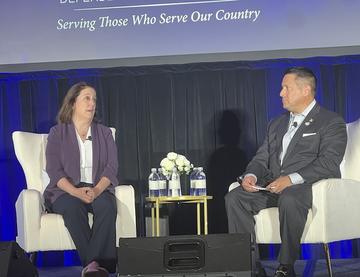
From left, Elizabeth Eurgubian with Tony Hernandez during DCUC meeting.
But that’s no more, with the Supreme Court saying it will be up to the courts to make such decisions.
Elizabeth A. Eurgubian, director of external affairs and communications, who has previously worked as an attorney for bank and CU trade associations, told the Defense Credit Union Council annual meeting that the “short answer” for what the decision means is “we’re going to see how this plays out,” but it’s going to mean “different things to different types of organizations.”
The Different Perspectives
She offered the perspective of trade groups and lobbyists, for example.
“When I was with CUNA years ago we would try to get some statutory language (from Congress or state legislatures).” Eurgubian explained. “The legislation was passed but you never get it right (given) all the compromises and negotiations. So, our lobbyists would come back and say, ‘We'll fix that on the agency side.’ That's going to be harder because agencies don't have that default deference any longer. What that means is if you're a lobbyist and you want something passed, you’ve got to make sure it is explicit in the language, or at least there is language in there that gives the agency the regulatory agency the authority to interpret the rules. It will have to be very clear.”
For NCUA, there are also obvious implications, Eurgubian said.
“We’re still going to write rules and we're going to still propose them, we're going to make sure we have the proper authority to do that,” she said. “From a practical standpoint, I would guess you're going to see in the proposed and final rules probably a little more justification in the legal authority section of that proposal.”
Industry Response
For credit unions and the broader financial services industry, the fallout from the Supreme Court decision will also be felt moving forward, Eurgubian said, noting how various parties respond will be driven by whether they like a proposal or rule or not.
Legal challenges from the banking trade groups, for example, are one potential outcome, Eurgubian said, noting field of membership-related rules may be ripe targets, as the banking industry has criticized NCUA for being overly broad in its interpretations.
On the other hand, should credit unions find a rule to narrow or stringent, litigation may also be filed by CUs, she noted.
Not an Episode of Law & Order
In either case, enacting rules will likely take longer, with Eurgubian reminding that in the legal process things don’t “happen overnight like on Law and Order…You have to assume it's going to be appealed…It could take two years before that (new rule) is finally resolved. From a practical standpoint, if I'm a credit union, by the time that issue gets resolved I'm probably already complying with the rule.
“There are really just a lot of factors in in this and how this plays out,” said Eurgubian. “I don't see this as a win or a loss for anybody. But if you bring a lawsuit (you have to ask) what is the gain and is the gain worth the expense?”