

WASHINGTON–After much concern in the lead-up to a Senate hearing that the credit union tax exemption would be put on the table as ripe for reevaluation and perhaps even elimination, the issue did not come up in the oral testimony, although it was included in one of the written statements submitted to the committee.
In its written statement, the Tax Foundation included as a footnote in its statement, Reining in America’s $3.3 Trillion Tax-Exempt Economy (taxfoundation.org), two notes:
- “While there still may be a role in today’s economy for insurance-providing fraternal organizations, credit unions, and collegiate sports leagues, there is no longer a justification to exempt them from taxation.”
- “Lastly, federal credit unions generated $7 billion in net income in 2019 and would have been liable for $2 billion in taxes had they been taxed at 21%.”
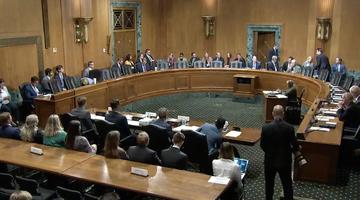
Daniel Bunn, president and CEO of the Tax Foundation, was among the four witnesses before the committee hearing. The Tax Foundation has been outspoken in its opposition to credit unions’ federal tax exemption, with one of its executives saying as part of a national TV broadcast one week earlier that CUs are no longer “membership-serving organizations. They're growing and expanding and they're essentially commercial banks masquerading as nonprofits.”
Turning Up the Decibel Level
“The bank lobby is attempting to turn up the decibel level in their criticism of the credit union tax exemption,” said John McKechnie, who advocates for credit unions on Capitol Hill. “At today’s hearing at least, they failed. Having said that a number of congressional tax committee members have recently commented that most, if not all exemptions are going to receive scrutiny when tax reform is revisited next year. Credit unions have good arguments on the consumer benefits of their tax exemption—let’s sharpen our pencils and be ready to put them out there.”
The Focus
While specific industries and tax exemptions weren’t discussed during the hearing, the discussion in the Senate Finance Committee hearing titled “The 2025 Tax Policy Debate and Tax Avoidance Strategies,” it was made clear just how diverse viewpoints are, how complex the issue of tax reform is, and how much the next year will be dominated by strong debate and disagreement as 2017’s Tax Cuts and Jobs Act (TCJA) sunsets at the end of 2025.
More than is often the case in congressional hearings, much of the hearing was dominated by speeches by members rather than by any Q&A with the four people on hand to testify.
Bait & Switch
In his opening comments, Committee Chairman Ron Wyden (D-OR) called much of the talking points around the tax code involve “bait and switch,” new taxes for working people, tax cuts for the rich, devastation for Social Security and big deficits.
“The big winners are people at the top and everybody’s else’s needs are shunted aside,” Wyden said.
Wyden said that for every dollar in tax cuts that go to families of modest means, $540 goes to the “typical millionaire.”
The Oregon senator criticized Republican presidential candidate Donald Trump as “tossing chickenfeed to the working people, while the ultra-wealthy like him pocket huge gobs of cash.”
A Counterview
Offering a counterview, Sen. Mike Crapo (R-ID), the committee’s ranking member, said the 2017 tax act “had a massive effect positively on everybody in America,” resulting in the strongest economy, lowest unemployment and strongest job growth anyone had seen in their lifetimes.
“Taxpayers already face too much uncertainty as they look to work, save and invest in this economic environment, and given the litany of tax hike proposals on the table from my Democratic colleagues, no area is more uncertain as we head into this election than taxes,” said Crapo.