

WASHINGTON—Following annual revisions to the national accounts and an improvement in payroll employment growth in both August and September, the economy now appears to be on firmer footing than previously thought, according to the October 2024 commentary from the Fannie Mae Economic and Strategic Research (ESR) Group.
While the ESR Group still expects economic growth to slow from the robust 3.2% pace recorded in 2023, the degree of expected slowing is smaller; growth in 2024 and 2025 is now expected to be 2.3% and 2.0%, respectively, near the long-run trend growth rate, Fannie Mae said.
The improved economic outlook stems in large part from significant upward revisions to recent personal income data, Fannie Mae explained.
“Previously, the ESR Group expected consumption growth to retrench, as it had grown unsustainably relative to incomes, but revised data now show the relationship between income and consumption to be closer to historical levels. As such, the ESR Group believes the economy can maintain growth closer to its long-run potential through its forecast horizon, barring an unforeseen shock to consumer or business confidence from an adverse exogenous event,” Fannie Mae said.
Following data revisions and recent employment data, bond market expectations for rate cuts have moved into closer alignment with the dot plot from the Federal Reserve’s latest Summary of Economic Projections. As a result, the 10-year Treasury is currently up more than 40 basis points from its mid-September low, Fannie Mae said.
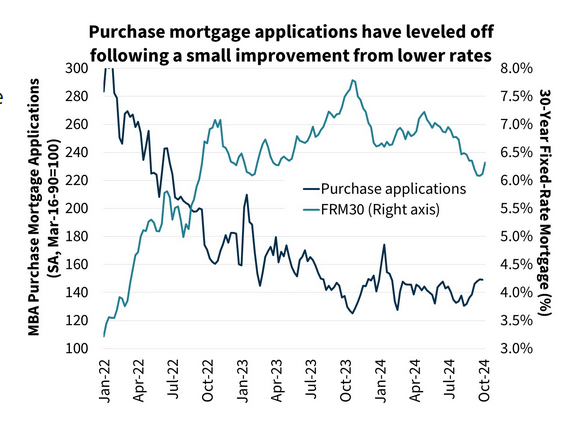
Upside Risk
“This represents upside risk to the ESR Group’s latest mortgage rate forecast, which now sees the 30-year mortgage rate ending the year at 6.0%, down from last month’s 6.2% projection, and to decline steadily to 5.7% by the end of 2025. Meanwhile, the ESR Group expects annual home prices to grow 5.8% in 2024 and 3.6% in 2025, both slight adjustments to their previous forecasts of 6.1% and 3.0%, respectively. While the general low level of homes available for sale is expected to continue to exert upward pressure on prices, the ESR Group expects ongoing affordability constraints and rising inventories of homes available for sale to help moderate the magnitude of home price growth moving forward,” Fannie Mae said.
“While potential homebuyers have noticed the decline in mortgage rates over the last few months, they are equally aware that there has been little relief on the home price side, the other primary driver of unaffordability, particularly for first-time buyers,” said Mark Palim, Fannie Mae senior vice president and chief economist. “The timing of the long-expected pick-up in home sales activity, as well as a further moderation in home price appreciation, will depend in part on the willingness of current homeowners to relinquish their low mortgage rates by offering their homes for sale. Of course, continued strong homebuilding activity will also play a significant role as the shortage of national housing stock remains the primary impediment to affordability.”