

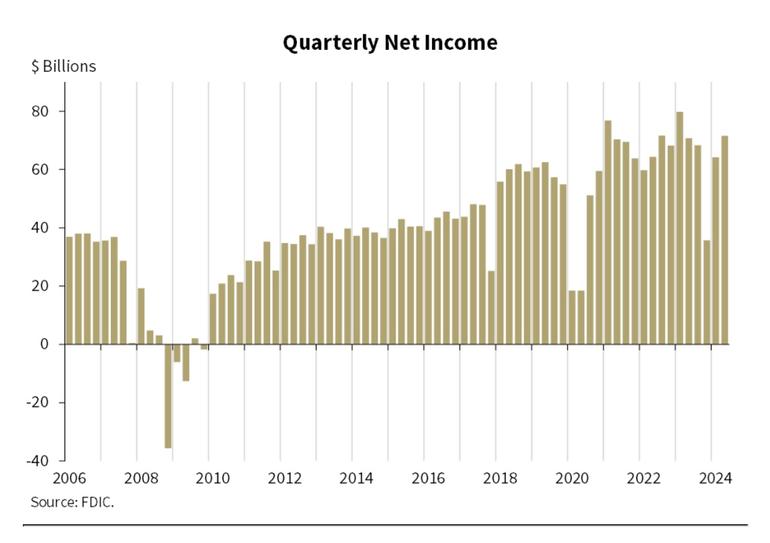
WASHINGTON— The nation’s 4,539 commercial banks and savings institutions insured by FDIC reported aggregate net income of $71.5 billion in second quarter 2024, an increase of $7.3 billion (11.4%) from the prior quarter, according to new data from the agency.
The FDIC said a decline in noninterest expense and one-time gains on equity security transactions contributed to the quarterly increase. The results were included in the FDIC’s latest Quarterly Banking Profile released today.
Here is how the FDIC insured banks performed by category:
The Industry’s Net Income Increased From the Prior Quarter, Driven By Lower Noninterest Expense and One-Time Gains
Contributing to the more than $70 billion in net income was a decline in noninterest expense (down $3.6 billion, or 2.4%) along with higher noninterest income (up $1.2 billion, or 1.5%) and higher gains on the sale of securities (up $937 million) were the primary factors driving the increase in net income, the FDIC said, adding that higher provision expenses offset some of the increase in net income.
“The quarterly increase in net income was largely driven by nonrecurring items including an estimated $4 billion reduction in reported expense related to the FDIC special assessment, approximately $10 billion in gains on equity security transactions by large banks, and the sale of an institution’s insurance division that resulted in an after-tax $4.9 billion gain,” the FDIC said. “These increases were partially offset by several large banks selling bond portfolios at a loss and a $2.7 billion increase in provision expense.”
ROA
The banking industry reported an aggregate return-on-assets ratio (ROA) of 1.20% in second quarter 2024, up 12 basis points from first quarter 2024 but down one basis point from first quarter 2023.
Community Bank Net Income Increased Quarter Over Quarter
Quarterly net income for the 4,104 community banks insured by the FDIC was $6.4 billion in the second quarter, an increase of $72.6 million (1.1%) from first quarter 2024. Higher net interest income (up $546.4 million, or 2.7%) and higher noninterest income (up $253.9 million, or 5.0%) more than offset higher noninterest expense (up $365.7 million, or 2.1%) and higher provision expenses (up $140.5 million, or 18.2%). The community bank pretax ROA increased one basis point from last quarter to 1.14%.
The Net Interest Margin Declined Slightly, Driven by the Largest Banks
According to the FDIC, the industry’s net interest margin (NIM) declined one basis point to 3.16% in the second quarter as the growth in funding costs slightly exceeded the growth in earning-asset yields.
The industry’s second quarter NIM was nine basis points below the pre-pandemic average NIM after falling below that level last quarter, the FDIC said. The NIM increased quarter over quarter for all size groups except for the largest banks, those with assets over $250 billion, who in aggregate reported a four basis-point decline in the NIM. The community bank NIM of 3.30% increased seven basis points quarter over quarter, reversing a five-quarter declining trend, but was still 33 basis points lower than the pre-pandemic average.
Asset Quality Metrics Remained Generally Favorable, Though Charge-Offs Increased
Noncurrent loans, or loans that are 90 days or more past due or in nonaccrual status, remained unchanged from the prior quarter at 0.91% of total loans and well below the pre-pandemic average of 1.28%.
“Despite the stability in overall noncurrent loans, the noncurrent rate for non-owner occupied commercial real estate loans of 1.77% was at its highest level since third quarter 2013, driven by office portfolios at the largest banks,” the FDIC said. “However, these banks tend to have lower concentrations of such loans in relation to total assets and capital than smaller institutions, mitigating the overall risk.”
Net Charge-Offs
The FDIC said the industry’s net charge-off rate increased three basis points to 0.68% from the prior quarter and was 20 basis points higher than the year-ago quarter.
“This ratio was also 20 basis points above the pre-pandemic average and remained the highest quarterly rate reported by the industry since second quarter 2013,” the FDIC said. “The credit card net charge-off rate was 4.82% in the second quarter, up 13 basis points quarter over quarter and the highest rate reported since third quarter 2011.”
Loan Balances Increased Modestly From the Prior Quarter and a Year Ago
Total loan and lease balances increased $125.8 billion (1.0%) from the previous quarter. The increase was driven by higher loans to nondepository financial institutions (NDFIs) (up $76.0 billion, or 9.6%) and consumer loans (up $25.8 billion, or 1.2%).
“Much of the growth in NDFI lending appears to be due to reclassification from other existing loan categories,” the FDIC said. “The majority of banks (75.1%) reported quarterly loan growth, and all major loan categories except construction and development loans showed quarter-over-quarter growth.”
Total loan and lease balances increased by $244.5 billion (2.0%) from the prior year. The annual increase was also led by loans to NDFIs (up $77.5 billion, or 9.8%), “likely due to reclassifications in the second quarter, as well as credit card loans (up $77.0 billion, or 7.5%) and adjustable rate 1-4 family residential mortgage loans (up $69.3 billion, or 7.5%),” the agency said. “A large majority of banks (82.9 percent) reported annual loan growth.”
Additional Loan Data Points
According to the FDIC
- Community banks reported a 1.7% increase in loan and lease balances from the previous quarter and a 6.3% increase from the prior year.
- Growth in nonfarm, nonresidential CRE loans and 1-4 family residential mortgage loans drove both the quarterly and annual increases in loan and lease balances.
- “Loan growth was broad based across community banks with over three quarters of such banks reporting higher loan balances from the prior quarter,” the FDIC said.
Domestic Deposits Decreased From the Prior Quarter
The FDIC report shows domestic deposits decreased $197.7 billion (1.1%) from first quarter 2024, well below the pre-pandemic average second-quarter growth of 0.2%. Both savings and transaction deposits declined from the prior quarter, with growth in small time deposits partially offsetting the declines.
Other deposit data points include:
- Brokered deposits decreased for the second straight quarter, down $10.1 billion (0.8%) from the prior quarter. Banks with over $250 billion in assets drove the quarterly decline in deposits.
- Estimated insured deposits decreased $96.0 billion (0.9%) and estimated uninsured domestic deposits decreased $50.4 billion (0.7%) during the quarter.
- Banks with assets greater than $250 billion reported lower uninsured deposits in the second quarter, while banks with assets less than $250 billion reported higher uninsured deposit levels.
The Deposit Insurance Fund Reserve Ratio Increased Four Basis Points to 1.21%
In the second quarter, the Deposit Insurance Fund (DIF) balance increased $3.9 billion to $129.2 billion. The reserve ratio increased four basis points during the quarter to 1.21%, the FDIC said.
The Total Number of Insured Institutions Declined
Much like the trend line in credit unions, the total number of FDIC-insured institutions declined by 29 during the quarter to 4,539. Three banks were sold to credit unions and 26 institutions merged with other banks during the quarter. One bank failed in the second quarter but did not file a call report in the first quarter, and no banks opened, the FDIC said.