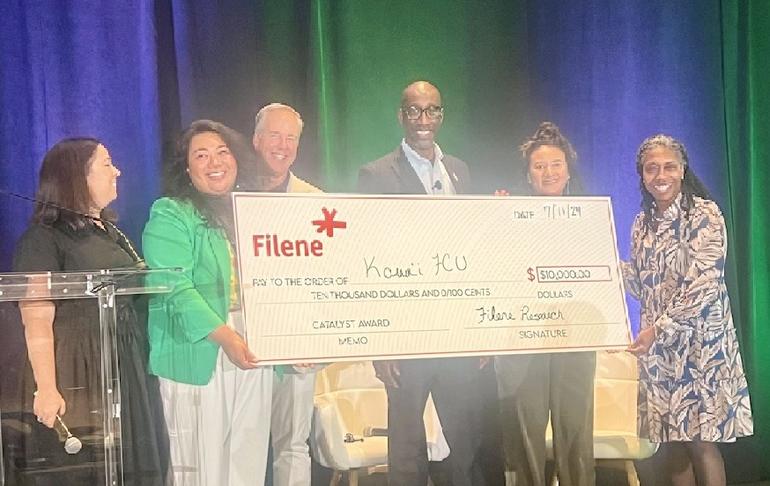
BOSTON–An initiative led by Kauai Federal Credit Union aimed at addressing home ownership challenges has won the first Racial Economic Equity Catalyst Award presented by Filene, along with the $10,000 prize that goes with it.
The credit union was recognized after being named one of two finalists for the award and making a presentation to Filene’s Spark Conference here, where audience members vote on the winner. The other finalist was Iowa-based Veridian Credit Union.
Overall, nine credit unions, 11 community partners and five expert coaches were involved in the initiative that was led by Filene’s Center for Innovation and Incubation’s Racial Economic Equity Incubator.
The Presentations
Here is a look at the presentations each of the two finalists made.
The challenge to home ownership on Kauai is no secret: the median home price on the island is $1.6 million, said Hazelmae Overturf of Kaua’I Federal. Just 20% of Kauai’s households can afford a home at that price, creating a market that has led 55% of native Hawaiians to leave the islands to live elsewhere, she noted.
Overturf added that of Kauai’s population of about 74,000, more than half qualify as ALICE (Asset Limited, Income Constrained Employed) households.
Seeking to play a role in boosting homeownership among Native Hawaiians, Overturf said the credit union entered into a partnership to do two things: create a downpayment assistance program and a cesspool-to-septic conversion program.
The programs are based on the Hawaiian world view and cultural priorities around land management and stewardship.
Similarly, the program’s tagline is based on a Hawaiian culture of helping one another: “Building a Network of Networks.”
In Kaua’I FCU’s case, the network seeks to build generational wealth, financial and climate resilience, and equity through access for underserved populations. Its partners include Hawaii Community Lending, FHLB Des Moines, Hoakeolapono Trades Academy.
Home Buyer Grant Program
Overturf said when KFCU asked members and communities what was their greatest need, the response was assistance with downpayments and other closing costs.
To that end the credit union worked with the FHLB-Des Moines and its downpayment assistance and financial counseling program. That included $25,000 grants for every family that is qualified.
Cesspool-to-Septic Conversion
Kauai may be known as the Garden Isle, but it is also home to more than 8,000 cesspools for collecting waste, according to Overturf. Not only is that a health issue, it’s also an obstacle to homeownership, as no permit for construction or home improvements will be granted if a property has a cesspool.
But with the average cost of a cesspool-to-septic conversion averaging $40,000, it’s a huge hurdle on top of everything else, said Overturf.
In response, KFCU partnered to create a cesspool-to-septic loan, which allows for the building of additional housing units and for people to stay in houses, she said.
“The long-term outcome is income generation, increased inventory, a decrease in migration and positive ecological improvements,” said Overturf.
The programs launched in April of this year. Overturf said that to date $300,000 has been provided; $1 million in green loans made; 12 DPA grants have been deployed; more than 50 clients have been counseled, and 30 cesspools have been converted.
Veridian Credit Union Initiative
Communities across the U.S. often take pride in being ranked first in some category, but in some cases it’s a distinction not to be proud of. That was the case for Waterloo-Iowa Falls, Iowa, which in 2018 was rated the number-one worst place in the U.S. for African Americans to live due to the wealth gap.
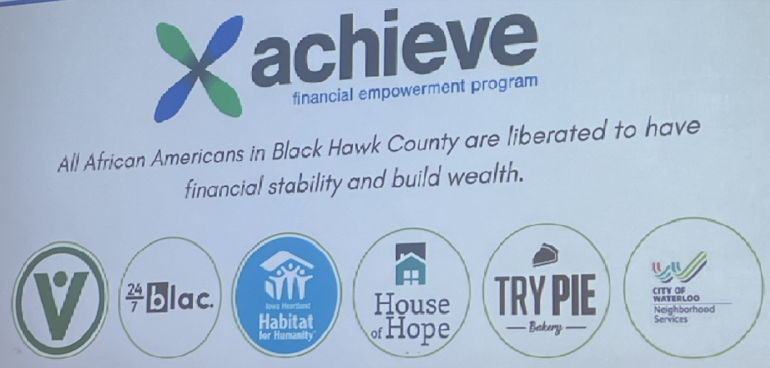
Veridian Credit Union decided to do something about that, and it partnered with a number of others in its communities on its initiatives, including 24/7 BLAC, Iowa Heartland Habitat for Humanity, House of Hope, Try Pie Bakery and the City of Waterloo. The goal was to ensure all African-Americans in Black Hawk County had the opportunity to have financial stability and to build wealth.
Meridian Moves
The first program created by Veridian Credit Union was called Money Moves, a six-week financial education program. At completion, participants could get a one-to-one match of $250 to be used toward a financial goal.
The credit union also created the Veridian Individual Development Account. For every $2,000 the participant saved, it was matched by $2,000. The funds could be used for paying down debt or downpayment.
The Participants
Other participants and features of the program included:
- Project Home. The program offers participants up to $2,500 in grants.
- Iowa Habitat created Blueprints Program, which provides personalized financial coaching over 24 month timeframe, with a goal of getting homeownership by securing a bank or credit union loan.
- House of Hope created the Driving Hope car loan program for single mothers and women aging out of foster care. Program offers a low-interest rate, double collateralized car loan regardless of credit score and debt to income ratio.
- Try Pie offers a financial independence program for teenage girls. The young women work in baking and selling pies, while learning financial literacy, job readiness and leadership training.
- The City of Waterloo focused its Neighborhood Services on boosting homeownership in historically underinvested communities.
Still Not Enough
Despite all the efforts and parties involved, representatives of Veridian CU and its partners told the Filene meeting their efforts were not enough, as the market still ranks in the top 10 places in nation that are the worst for African Americans.
As a result, the organizations formed “Achieve,” which offers multiple entry points in the program with an aim of achieving stability and wealth.
As the result of Achieve, in its first year 20 people achieved homeownership, 71% increased their savings or decreased their debt, 108 accessed homeowner education, 161 completed financial mentoring, and seven accessed transportation through the Driving Hope Loan.
Overall, 40% utilized more than one of Achieve partner’s services.
What’s Next?
Veridian CU said it has now set a goal is to reach 1200-1,300 families, is looking to build a website and a brochure, and to partner with the Iowa Finance Authority and the Waterloo Housing Authority.
Veridian CU won $2,500 as the runner-up with the African American Credit Union Coalition providing those funds.