

BOSTON–How does a credit union tackle strategic planning in an “everything everywhere all at once world?”
That was the question put to several experts during Filene’s Spark conference here. Moderated by Filene CEO Mark Meyer, insights were offered by Dr. Amy Hillman of Arizona State University, and Jacqui Kearns of Strategic Resource Management.
Here is a look at some of what was discussed:
Meyer: How Can CU boards act as a strategic asset for organizations:
Kearns: Your boards are so important to driving the thinking forward. If there’s not diversity in thought really (limits the effectiveness).
I spent some time with a company where there was very similar thinking and it really didn't help us move forward some key strategic initiatives, such as innovation development and diversity, so we started to think about different aspects of assets: what do we really need in the future? We talked about this as part of the nominating committee…It’s not just having some great, loyal members on the board, but having a composite of future innovators who can really help drive your strategies forward.
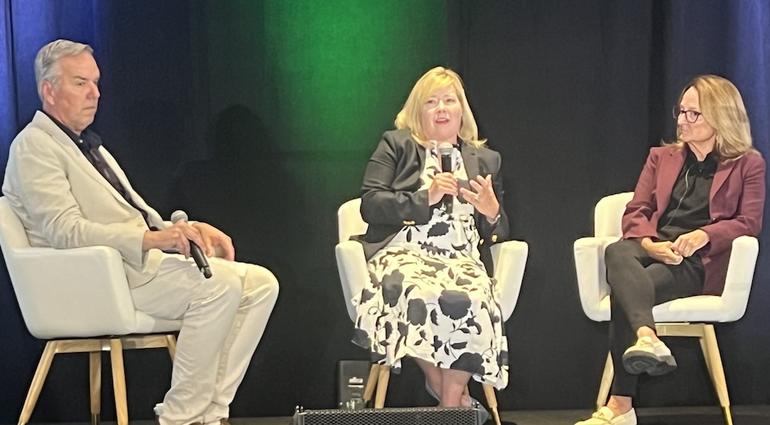
From left, Mark Meyer, Jacqui Kearns and Dr. Amy Hillman.
Hillman: A credit union board can be a source of competitive advantage (In previous role a company asked) what do we need in the future? It’s important to…really kind of change our mindset every time we're looking for a new director to say where do we need to be, not just what are we losing as a director rolls off.
Meyer: As you have worked with boards, what approaches to strategic planning have you seen be most effective?
Kearns: I think it’s about having a plan before you start planning. It’s really understanding who you uniquely are and what you are going to deliver to the market is incredibly important. Unfortunately, we are driven by timetables as opposed to thinking about what's the impact, especially at a cooperative, not-for-profit. It’s really about what drives the value ultimately for the membership.
It's really thinking about what you need before you even get into the room. It’s about not just making it an annual process but making it an active process that you're constantly going back to.
Hillman: It really needs to be a living document we come back to and ask how are we doing? I think it’s really important you continue to iterate along these. But I also think it’s important to understand what it is you’re uniquely trying to bring to the market. We think we need to do what everyone is doing and that may blur our strategic uniqueness and compromise where we're trying to get to because we're trying to do too much.
Meyer: You have both worked with boards. What about the mistakes you commonly see?
Hillman: Strategy is what you choose to do as an organization and that choice means you're also actively choosing not to do some things. I think this pressure for growth that you just discussed is the biggest enemy of strategy because you think ‘I should be growing where I'm growing’ but you don't think about the growth opportunities that deepen your strategic position as opposed to blurring it.
So, making trade-offs about this is a customer segment that we're not going to serve, or this is a product or service that we're not going to offer starts to create anxiety, because a lot of customers want this or you an addressable market that you want to try to capture. You’re trying to be everything for everybody and you can't do all those things.
Kearns: We are in such a unique position to be unique. And I think that that has to be embraced. (When you are much smaller than other providers) you have to find different ways of getting to market, but not every way that everybody else is doing it.
Too often I see the same lists client to client and I challenge that often because that's foundational to your operating plan. You have to have a digital strategy, a way to get to market through an interface, but it shouldn't be your strategy overall. What makes you a unique player in the marketplace?
I keep challenging that point today deliberately because I think that there's so much ingrained goodness in your mission, vision and values and that should be more of what leads your strategic imperatives.
Hillman: I was thinking about the presentation (Wednesday) morning around Generation Z and thinking about that generation is. There is an opportunity for credit unions to really bring this front and center when there are so many organizations that don't have that sense of purpose built in.
Meyer: What approach do you recommend credit unions use to recognize the best opportunities, that is, what is better than Post It Notes?
Kearns: I think comes back to the whole notion of where you’re starting, and it’s not just being in the room (for strategic planning). There is a whole process before that. There are things to think about when developing your strategies. Also, diversity of thought is often key in making sure you have those elements.
Sometimes it’s difficult because don’t have term limits or you have a strong block on the board. Bring it back to the member. We have a different obligation. It’s the core of who we are.
Hillman: I also think that there's a benefit to bringing someone in from the outside to facilitate these conversations, because often if there is a strong voice or there is someone who's domineering. Having someone who doesn't know that pattern or who can counteract that by saying, ‘OK, we've heard this, but let's go back and let's think about if there was one thing here that we could 100% achieve, what would it be?’ I think it's really important to have someone that can keep pushing that prioritization language so that you can start to see the trade-offs between different choices.