

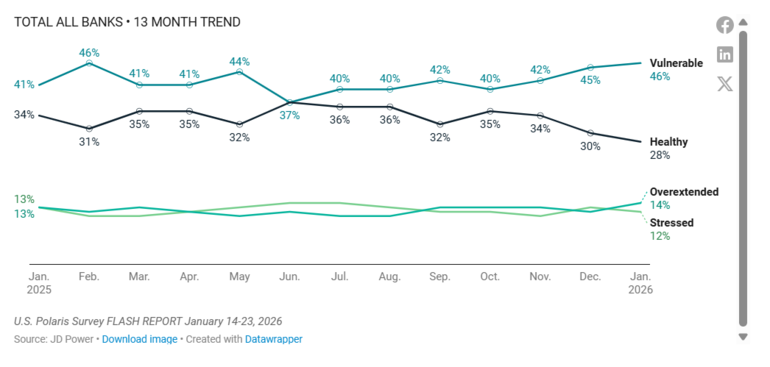
TROY, Mich.--The share of financially unhealthy consumers in the United States has climbed to a 12-month high, underscoring the continued strain from persistently elevated prices, according to JD Power’s February 2026 Banking and Payments Intelligence Report.
In January, 46% of consumers were classified as financially vulnerable, pushing the total share deemed financially unhealthy — defined as vulnerable, overextended or stressed — to 72%. Financial health has steadily deteriorated since October, and while holiday spending may have contributed to the latest spike, JD Power said a correction would be expected within the next month if seasonal factors are at play.
Inflation pressures remain entrenched. Sixty-eight percent of consumers say prices are rising faster than their income, a level largely unchanged over the past six months. Concern is even more pronounced among vulnerable (74%) and stressed (79%) consumers, suggesting many households may be nearing a financial tipping point.
As a result, consumers are prioritizing which bills to pay first if hardship strikes. More than half (56%) say they would delay or skip entertainment subscriptions or memberships, followed by internet or mobile phone bills (29%) and credit card payments (28%). Notably, 62% of financially healthy consumers and 61% of those over age 40 say subscriptions would be the first expense cut.
Despite available hardship programs and payment assistance options, a knowledge gap persists. While 73% of consumers say they know how to contact their internet or mobile provider for help, only 42% know how to reach a personal or student loan provider. Awareness is significantly higher among financially healthy and older consumers — groups less likely to require assistance, the report shows.
The report suggests banks have an opportunity to intervene through greater digital engagement. More than one-third (37%) of consumers say they are willing to increase their use of budgeting and spend-management tools, including 61% of overextended consumers and 54% of those under 40. Expanding access and adoption of such tools, JD Power said, could help mitigate rising financial stress as price pressures persist.