

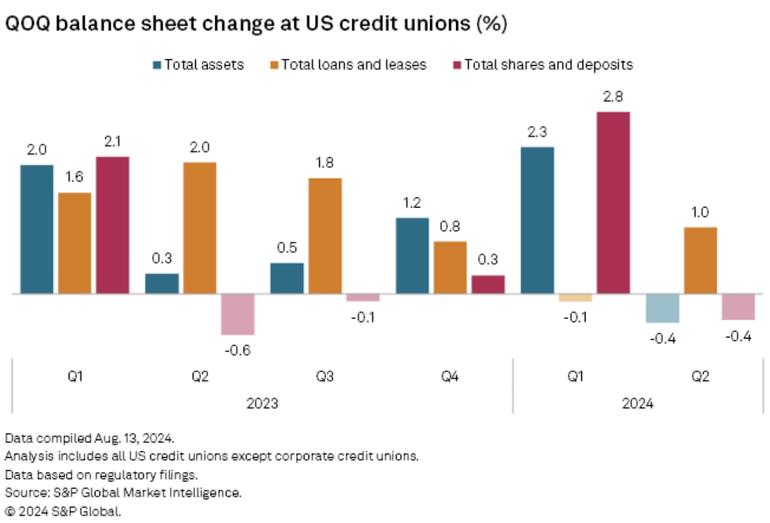
NEW YORK–Assets at credit unions in the U.S. contracted for the first time since mid-2014, according to a new analysis.
Total assets stood at $2.320 trillion at June 30, down 0.4% from March 31, according to data compiled by S&P Global Market Intelligence.
“That broke a streak of 39 consecutive quarters of credit union asset growth,” S&P Global reported. “U.S. banks also reported smaller balance sheets, but their streak of asset growth had been just two quarters.”
Contraction in Liquidity
The S&P Global analysis showed the contraction at credit unions came from liquid asset categories.
“The industry's cash-on-deposit balance declined $26.53 billion, or 13.6%, on a linked-quarter basis,” S&P Global reported. “Most of the decrease was from cash on deposit at Federal Reserve banks. Even with that recent decline, the industry held 9.6% of its asset base in cash and cash equivalents, which was the second-highest ratio in the last eight quarters.”
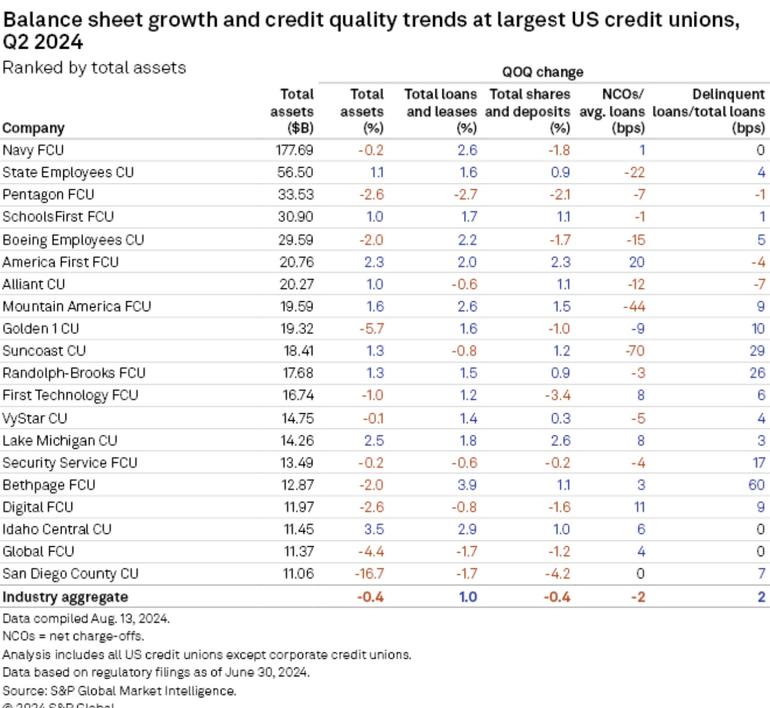
According to S&P Global, among the largest credit unions, San Diego County CU was an outlier, with quarterly asset contraction of 16.7%.
Cutting back on held-to-maturity debt securities and cash on hand at Federal Reserve banks allowed the $11-billion SDCCU to decrease total borrowings by about 55%, the analysis found.
Loan & Deposit Trends
In other findings, S&P Global said it found:
Loans & Leases Hit High
After reporting a smaller loan base for the first time in 13 years in the first quarter, S&P Global reported that total loans and leases at credit unions reached an all-time high of $1.633 trillion at June 30, up 1.0% sequentially.
“One- to four-family loans, both junior lien and first lien, were the primary growth driver,” S&P Global said. “Member business and unsecured lending also increased, while used vehicle loans were essentially unchanged.”
Vehicle Loans
In contrast, S&P Global said the mid-year numbers reveal new vehicle loans were down 1.2% from March 31, representing the third quarterly decrease in a row.
“Most of the largest credit unions have been lowering their exposure,” S&P Global said, pointing to:
- Chicago-based Alliant CU, which reported a reduction of 7.4% sequentially and 33.8% year over year.
- Vienna, Va.-based Navy FCU, at which total loans and leases were up 2.6% sequentially, including gains in new and vehicle loans as well as first and junior lien one- to four-family loans.
Funding Sources
“Like their banking brethren, credit unions are struggling to hold onto cheaper funding sources,” S&P Global said. “Total shares and deposits fell 0.4% from the end of March, representing the third decline in the last five quarters. (Members) continued moving into share certificates with a maturity of less than one year and away from regular shares with a maturity under one year. Money market deposit accounts (MMDAs) may have stabilized, with the aggregate balance staying in a tight range during the last three quarters: from $334.85 billion to $335.80 billion.”
The analysis highlighted Caledonia, Mich.-based Lake Michigan CU and Riverdale, Utah-based America First FCU for bucking the industry trend, with a quarterly increase in shares and deposits over 2%.
Both credit unions significantly boosted their MMDA balances during the quarter, the analysis added.
Credit Quality
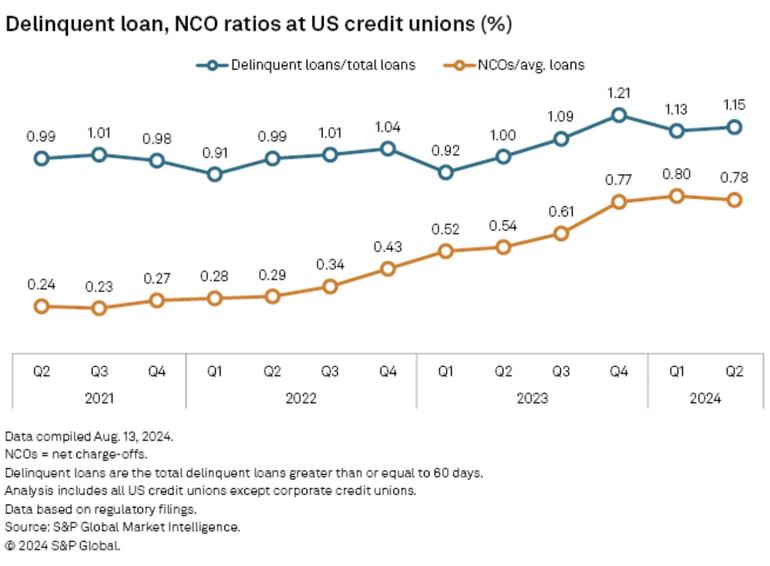
Credit quality may be plateauing across the industry. In the current cycle, the high for the delinquent loan ratio was the end of 2023, and the net charge-off (NCO) ratio peaked in the first quarter of 2024. On a quarter-over-quarter basis, delinquent loans to total loans was up 2 basis points to 1.15%, and NCOs to average loans ticked down two basis points to 0.78%.
Two outliers among the large credit unions were identified by S&P Global: Tampa, Fla.-based Suncoast CU and Bethpage, N.Y.-based Bethpage FCU. Suncoast lowered its NCO ratio 70 basis points from the first quarter, while Bethpage experienced a 60-basis-point jump in its delinquent loan ratio, the analysis stated.