MADISON, Wis.–For a credit union to remain sustainable, it must grow at just the right “speed.”
That’s according to a new analysis from the Filene Research Institute, which seeks to get to the bottom of why over the past two decades credit union performance has begun to diverge markedly across asset size ranges. What the Filene research has found is that there are consistent parameters around growth rates that separate the sustainable from the unsustainable CU operations.
As Filene notes in its latest analysis, Credit Unions: Financial Sustainability & Scale, “smaller credit unions bear far higher non-interest expenses per assets than their larger peers and struggle to offer comparable interest rates and to maintain similar asset growth rates.”
The report defines financial sustainability as being able to:
- Offer attractive terms and interest rates indefinitely for a broad asset size range of financial products
- Remain relevant in the financial lives of their members, and of Americans as a whole, by maintaining constant, or growing, market shares
- Maintain capital per assets ratios that are sufficiently high to withstand periodic shocks, such as economy-wide increases in loan losses
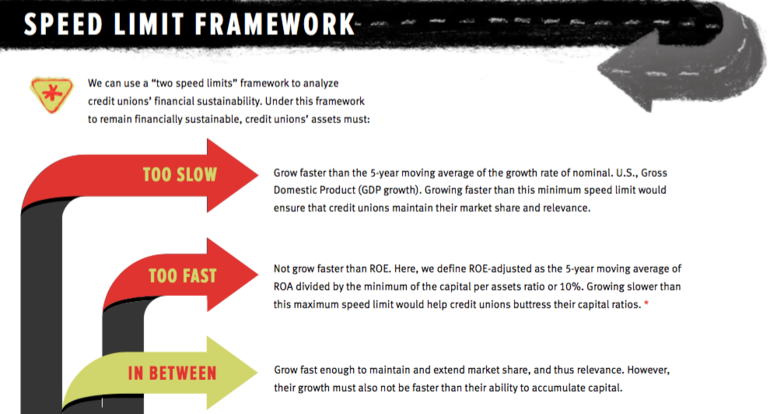
The analysis, by Dr. Luis Dopico, found that a “two speed limits” framework can be used to analyze credit unions’ financial sustainability. Under this framework to remain financially sustainable, credit unions’ assets must not grow too fast or too slow.
A credit union is growing too slow if it is not growing faster than the five-year moving average of the growth rate of nominal. U.S., gross domestic product (GDP growth), the analysis suggests. Growing faster than this minimum speed limit would ensure that credit unions maintain their market share and relevance.
But a credit union is growing too fast if it is growing faster than ROE, the analysis states. It defines ROE-adjusted as the five-year moving average of ROA divided by the minimum of the capital per assets ratio or 10%. Growing slower than this maximum speed limit would help credit unions buttress their capital ratios, notes Dupico in the Filene report.
The right speed, according to Dupico, is when a credit union grows fast enough to maintain and extend market share, and thus relevance, while its growth is not to be faster than the CU’s ability to accumulate capital.
The new analysis looks at credit unions across asset peer groups and identifies speed ranges at which each needs to grow in order to remain sustainable. It offers maximum and minimum “speeds” for growth. Similarly, it looks at those peer groups across several scenarios, including a financial crisis and a credit boom.
“Our projections for 2015 to 2025 imply that the credit union system as a whole will remain financially sustainable for the foreseeable future,” wrote Dupico. “Surprisingly, we find that very high credit growth might pose tougher challenges to credit unions than a financial crisis twice as deep as the most recent one. Our projections also do not appear to lift most very small and tiny credit unions back into financial sustainability. Small and large credit unions alike must mind the speed limits for a smooth ride on the road ahead.”