

NEW YORK — As a powerful nor’easter buried much of the Northeast under heavy, wind-whipped snow, the first signs of impact weren’t just on highways and power lines—they were on credit union homepages, where “Closed Due to Weather” alerts replaced lobby hours and thousands of members shifted overnight to mobile apps, call centers and ATMs to manage their money from the dark.
The nor’easter rapidly intensified into what forecasters described as a “classic bomb cyclone,” hammering the I-95 corridor and parts of New England with heavy, wet snow and damaging wind. Power failures quickly became the headline: Reuters reported more than 511,000 customers without electricity across the region, with major outage counts in Massachusetts and New Jersey among the hardest hit. ‘
Connecticut officials and utilities were warning of a longer tail to the disruption, with one local report noting restoration could take days in some areas once crews can safely begin repairs. The storm’s impacts also spread through daily life—suspended transit, flight cancellations, and emergency declarations across multiple states—driving home the reality that “banking hours” don’t matter much when the roads are closed.
For credit unions, as CUToday.info has reported in recent winters, that’s the operational tightrope: staying reachable for members while keeping staff off dangerous roads—and making sure digital channels hold up when branches can’t.
Staff Safety Top Of Mind
By mid-morning Monday, branch-closure banners and weather alerts had replaced marketing messages across many institutions’ homepages. In Massachusetts, Workers Credit Union posted that all branches were closed Monday due to inclement weather, reminding members that online and mobile banking remained available. In Connecticut, multiple credit unions issued similar messages—Nutmeg State Financial CU said all branches would be closed, while still pointing members to digital banking, ATMs, and contact-center support. American Eagle Financial CU also announced it would close offices for the day “to ensure the safety of our members and staff,” again emphasizing 24/7 digital access.
In New Jersey, the closures read like a map of the storm’s most dangerous travel corridors. Rutgers Federal Credit Union said all branches would be closed Feb. 23 “for the safety of our members and staff.” North Jersey Federal Credit Union likewise announced all branches would be closed due to severe weather and road conditions. United Teletech Financial FCU posted that all branches would be closed, directing members to mobile/online banking and its member-care team by phone. A similar message ran on Central Jersey Police & Fire FCU’s site, telling members it planned to reopen Tuesday morning, conditions permitting.
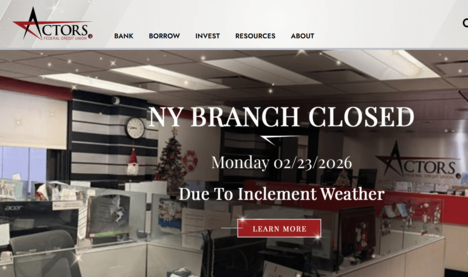
And in New York City—where heavy snowfall and high winds pushed officials toward aggressive travel restrictions—at least some credit unions narrowed service by geography. Actors Federal Credit Union posted that its New York branch would be closed Feb. 23 while phone support remained available and other out-of-state branches stayed open.
What members experience in these storms, however, is rarely just “the branch is closed.” As CUToday.info has often reported, it’s the member who can’t safely drive to work, but still needs to move money for a last-minute hotel, a generator, or a plumber. It’s the household watching a phone battery tick down—trying to conserve power while checking balances, waiting for an insurance adjuster, or rerouting a direct deposit.
Credit unions leaned into two themes across their alerts: keep service available remotely and reduce friction wherever possible.
Some institutions explicitly signaled operational continuity even with lobbies dark. APCI Federal Credit Union said its office would be closed Feb. 23 but staff would work remotely and phone services would remain available during normal hours. CrossPoint Federal Credit Union posted that while branches would be closed, its team would remain reachable by phone during the day—essentially shifting the “branch” to a call line when the roads weren’t safe.
Others tried to keep at least partial access open by adjusting hours instead of fully closing. APG Federal Credit Union posted a delayed opening—branches opening at noon—with its call center available earlier in the morning, a common compromise when conditions are expected to improve after daybreak.
Fraud Concerns Rise
And several used the moment to warn members about a predictable storm-side threat: fraud. CSE Credit Union—which announced it would be closed Feb. 23—paired the weather notice with a reminder about impersonation scams, emphasizing it would never ask for full card information by phone and warning about spoofed caller IDs.
CrossPoint FCU also posted a clear fraud warning, telling members it would never call to request account access codes. In other words: when the weather breaks routine, criminals often try to do the same—posing as “your credit union” when members are distracted and looking for quick answers.
The storm itself offered plenty of reasons for distraction. The Associated Press reported snow falling at rates up to three inches per hour in some areas, blizzard warnings, and power outages affecting more than 500,000 customers—conditions that stranded people at home and forced travel bans in parts of the region. The Washington Post described snowfall totals pushing toward two feet in places and widespread wind damage.