

CHICAGO—The first full-scale study of consumers about Apple Pay that was conducted after release of that revolution in payments offers some insights into what lies ahead, while one researcher observed there are now more questions than answers when it comes to new payments channels.
Conducted by Phoenix Marketing International in Salisbury, Md., its findings were released today in conjunction with BAI’s Reta
Source: Phoenix Marketing
il Delivery Show here.
According to Leon Majors, SVP with the research firm, there are seven key takeaways from the research, which is based on interviews with 4,000 households on all payments behavior, with one aim being to uncover how “Apple Pay could affect wallet positioning of credit cards.”
Those seven key takeaways:
- There has been massive exposure and high interest levels in iPhone 6 and Apple Pay (with 39% of consumer initially positive for iPhone 6; 43% initially positive about Apple Pay, and 36% positive toward the Apple Watch).
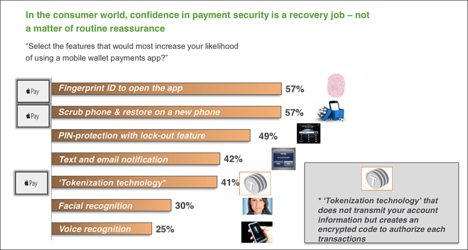
- The security and privacy message solves a problem for many consumers, in that the fingerprint ID and the data scrub feature are in addition to tokenization.
- Apple Pay’s “beachhead positioning” has left retailer rewards unaddressed. But delivery of issuer rewards is a “strong positive” for consumers, with 80% of card spend on rewards cards.
- In-store apps need to be able to deliver real-time data to the consumer.
- There remains a huge gap between installation and usage of apps (at nearly 50%).
- There are consumer hurdles to usage, including lingering NFC concerns for many, lack of awareness of locations accepting Apple Pay, customer service and technical support (which raises issues of issuer leadership, according to Majors), and transaction problems.
- The consumer’s need for choice and control is paramount and at risk.
Apple Makes First Chess Move
“We are getting the market perception from consumers of what this means to them,” said Majors. “What Apple has done is make the first move in a five-year chess match. What they had is the brand power and the money to make it pop. They switched the message from the traditional messages to being all about security. They’ve transformed security from a concern to a consumer end-benefit. They’ve made it about personal privacy over personalized retailer rewards. It’s working so far. What that gives them is a beachhead, a first-mover position in this space that others will have to react to.”
Majors expects that beachhead to move ashore.
“Apple can spend $1 billion a month on marketing without ever touching their principle. No one else can do that. Eighteen-million consumers listened to the press conference. Twenty-six million people went out and bought an iPhone 6. Sixteen-million people said as soon as their contract expires, they’re switching to Apple. If that works, that’s what Apple was after. What’s Android going to do to stop it? We have to wait and see.”
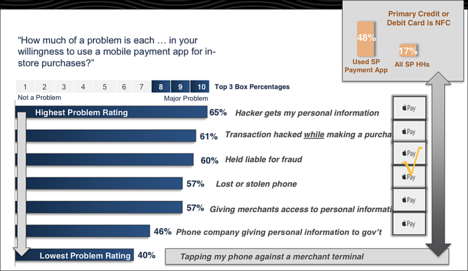
The research found that when consumers were asked “how much of a problem is each…in your willingness to use a mobile payment app for in-store purchases?,” 65% said “hacker gets my personal information” and 61% said “transaction hacked while making a purchase.” Seventy-eight percent of smartphone owners feel security breaches are accelerating, and 43% said they had had a credit or debit card compromised.
Sixty-five percent of households now report owning a smartphone, noted Majors, with an average of two phones owned per household. Moreover, 87% of Millennial households have a smartphone, iPad or tablet, and many have all three. But that doesn’t mean Apple Pay is going to build an insurmountable market position, said Majors, due in large part to costs of Apple devices.
“What they have is a limited product. There is no low-income product. There’s no Android crossover product. Others aren’t playing with Apple because, for instance, the number of 7-Eleven users who could possibly use Apple Pay is in the low single digits. Whole Foods is the perfect demographic for Apple Pay.”
Market Is Growing
But that isn’t to imply the market isn’t there and growing, said Majors. He pointed to research showing the use of smartphones for financial transactions continues to grow, led by Millennials (74% have used a smartphone to make a purchase in the last year) and Generation X (58%). But even 27% of Baby Boomers reported they also have used their phones to conduct a financial transaction. Phoenix Marketing estimates the user base for wallet payment apps is nine-million households.
There are numerous other big issues at work as the payments solutions market continues to shake out and evolve, said Majors.
First, there is the aforementioned lack of an Android solution. Phoenix’s most recent research found 43% of those with smartphones had an Android device, while 38% had an Apple device. Second, there is the “installation gap” created by consumers installing apps on their phones and never touching them again. With Apple Pay, it requires the user to have both iTunes and its Passport app. “Lots of people have Google accounts and have no idea they have Google accounts, and no idea they have a wallet. Verizon just puts in on (the phone).”
And then there is the merchant side of the payments ecosystem.
Source: Phoenix Marketing
“There are millions of merchants running on 20-year old technology and they don’t want to spend a dime to fix it,” he said.
Meanwhile, said Majors, its important for financial institutions to understand what it is that is driving Apple.
“Does Apple care what happens to the banks? No,” said Majors. “They care about the gap between Apple adoption and Android adoption. This is not about the banks; they need the banks, but it’s not about the banks.”
Apple Pay Shortcomings
For all the hype surrounding it, Majors noted Apple Pay has its shortcomings, including not providing any information on where Apple Pay is accepted. The answer: not many places at this point, with Majors noting that many reports of number of acceptance points have been inaccurate.
“It’s not 200,000 businesses, its 200,000 cash registers. There are 12 million cash registers in the U.S. That’s 1.8%. So they’ve got a bit to go,” he said.
Another shortcoming involves more players than just Apple. The survey found consumers like the idea of using smartphones in stores, including to receive specific offers. “People do want to use this, but the delivery system isn’t right yet. The Apple piece is right, but bank pieces, merchant pieces, are not done yet. So Apple Pay is a limited product.”
As CUToday.info previously reported, credit unions make up many of the more than 500 institutions that have raced to sign on with Apple Pay. But Majors is unsure what that will mean for many.
“I hear 500 banks are supporting Apple Pay. I believe 12 of them have really good reasons,” said Majors. He said each institution needs to review its card mix and that if the bulk of revenue is coming from debit cards, the institution should move slowly.
“Where are you now? If you’re top of wallet, you’re set. You’re going to be top of wallet in Apple Pay,” said Majors. “But let (Apple) start suggesting selling top of wallet, and it will change a lot of things.”
As for what’s ahead, Majors is projecting ongoing change.
“What this is going to boost is the competition,” he said. “Google has as many billions of dollars to spend on this as does Apple. And there are players who haven’t started up yet who are gong to play a role in this.”
Related links