

WASHINGTON–NCUA Chairman Kyle Hauptman announced Monday that NCUA will no longer publish overdraft and non-sufficient fund fee income for individual credit unions.
The NCUA will collect the data during supervisory examinations, Hauptman said.
Hauptman made the announcement during a chat with ACU President and CEO Jim Nussle at the 2025 Governmental Affairs Conference.
Hauptman, in a statement, called the original decision “well intentioned,” but recognized the move had some unintended effects on CUs.
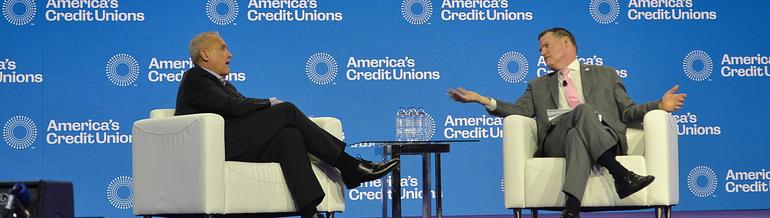
Jim Nussle (L) with Kyle Hauptman.
“There is a well-intentioned movement aimed at protecting consumers from excessive fees, which is something we all support,” Hauptman said. “However, we must also consider the unintended consequences of such policies. In this instance, the previous data collection policy incentivized credit unions to avoid serving the needs of low-income and underserved communities. These fees can be the best option in a bad situation, saving money and protecting individuals’ credit scores. Overdraft also protects people from much higher costs imposed by their local governments.”
As CUToday.info has extensively reported, the CFPB zeroing on overdraft fees has caused a shakeup in the overdraft market, dropping prices often to zero, and forcing many financial institutions, including credit unions, to consider the viability of offering the service to their members. Too, publishing of the OD data has drawn fire from consumer groups that have led to a great deal of negative media coverage for credit unions, particularly on the West Coast.
Under the previous data collection policy, the NCUA required federally insured credit unions with more than $1 billion in assets to disclose, separately, income from overdraft and non-sufficient funds fees. This data was available to the public on an individual basis and in the aggregate. Under the new policy, which goes into effect with the March 31, 2025, Call Report cycle, the NCUA will collect overdraft and NSF fee data as part of the examination process. The agency will continue to publish overdraft and NSF fee income data in the aggregate once updates to its examination system are complete, the agency said.
“Our regulatory framework should protect consumers from predatory practices without depriving them of the financial tools they need to navigate their lives,” Hauptman said. “The appropriateness of overdrafts and NSF fees charged is a matter between a credit union and its member-owners who ultimately determine how their credit union is run.”
A Mistake, Says One OD Expert
Michael Moebs, economist and chair of Moebs $ervices, called Monday's decision by NCUA a mistake, adding NCUA's previous OD data publishing policy was "badly done."
“The U.S. is built on free markets. Free markets mean free information too," Moebs said. "How this OD reporting was initially done last year was a bad move. The information should not have been limited to only credit unions with assets of more than $1 billion. It should have gone to all credit unions. If the reason to withdraw the OD reporting/publishing requirement is the data made a few CUs look bad, then this again is not a free market. Credit unions have collected substantially more overdraft revenue on a relative percentage basis than banks for decades. CUs have helped members who were short of funds to cover errors by the consumer to unexpected bills such as medical expenses. The problem is not reporting, the problem is the price charged. Moebs $ervices has advocated for OD prices substantially below $20 a transaction for over 40 years. Finally banks report OD info, so why should CUs be excused?”
Hauptman told Nussle Monday that he can relate to the problems faced by Americans who live paycheck to paycheck, and would not want the agency to impact the delivery of a needed service to its members.
"I remember when I made 27 grand a year. I had student loans and I had bills. I was very aware of when my utilities might get cut off or a boot put on my car," he said.
De Novo CUs
Separately, Hauptman Monday addressed de novo CUs.
Hauptman discussed what he called “true financial inclusion,” which he said means removing barriers to de novo credit unions and removing the ‘pain points’ that have led to fewer small credit unions.
“The NCUA must ensure our regulatory burden is not a factor in a credit union’s decision to merge away,” he said. “Once those credit unions are gone, rarely does anyone come to fill their place. Relieving the regulatory burden on credit unions, especially the small and newly formed ones posing relatively low risk to the Share Insurance Fund, is vital to keeping these credit unions thriving now and in the future.”