

BOSTON–In a call center in which most of the telemarketers consistently heard “click” from the other end of the phone before they ever made their pitch, one man was constantly ringing the bell indicating he had closed another deal. What was his secret? It had nothing to do with the script the telemarketers had been given.
That was one of the stories shared here by LaQuita Cleare who shared with a credit union audience here—fittingly enough—why they should rethink just about everything they do in terms of storytelling.
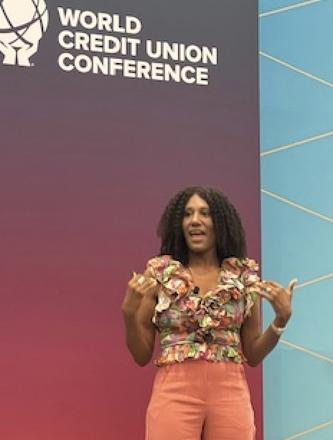
LaQuita Cleare
Cleare, a speaker and consultant, spoke to the Global Women’s Leadership Network/WYCUP Forum here ahead of the World Council of Credit Unions’ World CU Conference with remarks themed, “The Power of Storytelling to Help Create Real Change.”
As noted, Cleare shared a story from her very first job working as a telemarketer in that call center. She said she was excited about the job and “thought I was going to be rich.” What she discovered, not surprisingly, is no one wanted to hear her pitch and what she mostly heard was “click.”
Strategy Rings a Bell
Sitting across from her was an older gentleman. In that call center workers rang a bell every time they had a successful sale, and that gentleman was always ringing the bell. So, said Cleare, after noticing he spent his shifts standing and walking around, she decided to eavesdrop on him and noticed that while everyone else was dutifully following their scripts, he did not. Instead, he told stories about his day, where the money they were raising would go, and more.
That’s when she realized that maybe “everything we do is not about delivering information and it is instead about stories.”
A Second Lesson
The second lesson came from Hollywood.
Cleare said she left her Chicago home for California even though she had never been there, and had no friends or family or job in the state. Nevertheless, she said she threw herself into the world of Hollywood and learning how to tell stories.
“But the biggest lesson is it wasn’t about stories in Hollywood, it was about how the stories make you feel,” Cleare told the meeting. “I realized that not only was the impact about connecting and feeling something, the impact was also leading to dollars, leading people to take action.” According to Cleare, that’s a lesson that is “desperately needed” in a world of “transactional communications.”
The Engagement Code
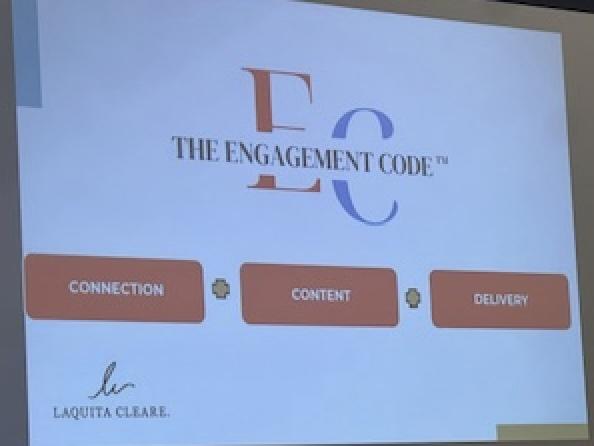
Cleare said she returned to school to get a master’s degree in psychology and then combined that knowledge with her experience in Hollywood to create what she calls the “Engagement Code.”
The Engagement Code, said Cleare, is about three things:
- Connection. “You have to have it in this order for it to work. If you have connections, what does that really mean? You may have an agenda for a meeting, but what is more amazing is building the connection first, building that common ground. Those are the things that stories allow us to do.”
- Content. Content should be clear, concise and compelling.
- Compelling. And to make it compelling, Cleare said anecdotes and stories are most effective.
Creating Stickiness
“Why do we use stories? People talk about stories a lot, but we don’t always think about why we use stories,” said Cleare, noting stories create “stickiness.”
From a scientific standpoint, Cleare says telling stories uses the same part of the brain as that used to listen to stories.
“It’s about using the experiences and turning them into our own experiences. We call that mirroring,” said Cleare. “It’s the neural coupling happening in your brain. It’s about emotions. We don’t make logical decisions, we make decisions based off emotions. And we do that by using and telling stories.”
Not all stories are created equal, however, said Cleare, explaining there are certain types of stories and qualities that can be used in stories to create better connections.
The Six C’s
To that end, Cleare advised incorporating the six C’s:
- Circumstance. This is the basis for the story.
- Characters. “If you are telling a story to a member and that member can see themselves in the characters in the story, then that story is going to be more impactful,” she said.
- Conflict. “Do stories exist without conflict?” Cleare asked. “It’s an absolute no. In trying to solve a problem for a member, you tell them a story about how you solved the problem for another member. That conflict you set up is key.”
- Curiosity. “The curiosity you have in that story is the moment when you don’t know what’s going to come next. You offer products A and B. What will they choose?”
- Change. “We keep watching and listening to see what change occurs.”
- Conclusion. “If you have all six C’s chances are your story is powerful and is going to connect,” said Cleare.
How to Use on a Daily Basis
Cleare noted every organization has an origin story, which she said is “crucial.”
But there’s a related issue that’s also crucial, she added.
“Credibility without relatability can be very problematic. It’s nice you have 25 years’ experience, but if you’re not relatable and don’t know what I’m going through, it doesn’t matter,” Cleare said.
For that reason, Cleare urged credit union leaders to think about their own personal stories and how they can be shared in day-to-day leadership.
“Are there stories you can share to get buy in? Are there stories you can share with members about why you are in this space?” asked Cleare.
Defining Moments
Cleare also urged CU leaders to think of a moment that can be used with your teams, with members, with boards, that is no more than two minutes long and then to highlight it. For those concerned about over-sharing, Cleare added that not every story should share the same level of vulnerability, but it needs to be appropriate to the audience to create that connection.
“We think we are going to connect by asking the other person questions, but how can you expect me to open up if you don’t?” asked Cleare. “How can I trust you if I don’t feel like you’re trusting me with information.”