

By Ray Birch
ALEXANDRIA, Va.—The NCUA board on Thursday outlined progress under President Donald Trump’s right-sizing order, saying credit unions should see a lower bill from the regulator as a result of the agency’s efficiency drive.
During NCUA’s open board meeting Thursday, Chairman Kyle Hauptman—who held the meeting as the sole board member—directly addressed how they agency has been managing its way through its downsizing, including what credit unions can expect.
“The pot of money that we're going to save…a big chunk of that right off the top goes straight back to credit unions,” said Hauptman.
Hauptman said the agency, however, will need to retain some of those savings when the Trump hiring freeze is eventually lifted, and due to inflation. Hauptman pointed to the government hiring freeze that was lifted in 2018, stating if the current Administration follows a similar path, next year the hiring freeze could be lifted in June.
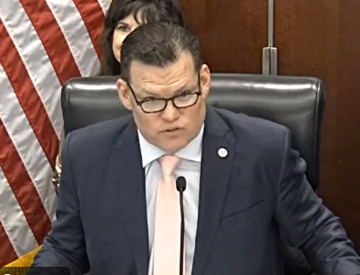
Kyle Hauptman
Hauptman pointed out NCUA will need to keep some of the savings to cover hiring new staff. He said that while bills to credit unions are always impacted by a credit union’s growth, “The bill is going to be noticeably lower…Money is coming your way. All this effort we're doing to land this plane safely is going to result in what it's supposed to—a noticeable decrease in your bill.”
Acting CFO Melissa Lowden addressed how NCUA is progressing against its current budget.
Two Big Changes
She pointed out two “significant changes” aligned with the new Administration's policies impacted the agency’s budget this year—the Voluntary Separation Program for NCUA employees and the reduction in planned contracts funding.
Lowden noted the Separation Program cost the agency $13.6 million more than it had budgeted for employee compensation in 2025.
“These separation costs can be partially offset by compensation amounts budgeted for vacant positions that have not been filled in 2025,” she explained. “The NCUA's offices also identified $15.7 million in lower priority services and reduced their contract services budget by that amount through August. We're on track to maintain this lower level of non-payroll spending, part of which will be used to pay for the costs of those employees enrolled in the Voluntary Separation Program. In addition, we project modest surpluses for the 2025 travel budgets due to the agency’s reduced staffing.”
Hauptman stated the draft 2026-27 staff budget will likely be released next week. Hauptman added a public budget hearing will be scheduled, with a date yet to be determined.
Hauptman also shared there will be no October board meeting. Fired board members Todd Harper and Tanya Otsuka have been barred from returning to the NCUA board while their appeal is pending.
Single Board Member
Hauptman acknowledged that he remains the board’s lone member, noting there have been similar instances in the past. He also noted the board could someday be made up of "zero" members.
“You may notice that I continue to be the sole person sitting at the board table today. As I said before, no matter what the board looks like, the NCUA will continue to fulfill its core mission, as well as seek ways to improve our effectiveness and efficiency,” Hauptman said. “I also want to correct something I said earlier this year, which is that 2001 was the last time NCUA had a board meeting with just one board member. That did happen in 2001, but in the interest of accuracy, I stand corrected, since I was alerted that 2005 seems to be when NCUA last had a one-person board meeting. Looking at our records, it was almost exactly 20 years ago when the then-single-board-member and Chairman Joann Johnson ran a meeting like this. For what it’s worth, that meeting entailed Chair Johnson approving Final Rule, Part 713, related to Fidelity Bond and Insurance Coverage for Credit Unions. The rule remains on the books to this day.
“The main thing is that NCUA insurance is as sound as ever. NCUA will continue to do business as usual, just as we did under the sole board member Chairmanships of Dennis Dollar and Joann Johnson,” continued Hauptman. “And of course at some point in the future, there won’t be one board member. There may be zero or two or three, but regardless my mission and that of my colleagues is doing our jobs the best we can on behalf of America’s 140 million credit union members.”
As CUToday.info has extensively reported, the Trump Administration has addressed combining federal regulators.
Town Hall Results
Hauptman turned to the results of the agency’s first-ever Strategic Plan Town Hall, held last week.
“The virtual event included representatives from credit unions, CUSOs, trades, and leagues,” he explained. “NCUA staff asked questions related to challenges communities face and how NCUA can best support the safety and soundness of the credit union system while simultaneously encouraging innovation and growth. We received a lot of feedback on what’s working and not working, what the community would like to see regarding deregulation, and what issues they foresee for the future of the credit union system. Even after the town hall we continued to receive feedback through AskNCUA. Thank you to all those who participated.”
Hauptman emphasized a key point credit unions shared during the Town Hall and afterward.
“One thing that is clear following the feedback process is the outsized burden that obsolete, duplicative, and overly pre- or proscriptive regulations can have on credit unions,” he said. “And in 2025, we’re down over 20% of our workforce. So, we at the NCUA have an operational imperative to right-size everything we do. The current President started the most far-reaching regulatory reform in American history. NCUA is proud to be part of this reform effort, and staff are currently reviewing our regulations to identify burdens that can be lifted.”
Share Insurance Update
During the meeting the board received its quarterly share insurance update. Lowden reported $82.0 million in net income during the second quarter of 2025 and $23.2 billion in total assets as of June 30, 2025. Lowden noted the equity ratio was 1.28% as of June 30, 2025, which represents a decrease of 2 basis points from December 31, 2024. The semi-annual decline was attributed to the growth of insured shares, which increased by 2.9%. Lowden also shared that the Share Insurance Fund could withstand a loss of $1.4 billion without dropping below the 1.20% equity ratio threshold.