IRVINE, Calif.–It’s becoming more difficult for Americans in a number of markets to afford to purchase a home.
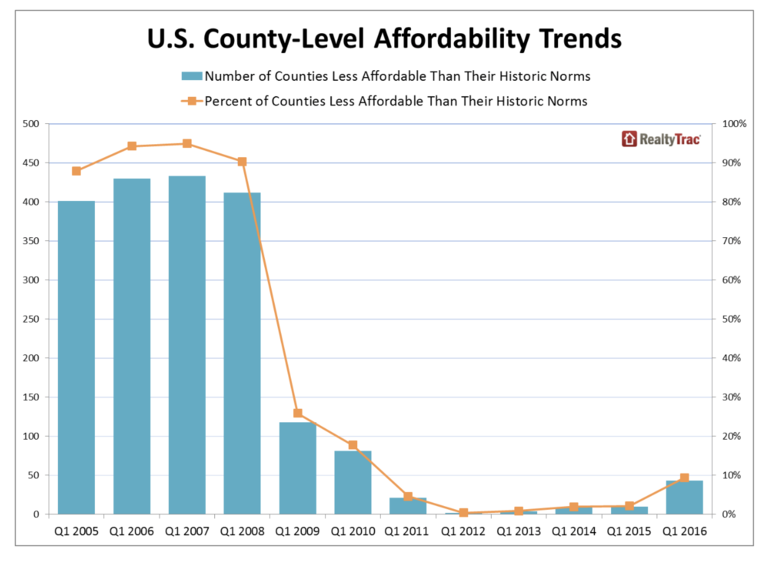
RealtyTrac’s just released Q1 2016 Home Affordability Index found that during the first quarter 9% of U.S. county housing markets were less affordable than their historically normal levels, up from 2% of markets that exceeded historic home affordability levels a year ago.
The report analyzed median home prices derived from publicly recorded sales deed data collected by RealtyTrac and average wage data from the U.S. Bureau of Labor Statistics in 456 U.S. counties with a combined population of 221 million. The affordability index was based on the percentage of average wages needed to make monthly house payments on a median-priced home with a 30-year fixed rate and a 3% down payment, including property taxes and insurance, according to RealtyTrac.
Out of the 456 counties analyzed in the report, 43 counties (9%) had an affordability index below 100 in the first quarter of 2016, meaning buying a home was less affordable than the historically normal level for that county going back to the first quarter of 2005. That was up from 10 counties (2% of the 456 counties analyzed) exceeding historically normal home affordability levels in the first quarter of 2015, RealtyTrac said.
RealtyTrac reported that at the peak of the housing bubble in Q2 2006, 454 of the 456 counties analyzed (more than 99%) were less affordable than their historic norms. In Q1 2012, when median home prices bottomed out nationally, only two counties out of the 456 analyzed (less than one-half percent) exceeded their historically normal affordability levels.
“While the vast majority of housing markets are still affordable by their own historic standards, home prices are floating out of reach for average wage earners in a growing number of U.S. housing markets,” said Daren Blomquist, senior vice president at RealtyTrac, in a statement. “The recent drop in interest rates has helped to soften the blow of high-flying price appreciation in some markets, but the affordability equation could change quickly if interest rates trend higher and home prices continue to rise faster than wages.”
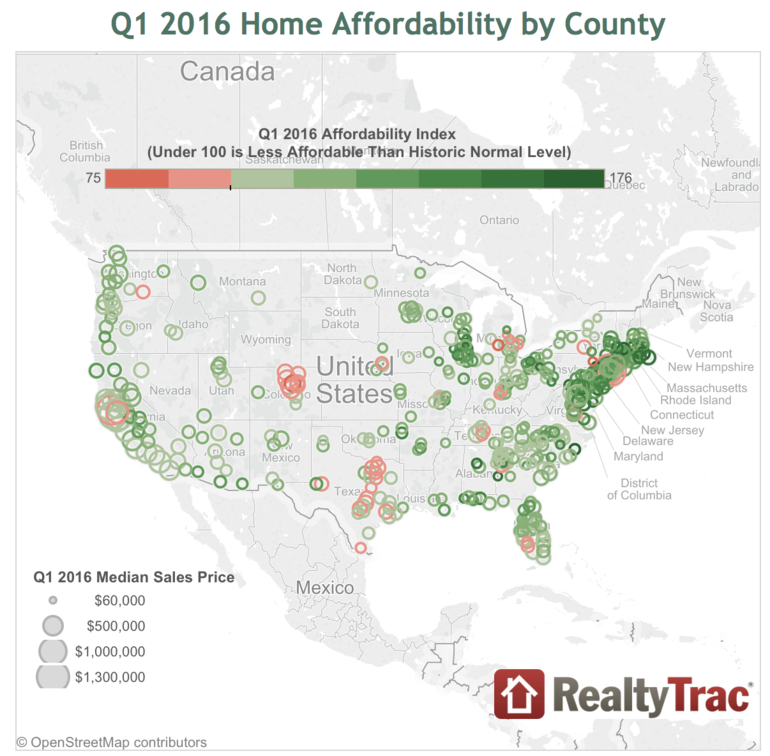
According to RealtyTrac, the top 20 county housing markets least affordable in the first quarter of 2016 compared to their historic affordability norms included counties in Denver; New York City; Omaha, Neb.; Austin, Texas; Dallas; San Francisco; and St. Louis.
The five most-populated county housing markets less affordable than their historic norms were Kings County, New York (Brooklyn); Dallas County, Texas; New York County, New York (Manhattan); Alameda County, California in the San Francisco metro area; and Oakland County, Michigan in the Detroit metro area.
The top 20 county housing markets most affordable in the first quarter of 2016 compared to their historic affordability norms included counties in Boston; Baltimore; Birmingham, Alabama; Providence, Rhode Island; and Chicago.
The five most-populated county housing markets still more affordable than their historic norms were Los Angeles County, California; Cook County, Illinois (Chicago); Harris County, Texas (Houston); Maricopa County, Arizona (Phoenix); and San Diego County, California (San Diego).
Nationwide in the first quarter of 2016, the average wage earner needed to spend 30.2% of monthly wages to make monthly mortgage payments (including property taxes and insurance) on a median-priced home ($199,000), up from 26.4% of average wages needed to buy a median-priced home in the first quarter of 2015, according to RealtyTrac.
The top five least affordable counties based on percentage of average wages to buy a median priced home were Kings County, New York (Brooklyn) at 120.4%; Marin County, California in the San Francisco metro area at 109.2%; Santa Cruz County, California in the Santa Cruz metro area at 106.9%; New York County, New York (Manhattan) at 105.1%; and San Francisco County, California at 95.3%.
The top five most affordable counties based on percentage of average wages to buy a median priced home were Wayne County, Michigan (Detroit) at 8.5%; Baltimore County, Maryland at 9.2%; Clayton County, Georgia in the Atlanta metro area at 10.1%; Bay County, Michigan in the Bay City metro area at 11.5%; and Rock Island County, Illinois in the Davenport-Moline-Rock Island metro area at 12.3%.