

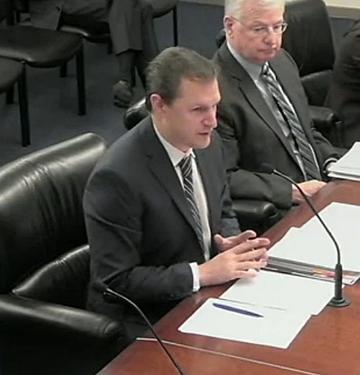
Larry Fazio
ALEXANDRIA, Va.—At NCUA’s board meeting Thursday, the agency shared insights into how state member business lending rules will be addressed via the new rule.
The agency unanimously approved a final MBL rule Thursday during its open board meeting. Portions of the new rule will go into effect in 60 days, but the bulk of the proposal will not be in place until much later.
“Like the current rule, our final rule contains a provision for FISCUs in a state to be exempt from Part 723 if the state adopts an MBL rule that NCUA determines faithfully covers the Federal Credit Union Act requirements and the necessary safety and soundness standards for all insured institutions,” explained NCUA Director of Examination and Insurance Larry Fazio. “In the regulation we want to be clear what NCUA bases its standard on for determining whether a state rule will supersede NCUA’s rule.”
Fazio reminded that the agency cannot “abdicate” its responsibility to enforce the Federal Credit Union Act or to safeguard the NCUSIF.
“Like any insurer, NCUA must determine the minimum acceptable insurability standards,” Fazio told the board. “The final rule reflects NCUA’s faithful application of the statutory MBL cap applicable to all federally insured credit unions, which is contained in section 723.8. The final rule also contains the core risk management principles, or minimum safety and soundness provisions, NCUA as insurer has determined are necessary to safeguard the insurance fund with respect to business lending conducted by insured credit unions.”
Governance Structure
Fazio said those principles are contained in sections 723.1 through 723.7.
“Essentially they specify which credit unions and types of loans the rule covers, the necessary governance structure, including policies and expertise, needed for a credit union involved in business lending, criteria specific to construction and development lending, and prohibited activities to address conflicts of interest,” said Fazio. “These fundamental risk management principles have been extensively vetted with stakeholders through a transparent and deliberate process involving public input.”
Fazio noted that because in NCUA’s view as the insurer, the principles are fundamental to “faithfully applying the Act and safeguarding the share insurance fund,” they are the basis upon which NCUA would determine whether or not to allow a state MBL rule to supersede NCUA’s rule.
Fazio emphasized that first, NCUA’s focus in making this determination will be on whether the state rule sufficiently covers what is fundamental to managing the risk of business lending, as well as the faithful application of the Act.
“NCUA is open to variations in approach to how to ensure the risk of business lending in credit unions is well managed,” said Fazio. “The proposed state rule does not need to be identical, or even largely similar, to Part 723. States can take different approaches to controlling the risk which NCUA could conclude meets our needs as insurer – but at its core there can be no gaps in the state rule related to the fundamental risk management principles reflected in Part 723.
“Second, NCUA is not approving the entire state rule under this approach,” continued Fazio. “The state’s rule could be broader in scope, more prescriptive, and even much more rigorous in its requirements. That is the right of the states to do for the institutions they regulate, and this rule respects that. NCUA’s review will merely focus on whether the rule at a minimum sufficiently addresses the risks to the share insurance fund and faithfully implements the statutory MBL cap.”
Novel Approach
Fazio noted that some people might ask whether a state regulator could come up with a novel approach to prudently regulating the risk in credit union business lending, and could that approach somehow vary so significantly from Part 723 so as to appear to not need to cover one or more of the core risk management principles in NCUA’s rule.
“My first observation is that this fact pattern suggests the state rule likely does cover the core risk management principles in Part 723, but varies in the exact construction and details so as only to appear not to do so,” said Fazio. “In this case, the NCUA board could conclude it in effect covers all the provisions of Part 723 and was no less restrictive.”
However, if a state regulator finds an especially innovative approach that does not cover the core risk management principles in Part 723, but still sufficiently protects the NCUSIF, Fazio said he would suggest that the NCUA board may propose such a change for all insured credit unions to take advantage of with full notice and comment.
“This would ensure no unwarranted competitive inequalities between federal credit unions and FISCUs in other states resulting from an action of the NCUA board in allowing FISCUs in a particular state to operate on fundamentally different rules intended to safeguard the insurance fund,” concluded Fazio.