

MADISON, Wis.–Credit union loan growth has slowed significantly in 2024 and will likely remain slow through 2025, although there is a potential lending growth opportunity as banks tighten underwriting standards, according to TruStage’s June Trends Report, which is based on data through April.
In addition, first mortgages now make up 82% of all credit union loan balances, down from 85% last April, but the high proportion of fixed rate debt raises concerns for interest rate risk, according to the report, which is predicting a surge in mergers during 2024-2027.
Here’s a look at how credit unions performed by category, according to the Trends Report.
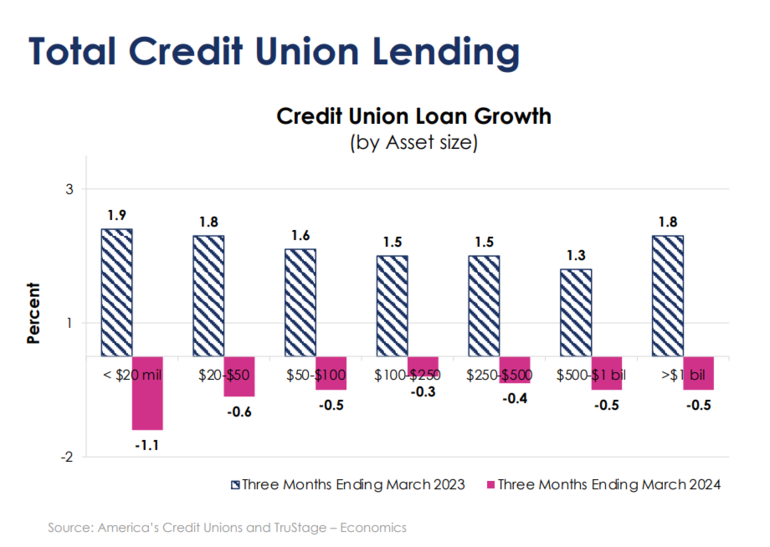
Total Credit Union Lending
Credit union loan balances rose 0.4% in April, a little more than half the 0.7% pace reported in April 2023, and 4.5% during the last 12 months, according to the Trends Report, which notes that April is historically the beginning of the credit creation season with seasonal factors typically adding 0.2 percentage points to the underlying trend loan growth rate.
The Trends Report data show that during the first four months of 2024, loan balances rose 0.2%, significantly below the 10-year average growth rate of 2.4%. Home equity loan balances grew $2.9 billion (3.1%) in April which constituted half of all loan balance growth and increased 24% during the last year.
“Credit union loan growth has slowed significantly in 2024,” noted TruStage Chief Economist Steve Rick, the author of the monthly Trends Report. “Credit union total loan balances fell 0.14% in the first quarter of 2024, significantly below the 1.6% rise in the first quarter of 2023. Credit unions with assets exceeding $1 billion reported loan balances falling 0.5% compared to a 1.8% jump in 2023, while credit unions with asset less than $20 million reported loan balances falling of 1.1%, versus a 1.9% gain last year.”
What to Expect
Rick said credit unions should expect loan balances to rise only 4% in 2024, and 5% in 2025, which will be below the long run average rate of 7.2%.
“Loan growth will be weak due to higher lending interest rates reducing the demand for credit and tight liquidity reducing the supply,” the Trends Report states. “The slowdown in both credit union and bank lending is one of the ‘long and variable lags of tight monetary policy’ that Federal Reserve Chairman Jerome Powell likes to mention at his press conferences to reduce the inflation rate. If inflation is caused by too many dollars chasing too few goods, then less lending will reduce dollars and therefore inflation.”
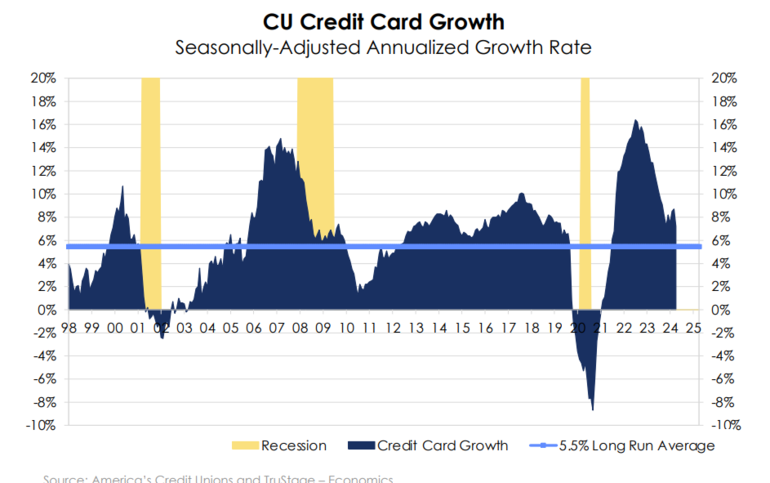
Consumer Installment Credit
Credit union credit card loan balances rose 0.4% in April, a slowdown compared to the 1.3% increase reported in April 2023, according to the Trends Report.
On a seasonally-adjusted annual rate, credit card balances rose 7.2%, above the long run average of 5.5% but slower than the 12.7% pace reported in April 2023. The post pandemic spurge on travel and leisure appears to be ebbing and we can expect credit card loan growth to slow to the long run trend rate over the second half of 2024, the Trends Report states.
The report further notes that:
- Total consumer credit by all lenders in the U.S. rose by 0.2% ($8 billion) in April and 1.5% at an annualized rate.
- Revolving credit rose 0.3% ($3.3 billion).
- Nonrevolving credit (auto and student debt) rose 0.1% ($4.7 billion).
- Total consumer loan balances rose 2.0% over the last 12 months, below the 6% average reported over the last decade.
‘Downward Trend, But Potential Opportunity’
“Growth in the stock of consumer credit is firmly on a downward trend as higher interest rates and tighter lending standards crimp borrowing,” the Trends Report states. “On the credit demand side, higher interest rates will make it more expensive to finance purchases, resulting in weakened demand for loans. With inflation in retreat, the Federal Reserve is expected to start lowering interest rates in the fourth quarter of 2024, providing some relief for borrowers.”
The report further points out that on the credit supply side, 25% of all banks planned to tighten lending standards in the second quarter, according to the Senior Loan Officer Opinion Survey.
“This will slow the pace of bank lending, opening a window of opportunity for credit unions to pick up market share,” Rick stated.
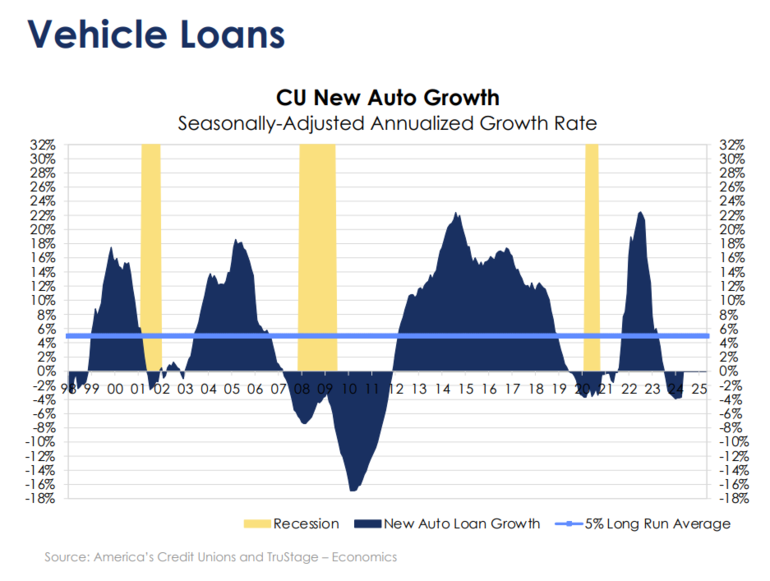
Vehicle Loans
Credit union new-auto loan balances fell 0.5% in April, a big decrease compared to the 0.1% decline reported in April 2023, according to the Trends Report.
The analysis shows that on a seasonally-adjusted annual rate new-auto loan balances fell 3.7% in April significantly below the normal 7% pace. New-auto loan balances fell 3.5% year to date, less than the 1.1% increase reported during the first four months of 2023.
“Looking forward, the month of May is historically the beginning of the new-auto lending season, so we expect credit union new-auto lending to accelerate through October,” the Trends Report forecasts.
Through the Windshield
When it comes to the auto market, the Trends Report noted:
- New vehicle sales rose in April to a 15.8 million seasonally-adjusted annualized sales rate – up 2% from March, and 0.7% above the pace set in April 2023. “Despite high lending interest rates, consumer demand for new vehicles has remained robust driving the uptick in sales. Moreover, the improvement in sales was due to more vehicles available to buy. Inventories of vehicles as measured by the days’ supply of new-vehicle inventories were up 70% from last year.”
- Auto production increased 3% compared to April 2019, before the COVID-19 Pandemic. “This indicates that U.S. auto production has not only recuperated from the pandemic’s impact but is also advancing. Currently, inventory levels exceed monthly vehicle sales, contributing to a downtrend trend in average vehicle transaction prices. Additionally, dealerships are ramping up vehicle incentives to entice customers to make new vehicle purchases. As inventory levels continue to rise, dealerships are expected to increase discounts, further reducing transaction prices.”
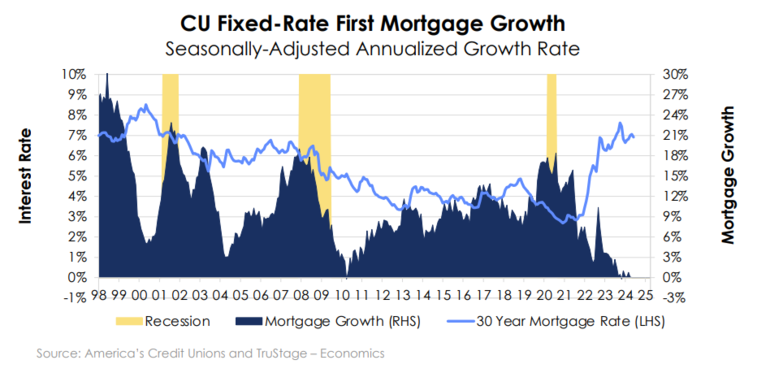
Real Estate Information
Credit union fixed-rate first mortgage loan balances rose 0.3% in April, above 0.0% reported in April 2023.
The Trends Report found credit union fixed-rate first mortgage loan balances rose 0.1% at a seasonally-adjusted annual rate in April, the second slowest pace in modern history. Adjustable-rate first mortgage balances fell 0.7% in April, above the 1.2% drop reported in April 2023.
“Fixed-rate first mortgages now make up 82% of all credit union first mortgage loan balances, down from 85% last April which was the highest in credit union history,” the Trends Report states. “This high proportion of fixed rate debt raises concerns for interest rate risk as market interest rates rise.”
Savings & Assets
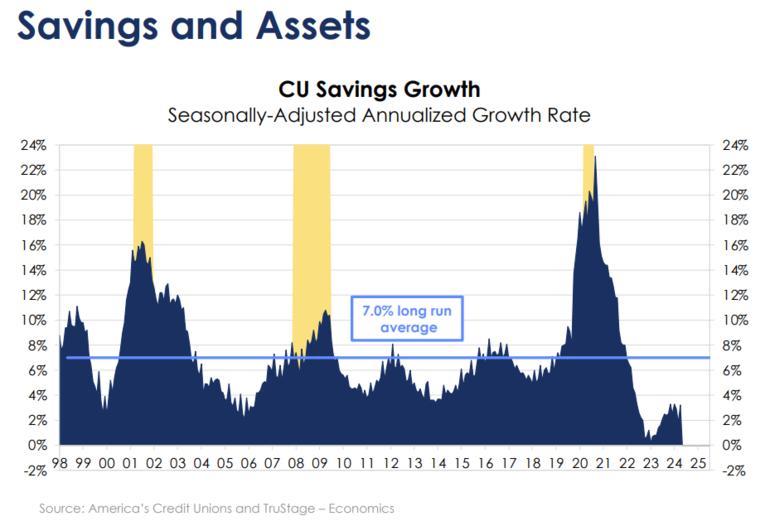
The new data show credit union savings balances fell 0.6% in April, better than the 0.7% reported in April 2023, but worse than the long run average decline of 0.5%.
“April is typically one of the weakest months for savings growth as members use deposits to pay tax liabilities. Savings balances rose at a 3.2% seasonally adjusted annual rate in April, significantly below the 7% long run average,” Rick wrote. “Credit unions still face a tight liquidity environment when it comes to savings deposits. The total household savings market fell 0.8% over the last year, from $14.389 trillion to $14.267 trillion today, significantly below the 6.5% average annual savings growth rate. Household savings is defined as the sum of checkable deposits, savings accounts, money market deposit accounts, small time deposits, money market mutual funds and savings bonds.”
‘Fortunate’ Development
Fortunately, the Trends Report adds, “credit unions are getting a bigger piece of a shrinking pie. Credit unions now hold 13.8% of the total household savings market, the highest in credit union history and up from 13.3% one year ago, 9.6% twenty years ago and 4.6% forty years ago. Banks currently hold 65.7% of total household savings, down from 71.3% one year ago.”
The report further notes that savings growth for the first four months of the year came in at 2.3%, above the 1.4% set last year but below the 4.1% average pace set during the last 20 years.
“Expect savings balances growth to slowly rise this year as consumers return to a more normal pace of spending and saving following the atypical spending/savings patterns experienced during the COVID-19 pandemic and aftermath,” the report forecasts.
Equity and Other Key Measures
According to the Trends Report, credit union return-on-asset ratios averaged 0.63% in the first quarter of 2024, 17 basis points lower than the 80 basis points reported in the first quarter of 2023, due to rising provision for loan losses (15 bps) and higher operating expense ratios (five bps) offsetting higher other income (five bps).
“Credit union operating expenses rose almost 6% during the last year, faster than asset growth of only 4.2%,” the report states. “This pushed the operating expense ratio to 2.96% in the first quarter of 2024, up from 2.91% in the first quarter of 2023. During the last four years, the price level rose 22.4%. As credit union vendor contracts renew much of this cost increase in showing up in new vendor pricing.”
Additional Findings
The report shows net interest margins declined one basis point as asset costs rose from 1.05% in the first quarter of 2023, to 1.84% this year. Meanwhile asset yields rose from 4.06% to 4.84%. “The net interest margin ratio measures the profitability of financial intermediation, i.e., taking in deposits and originating loans.”
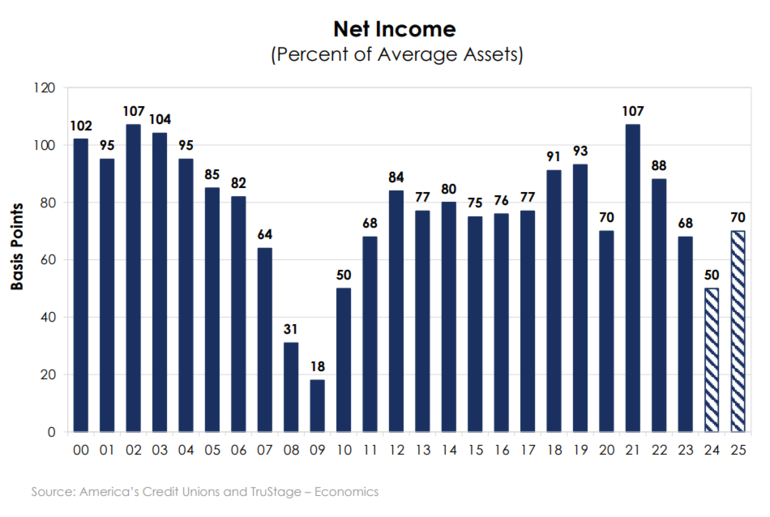
“For the full year we now expect credit union net income as a percent of average assets to fall to 0.50% in 2024, from 0.68% in 2023 and then rise to 0.70% in 2025,” the report states. “Earnings will be under pressure this year due to credit unions experiencing higher operating expense ratios from rising wages and inflation, rising provision for loan losses, and rising cost of funds.”
Credit Unions & Members
As of April 2024, America’s Credit Unions estimated 4,719 credit unions were in operation, 17 fewer than in March, according to the report, which notes that during the first four months of 2024, approximately 77 credit unions ceased to exist because of mergers, purchase and assumptions or liquidation.
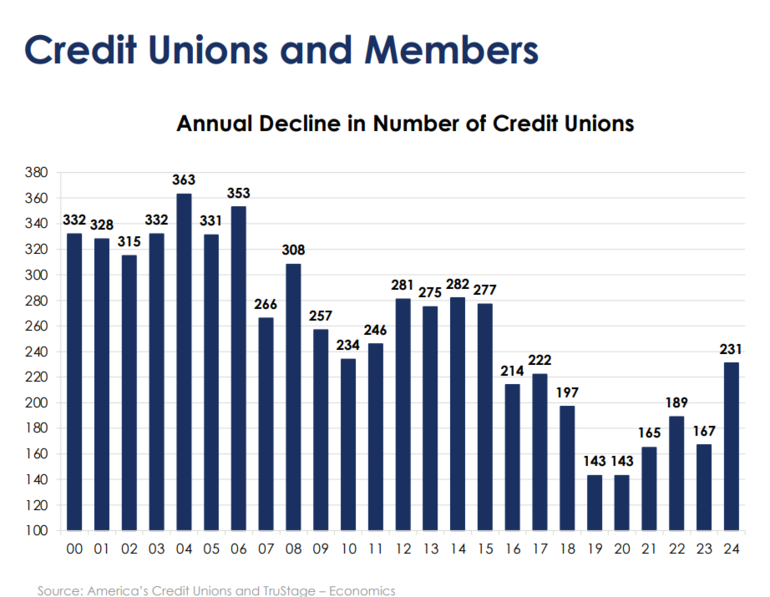
“This rate is above the 51-credit-union decline reported during a similar time period in 2023,” the report states. “In 2023, the number of credit unions declined by 167 (with 80 occurring during the first half and 87 taking place in the second half of the year. The second half of a year will typically experience 53% of all credit union mergers.
‘Surge’ in Mergers
“Expect the pace of credit union consolidation to accelerate in 2024, and 2025, due to some credit union managers focusing on possible merger opportunities as high interest rates reduce credit union deposits, equity levels and net interest margins,” the report continues. “We expect the number of credit unions to decline by 231 in 2024, the fastest pace since 2015. This acceleration in the pace of consolidation is what happened in the wake of the global financial crisis in 2009-2011 when the number of mergers actually dipped in 2010, and 2011, but surged in the four years following the crisis.
“With high short-term interest rates stressing some credit unions to the point of considering a merger, expect a surge in mergers during 2024-2027 as smaller credit unions with limited asset growth, capital growth and digital capabilities will look for merger partners to increase the products and services offered to their members,” the report states.