

FORT LAUDERDALE, Fla. – Providing services to marijuana-related services and and human trafficking were two top issues of discussion during the second day of the NASCUS/CUNA Bank Secrecy Act (BSA) Conference here.
Timea Nagy, a victim of human trafficking herself in the sex slave trade, called credit union BSA officers “superheroes” because they have the power to curb human trafficking by reporting suspicious financial dealings to law enforcement.
“It's all about greed,” Nagy said of the human traffickers. “But you have the money, you can control it – and that really pisses off (the traffickers).”
Nagy urged credit unions and other financial institutions to be on the lookout for signs of human trafficking activities, which include lifestyle, who the account holder is, the type of businesses involved in transactions, the type of transactions involved, where the money is going, and who is ultimately profiting.
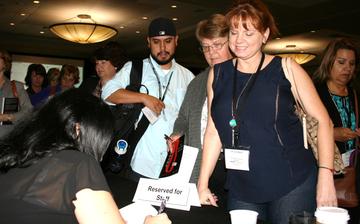
BSA Conference participants line up to have books signed by Timera Nagy (left foreground) following Nagy’s presentation to the NASCUS/CUNA BSA Conference.
“Human trafficking is engaged in all kinds of businesses,” Nagy said, noting there is no particular concentration of industry or trade.
She said those businesses could be as diverse as modeling agencies, travel agencies, employment agencies, au pair babysitting businesses and more. “No one thing tells you human trafficking is going on,” she said, adding that the indicator is a collection of patterns that indicate a trend.
Brendan Brothers of Verafin, a financial information security firm, that sponsored Nagy’s appearance, urged BSA officers to follow up with law enforcement when they file a suspicious activity report (SAR) that they believe involves human trafficking. “You are the first line of defense; you have the money, you have the control,” he said.
Earlier in the day, Braddock Stevenson of the Financial Crimes Enforcement Network (FinCEN) discussed his agency’s anti-money laundering efforts, but touched off a discussion with the audience when he broached the issue of how credit unions and other financials may offer banking services to marijuana businesses.
Stevenson told the group they should follow the Justice Department’s “Cole Memo,” and also consider factors such as particular business’ objectives, evaluation risks as well as the credit union’s ability to manage the risks, and understand the type of marijuana trade the business is engaged in: limited, priority or “close”.
But a number of audience members noted that much of the guidance they have received to date has been confusing and ambiguous. Some said they felt as if they were being asked to police activities of their members. Others expressed frustration with how far they had to go in checking backgrounds of members and their businesses.
Stevenson – who had to cut short his program to address the many questions – remarked in closing his presentation that. “I probably should have just done the whole thing on marijuana.”