

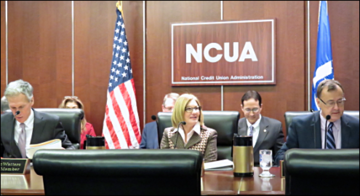
Left to right: Mark McWatters, Debbie Matz, Rick Metsger
By Frank Diekmann
ALEXANDRIA, Va.—The NCUA Board voted 2-1 this morning to approve a 2015 budget of $279.4 million, with board member Mark McWatters saying he was “dismayed” at the agency’s budget and budgeting process and calling for more input from “stakeholders” in the year ahead.
At the heart of the divide: Matz argued that it was that stakeholder input from the trade associations and CUs that led to previous reductions in NCUA’s budget and contributed to the deep losses experienced by credit unions during the recession, threatening safety and soundness.
The 4.2%, or $11-million, increase in the budget over 2014 reflects a “modest net increase to authorized staffing levels,” bringing its staffing to 1,268 people. The agency said that will mean a net increase of 4.2 positions and reallocation of existing regional staff to positions of greater specialization. NCUA has sought to build its expertise in capital markets, real estate, business lending, and IT/cyber-security, according to the agency’s CFO. Areas where specialization is being developed, such as travel and salaries/benefits, comprise 72% of NCUA’s budget.
The NCUA board meeting on which the budget was voted upon was marked by clear disagreement between Matz and McWatters, who was casting his first vote on an NCUA fiscal year budget, and cast a vote against its passage. One issue of disagreement: how transparent is the agency’s budget process, and the degree of input that credit unions, trade groups and others should have in its budget.
In recent weeks both credit union trade groups called on the agency to reduce its budget, which is up 50% since 2008, and have further requested input into the budgeting process. That brought asides during the board meeting from both Matz and Board Vice Chairman Rick Metsger that credit unions and trade groups have both fought disclosures when it applies to CUs themselves, such as disclosing executive pay and conference-related travel costs.
2015 Increase Smallest In Seven Years
In her remarks prior to the board vote, Matz said NCUA’s 2015 budget increase is its smallest in seven years, and “ensures we have the resources to do our jobs…in a manner that is efficient and that recognizes that our operating costs are borne by the credit unions that we regulate and insure.”
Matz said the agency continues to use zero-based budgeting, and has reallocated resources wherever possible rather than hire new people, noting the median hours spent examining CUs smaller than $10 million in assets is down 22%, while time spent in CUs of more than $50 million is up 50%.
“I know there will always be those who argue that NCUA should cut the budget. Cutting the budget is not an option,” said Matz, who cited various non-discretionary costs as one driver of the increase.
But it was the idea that NCUA should cut staff over which Matz was most passionate, saying history is a guide to the damage that can occur when budget is cut.
“This agency made the mistake of cutting staff in the years leading up to the recession, cutting 71 FTEs between 2001-08, and we expanded to 18 months the time between exams. The result was the agency was unable to identify many credit unions’ problems early enough to save the losses.”
Matz said just because a CU fails, its problems don’t just disappear, but are absorbed by an acquiring credit union or the agency itself. Moreover, more sophisticated powers by some credit unions have meant greater demands for sophisticated examinations.
“This budget is designed to ensure expertise keeps pace with credit unions’ expanded risks,” said Matz.
Matz also argued NCUA is a leader in budget transparency among federal agencies, and that the agency now discloses far more information than it has in the past, including detailed expenses from all of its offices. Matz said the agency is also preparing to post four “fact sheets” related to its development process, its Information Technology Prioritization Council (which was created by Matz to weigh cost/benefits of all IT), its procurement process, and its efforts at transparency.
Debbie Matz
For his part, McWatters said he doesn’t understand the budget increase the agency was seeking.
“As the newest member of the NCUA board, I’ve learned more about the NCUA budgetary process, and I am dismayed by the increase in the NCUA budget, the overhead transfer rate, and certain aspects of the budget process as employed by NCUA.”
NCUA To Do More Than 'Follow Script'
Responding to an argument made by Matz, McWatters said, “The board’s job in my view is not merely to follow the script set by other financial regulators, but to lead. To lead. I have argued over the past few weeks for additional transparency and I welcome the additional transparency.”
To that end, McWatters called for additional detail on employee pay and benefits, travel, rent, contracted services and more; detailed analysis of how NCUA may reduce those expenses; a detailed description of the methodology; a detailed analysis of expenditures among NCUA, the NCUSIF, the corporate stabilization fund and more; a detailed analysis of why NCUA’s budget has increased by more than 50% over last five years; a detailed analysis of all cost savings programs of last five years; a detailed analysis of expenses of the Information Technology Prioritization Council; a detailed analysis of expenditures NCUA expects to incur from its proposed RBC rule; a formal cost-benefit analysis of each rule proposal by NCUA and the methodology of conducting that analysis, and a detailed analysis of how NCUA intends to allocate its budget to achieve its goals.
McWatters proposed that in 2015 NCUA posted its 2016 budget proposal several weeks ahead of the board meeting on which that budget will be voted upon, and to allow for comments, including comments during the board meeting itself.
McWatters said he had two other issues: That NCUA is overly concerned with headcount, which he called “myopic” and said if NCUA needs staff, it should add them without “hand-wringing,” but should do so with a full explanation of why. He also dismissed those critical of NCUA’s expenditures on “non-core functions,” such as its Office of Small Credit Union Initiatives, for which he expressed strong support, saying it’s consistent with why credit unions were created.
Matz responded by saying, “It is easy to vote against something when you don’t participate in the process and work toward achieving the goal. It makes headlines and doesn’t make our jobs easier. Our budget process is extremely transparent. I challenge anyone to point to any other federal regulator that provides as much or more information that we do. The Congress created the NCUA board with the responsibility to expend such funds and perform such functions as appropriate. It was not the intent of Congress that NCUA collect fees from credit unions and then let the credit unions to determine how we regulate and how we spend our funds. I’m very pleased to say that credit unions are in very good condition, unlike the condition I found them in when I arrived at the board. There was effort to play to the industry, and we didn’t have the resources. The CU industry was on the verge of destruction. We have worked hard to increase our resources where necessary.”
But McWatters responded to the “comments that were directed to my statement” by saying, “I don’t think I am held to a standard by what the FDIC or the Fed does. I’m also not held to the standards of private businesses. I’m held by the standard of NCUA. This is a public agency. We are using other people’s money to do things here. Unless there is a legal reason not to disclose something, we should disclose it. I’m trying to act, rather than react. I do appreciate the changes that have been made, and I do think we have a much better product. Is there room for improvement? Yes, it is a positive first step.
“As for the public hearing, I have to be careful. What I am suggesting is that members of the credit union community can come up here and can make comments on the budget. That does not lead to regulatory capture,” said McWatters, referring to a term used earlier by Matz. “That is absurd. What I would expect to hear would be things like inefficiencies in the examination process, and that would allow us to work on the employee side of the budget, which is 73% of the budget. I think the three of us are strong-willed enough not to have our arms twisted.”
But Matz countered, “I strongly disagree. In years where there were public hearings there was an effort to keep our budget in line with the requests made at those hearings, and the result was a reduction in budget and reduction in FTEs and almost at total failure in 2008. What’s interesting is that in all of your remarks we have heard nothing about safety and soundness, which is why we are all here. I do believe in transparency, we provide a great deal, more than any other, and while you may think that is not relevant, that is relevant. I am not sure what it is you want other than to have the trade associations come here and sign our budget for us.”
To which McWatters answered, “Wait a minute. I didn’t say that. Don’t say that I said that.”
Related links