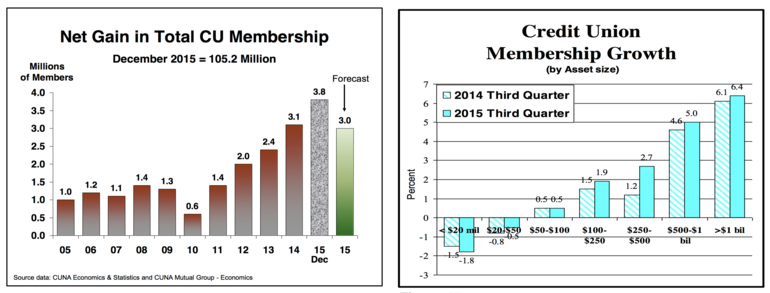
MADISON, Wis.–Membership growth in 2015 was the fastest in history, as some 3.8 million new members were added to bring the total number of members to 105.2 million, or 32.5% of the total U.S. population, according to CUNA Mutual’s Trends Report for December 2015.
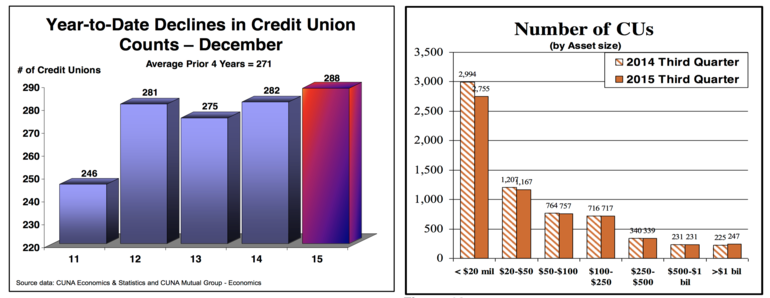
The total number of CUs operating at year-end was estimated to be 6,225, with a record 247 CUs now holding more than $1 billion in assets.
Meanwhile, CU real estate loan balances grew 8.1% in 2015, the fastest pace since 2008, due to a 39% surge in mortgage originations.
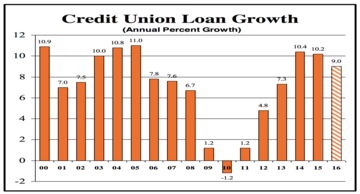
CUNA Mutual is estimating that CU loan growth will “decelerate” to 9% in 2016 but remain well above the past 25-year average of 7%.
In addition, according to CUNA Mutual Group’s Trends Report for December 2015, which is based on data compiled by CUNA, CUs reported solid numbers across all areas of performance in the final month of the year and for the year overall.
Here’s a look at numerous performance categories, with analysis provided by CUNA Mutual in its Trends Report.
- Community Banks Vs. Credit Unions. Overall, the nation’s credit unions outperformed the 5,812 community banks in the credit arena in 2015. Community bank total loan balances rose only 5.8% in the year ending in third quarter of 2015, below the 10.7% gain for credit unions. Community bank “loans to individuals” rose only 2.9% during the 12-month period. Community bank real estate loans rose 5.8%, versus 8.1% for credit unions. However, community banks’ return on assets of 1.0% in the third quarter was significantly above the credit unions’ 0.77%, due to higher net interest margins, 3.62% versus 2.89% for credit unions. Asset quality was slightly better at credit unions than community banks in the third quarter with credit unions reporting an annualized loan charge-off rate of 0.46%, below the 0.56% rate at community banks.
- Total Lending. Credit union loan balances rose 0.9% in December, slightly better than the 0.8% pace reported in December 2014. Driving overall loan growth was strong growth in adjustable-rate mortgages (3.2%), credit card loans (2.2%) and new auto loans (1.7%). November credit card seasonal factors – holiday shopping - typically add 3.9 percentage points to the underlying credit card trend loan growth. The muted December credit card growth was caused by the continuing windfall from lower fuel prices. Credit union loan balances rose 10.2% in 2015, down slightly from the 10.4% reported in 2014 due to a slight slowdown in new auto and credit card growth rates.
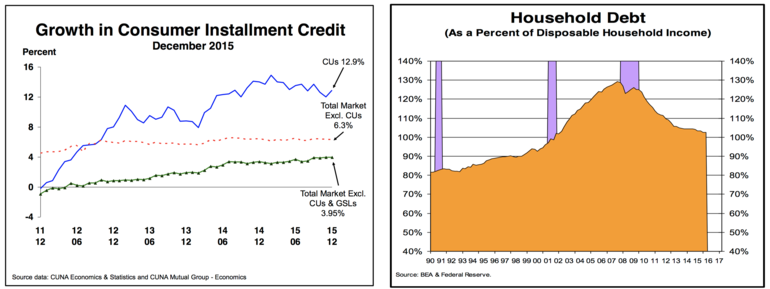
- Credit Union Consumer Installment Credit (CUCIC). Credit union consumer installment credit balances (auto, credit card and other unsecured loans) rose 1.4% in December, twice the 0.6% pace set in December 2014. During 2015 credit union consumer installment credit grew 12.9%, faster than the total market excluding credit unions which grew only 6.3%.
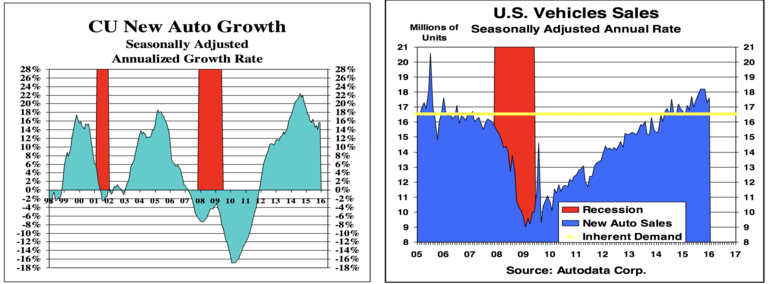
- Vehicle Loans. Credit union new auto loan balances rose 1.7% in December, faster than the 1.0% pace set in December 2014, and rose 16.5% for the full year. On a seasonally-adjusted annualized basis, new auto loan balances rose 15.7% in December, a slight acceleration from the third quarter but below the 22% cyclical high reported in August 2014.
- Real Estate-Secured. Credit union real estate loan balances grew 8.1% in 2015, the fastest pace since 2008, due to a 39% surge in mortgage originations. The only real estate loan category reporting negative growth in 2015 were second mortgages due to members rolling those balances into refinanced first mortgages. By year end, fixed-rate first mortgages made up 28.2% of all loans, up from 22.6% in December of 2007, the beginning of the Great Recession. Currently 2.4% of members have a first mortgage loan at their credit union, up from 1.9% in 2009.
- Surplus Funds (Cash + Investments). Credit union liquidity fell to the lowest level since February 2009 in December. Credit union surplus funds as a percent of assets declined to 30.2% in December, down from 32.3% one year earlier, due to loan growth outpacing savings growth. Credit unions are however increasing the liquidity of their surplus funds. In December, 45.9% of surplus funds had a maturity less than 1 year, up from 42.4% one year earlier. Loans rose to 65.5% of assets in December, up from 63.7% one year earlier, which was the highest level since August 2009.
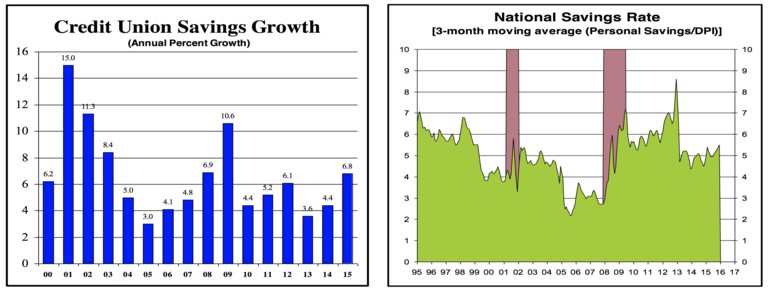
- Savings and Assets. Credit union savings balances rose 1.1% in December, above the 0.1% reported in December 2014, as falling expenditures on gasoline left more of members’ paychecks in their checking account at the end of the month. Savings balances typically decline 0.2% in December due to recurring seasonal factors like holiday spending. Savings balances rose 6.8% for all of 2015, the fastest pace since the Great Recession of 2008-2009.
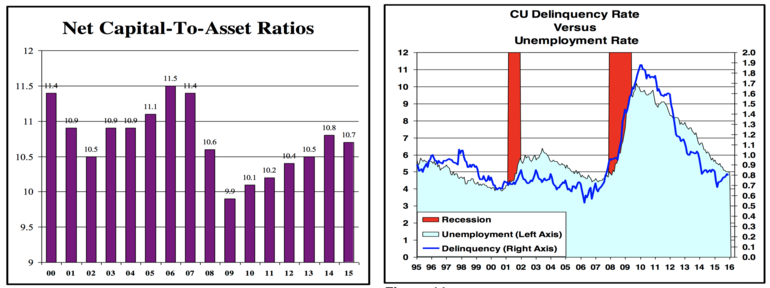
- Capital and Other Key Measures. The credit union industry’s capital-to-asset ratio ended 2015 at 10.7%, down slightly from the 10.8% reported at year-end 2014 as asset growth outpaced capital growth (Figure 11).
- Delinquencies. The credit union loan delinquency rate (loans two or more months delinquent as a percent of total loans outstanding) remained at 0.80% in December from its November reading, but down from the 0.85 reported one year earlier. During 2015, the delinquency rate’s annual seasonal pattern reverted back to what we saw in the 2001-2008 period.
- Credit Union Numbers. As of December 2015, CUNA estimates 6,225 credit unions are in operation, down 288 from December. The pace of consolidation in the credit union system accelerated in 2015 due to retiring baby-boomer CEOs, rising regulatory/compliance burden, record low net interest margins, rising concerns over scale and operating efficiency, rising competitive pressures and members’ demand for more products, services and access channels. There are now approximately 247 credit unions in the U.S. with assets greater than $1 billion, according to NCUA call report data.
- Members. Credit unions added 248,000 memberships in December, bringing the 2015 membership growth to 3.8 million new members, the biggest annual increase in credit union history and more than twice the pace set a decade earlier. Total credit union memberships reached 105.2 million at year end 2015, which is 32.5% of the total U.S. population of 323 million. This is up from 31.7% of the population at year end 2014. Once again, large credit unions reported the fastest annual growth while credit unions with less than $50 million in assets reported falling memberships.