ARLINGTON, Va.—More credit unions are utilizing financial literacy resources, according to data compiled by NAFCU as part of its April Economic & CU Monitor.
NAFCU said the survey of its membership found that member utilization of financial literacy programs increased in 2014 for 61.9% of respondents. Those respondents said that they found NCUA’s financial literacy resources more useful and used them more often than resources supplied by the CFPB.
“Financial literacy training programs have long been a hallmark of credit unions’ commitment to serve their communities,” NAFCU said in the Economic & CU Monitor. “Thanks to these programs, countless credit union members are armed with the tools to make better decisions for themselves and their families.”
NAFCU said respondents to its survey indicated that their educational programs are growing in both breadth and popularity, noting that nearly every survey respondent offers financial literacy training to its members (84.6%) and employees (92.3%). On average, respondents spend 86 hours each month on matters related to financial literacy, and those programs reach an average of 20,800 members per credit union, NAFCU found.
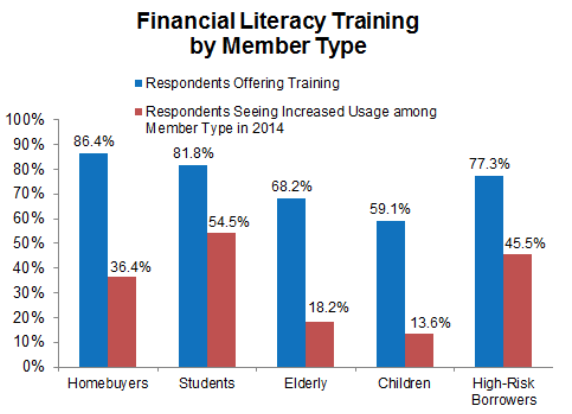
“Overall, member utilization of financial literacy programs increased in 2014 for 61.9% of respondents and decreased for only 9.5%,” NAFCU said. “Training programs target a wide array of members, including homebuyers (86.4%) and students (81.8%). The group that was most often cited for increased usage of those programs was students (54.5%), followed by high-risk borrowers (45.5%).”
In terms of the types of training programs offered, the most popular methods were:
- Home buying, 86.4%
- Overdraft avoidance, 81.8%
- Online financial tips, 77.3%
- Overuse of financial services, 68.2%
- Emergency fund planning, 63.6%
NAFCU said the education method that saw the most increased usage was online financial tips (50%).
Training tools among those surveyed were most often developed in-house or using online sources, while survey respondents said they offer a wide array of products to the unbanked and underbanked, including second chance checking accounts, fresh start loans, credit counseling, programs coordinated with Wounded Warriors and teaching sessions at public libraries, YMCAs and schools.
Meanwhile, the CU & Economic Monitor also found that for February, respondents reported:
- Member growth was up 3.1% year over year.
- Share growth was up 4.5% year over year.
- The aggregate network ratio declined six BPs to 10.92%.
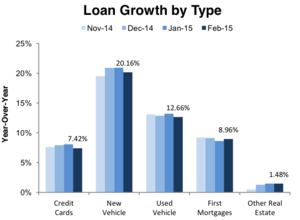
- Loan growth remained at 10.5%.