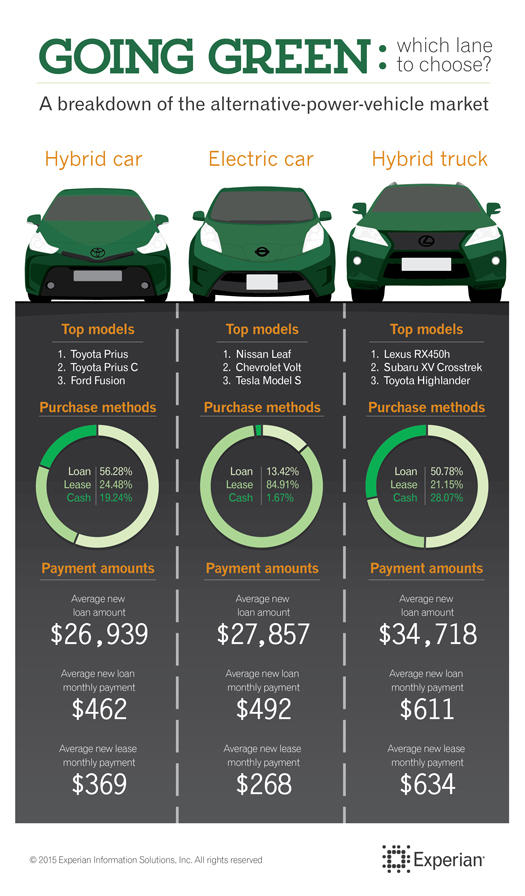
SCHAUMBURG, Ill.—In honor of Earth Day last week, Experian Automotive conducted research on green vehicles and found consumers are using more of their own green to buy them.
According to the analysis of the alternative-powered vehicle market, findings showed that in 2014, more than 18% of consumers that purchased a green vehicle paid in cash, compared to 15.24% of those that purchased a gas-powered vehicle (see infographic below).
“Despite the increases we have seen in automotive financing over the past few years, it’s interesting that a larger percentage of consumers buying green vehicles are choosing to buy with cash,” said Melinda Zabritski, senior director of automotive finance for Experian. “To put it in context, nationally, consumers purchased new vehicles with cash roughly only 16% of the time. A possible reason for this could be that consumers buying green vehicles are in the highest credit tiers, which could indicate they have more disposable income than those buying a gas vehicle.”
By being in the highest credit tiers, consumers purchasing green vehicles also tend to be a slightly lower credit risk than those purchasing traditional models, Experian found. Nearly 83% of consumers who purchased an alternative-powered vehicle fell within the prime credit category, compared to 71.5% of consumers who purchased a gas-powered vehicle. Additionally, the average credit score of a consumer purchasing green was 737, while it was 711 for traditional vehicles.
From an overall market perspective, the percentage of new registered alternative-powered vehicles experienced a slight decrease year-over, going from 4.1% in 2013 to 3.9% in 2014.
“While consumers purchasing an alternative-powered vehicle can satisfy their environmentally conscious side, the influx of traditionally powered vehicles with extremely high fuel efficiency have presented more options for consumers looking to save a buck at the fuel pump,” continued Zabritski.
At the model level, nearly 50% of all green vehicles registered in 2014 were Toyotas, led by the Prius (24.7%). The remaining top 10 included the Prius C (7.4%), Ford Fusion (6.9%), Toyota Camry (6.8%), Nissan Leaf (5.8%), Prius V (5.7%), Ford C-Max (4.2%), Hyundai Sonata (3.8%), Chevrolet Volt (3.5%) and Lexus CT 200h (3.3%).
For traditionally powered vehicles, the top model was the Honda Accord (3%), followed by the Ford F150 (2.8%), Honda CR-V (2.7%), Toyota Camry (2.6%), Chevrolet Silverado 1500 (2.6%), Honda Civic (2.6%), Toyota Corolla (2.2%), Toyota RAV4 (2.0%), Nissan Altima (2.0%) and the Ford Escape (2.0%).
“Gaining insight into what’s happening in the different segments of the market allows consumers to paint a clearer picture of what options are most popular, but it also enables dealers and manufacturers to adjust their strategies and make more informed decisions,” continued Zabritski. “By leveraging these insights, dealers and manufacturers are able to use this data for good, by providing inventory that not only meets the needs of the market, but also better fits in with consumer demand.”
Other findings:
• In 2014, 53.3% of consumers took out a loan to purchase a green vehicle, while 70.2% of consumers took out a loan to purchase a traditional model.
• For leases, 28.2% of consumers leased an alternative-powered vehicle in 2014, compared to 29.6% of consumers leasing a gas-powered vehicle.
• The average loan for an alternative-powered vehicle in 2014 was $27,288, compared to $27,817 for a gas-powered vehicle.
• In 2014, the average monthly payment for an alternative-powered vehicle was $468; gas-powered vehicles were $473.
• The average lease payment for an alternative-powered vehicle was $358, compared to $407 for a gas-powered vehicle.
• The top five states with the highest percentage of alternative-powered vehicle registrations in 2014 were California, Hawaii, Oregon, Washington and Georgia.