ARLINGTON, Va.— Calling it a “costly experiment for credit unions,” NAFCU has sent a letter to Congress raising formal objections to NCUA’s revised risk-based capital plan. In a letter sent to both the Senate Committee on Banking, Housing & Urban Affairs and to the House Financial Services Committee, NAFCU said “we have serious concerns about the costly nature of this solution in search of a problem. There have also been credible important arguments raised about the legality of the proposal under the Federal Credit Union Act.”
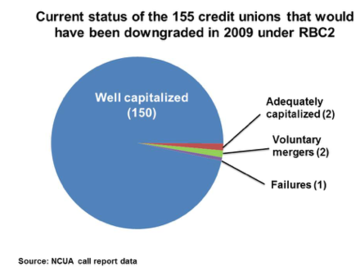
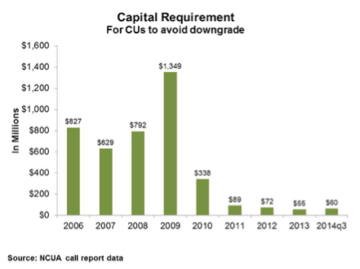
The NAFCU letter, signed by VP-Legislative Affairs Brad Thaler, states that the trade group’s analysis has found that were the new risk-based capital proposal in place during the financial downturn in 2009, 155 credit unions would have been downgraded. “Only one of those, however, actually ended up failing during the crisis,” said Thaler. “On the other hand, 150 of those credit unions are healthy and well-capitalized today. NCUA’s current proposal would have required these credit unions to raise $1.4 billion to avoid being downgraded during the financial crisis, further straining the credit union system during this difficult time.”
NAFCU said that figure does not take into account the additional capital that credit unions would have needed to hold in order to maintain their capital cushion levels during the financial crisis. INSERT CHART HERE
NAFCU told Congress it also remains “deeply concerned” about the cost of the proposal to NCUA, which it is pegging at $3.75 million for adjustments to be made to Call Reports, updates to its examination systems, and for training for internal staff to implement the proposed requirements. NCUA also estimates credit unions would incur an ongoing $1.1 million expense to complete the adjusted Call Report fields.
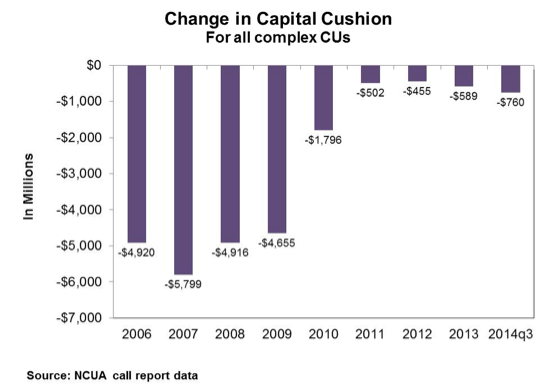
Furthermore, NAFCU said its analysis estimates that credit unions’ capital cushions (“a practice encouraged by NCUA’s own examiners”) will “suffer a $490 million hit if NCUA promulgates separate risk-based capital threshold for well-capitalized and adequately capitalized credit unions (a “two-tier” approach).”
“Specifically, in order to satisfy the proposal’s ‘well-capitalized’ thresholds, today’s credit unions would need to raise an additional $760 million,” Thaler writes in the letter. “On the other hand, to satisfy the proposal’s “adequately capitalized” thresholds, today’s credit unions would need to raise an additional $270 million. Despite NCUA’s assertion that only a limited number of credit unions will be impacted, this proposal would force credit unions to hold hundreds of millions of dollars in additional reserves to achieve the same capital cushion levels that they currently maintain. These are funds that could otherwise be used to make loans to consumers or small businesses and aid in our nation’s economic recovery.”
Finally, NAFCU has also challenged NCUA’s legal authority for the separate risk-based capital thresholds for well-capitalized and adequately capitalized credit unions, and cites NCUA board member J. Mark McWatters’ statements that NCUA lacks that authority.
“The FCU Actdoes not provide NCUA the express authority to implement a separate risk-based net worth threshold for the ‘well capitalized’ net worth category,” said NAFCU. “Simply put, Congress has not expressly authorized the Board to adopt a two-tier risk-based net worth standard.”
The trade group called on both the Senate and the House committees to review the NCUA proposal.