Lucy Ito, NASCUS
ARLINGTON, Va.—State-chartered credit unions are paying an outsized amount to fund NCUA as the result of budget shifts the agency has made related to the share deposit fund, according to the trade group representing state regulators.
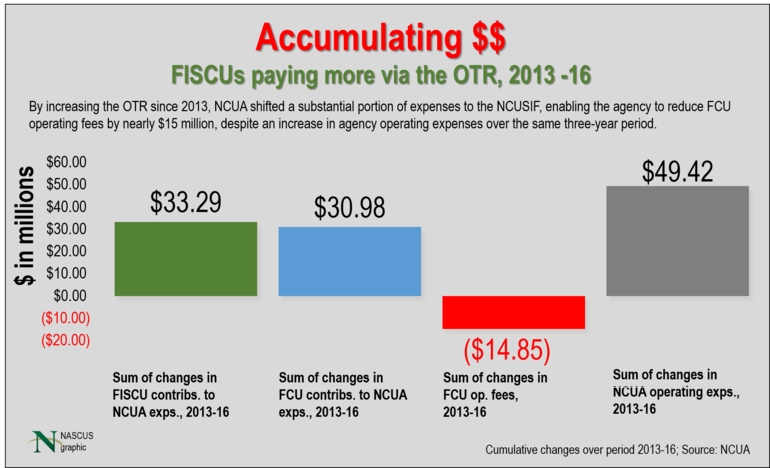
The National Association of State Credit Union Supervisors has issued an analysis it says shows NCUA has “shifted a substantial portion of its expenses to the National Credit Union Share Insurance Fund since 2013, funding the transferal through increases in the overhead transfer rate while at the same time reducing federal credit union operating fees by nearly $15 million.
Over that time, however, NCUA has increased its operating expenses by more than $49 million, NASCUS reported.
“At stake is whether NCUA should have carte blanche in the use of credit union dollars contributed to the Share Insurance Fund,” said Lucy Ito, president and CEO of NASCUS. “We believe the system should have full accountability, such as providing a complete explanation for how the activities it defines as ‘insurance-related’ for the purpose of the OTR are actually related to insurance.”
NASCUS has created an infographic, below, that it says demonstrates NCUA’s additions to operating expenses have been accomplished largely through the overhead transfer rate (OTR). The OTR portion contributed by federally insured, state-chartered credit unions (FISCUs) increased by more than $33 million from 2013-16, while the FCU portion has increased by nearly $31 million.
“However, by reducing FCU operating fees by $14.8 million over that period, the agency has essentially lessened the burden on federals – while still increasing its operating expenses by more than $49 million in the period 2013-16,” NASCUS said.
“The OTR has become an inequitable distribution, favoring the FCU over the state charter by lowering FCU operating fees and reallocating a significant portion of the expense related to FCU supervision to the NCUSIF, which is also funded by state-chartered credit unions,” Ito said. “As the legal analysis NASCUS commissioned last summer stated, ‘the resulting reduction in FCU Operating Fees provides a singular advantage to FCUs and adversely affects the competitive position of FISCUs relative to FCUs.’ If the dual-chartering system is to thrive – and we know it should – that inequitable distribution must come to an end. The credit union system can help ensure that by letting its voice be heard during this comment period on the OTR.”
Ito said the increasing reliance on the insurance fund to pay the expenses of the agency reduces the opportunity for all federally insured credit unions to realize benefits. “The significant increases in the OTR have reduced the likelihood that federally insured credit unions will receive a rebate from the NCUSIF,” she said.
Ito added that all stakeholders with an interest in how NCUA allocates resources from the insurance fund should keep these points in mind as they consider responses to NCUA’s call for comments – which all stakeholders should do, regardless of their charter type, she said.