

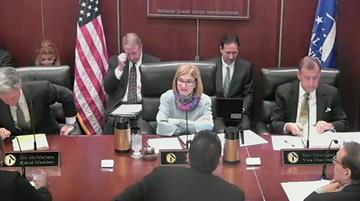
L-R: Mark McWatters, Debbie Matz, Rick Metsger
ALEXANDRIA, Va.—By a 3-0 vote Thursday, the NCUA board approved a proposed field of membership rule that represents what Chairman Debbie Matz called the “most comprehensive” FOM reform in the history of the agency.
The 160-page proposal (click here for the document) is out for a 60-day comment period.
NCUA staff noted during a presentation at the board meeting that the FOM rules had been in place since before Internet banking had become a marketplace reality, and certainly prior to the emergence of mobile banking.
NCUA Vice Chairman Rick Metsger, who has championed FOM since taking his seat on the board, has consistently stated that modernizing field-of-membership regulations is the most important issue for the long-term health of America’s credit unions, and Thursday Board Chairman Debbie Matz said that nothing is “more vital to the future of credit unions than the ability to attract new members.”
Click here for Metsger's prepared remarks.
“With Congress deadlocked, NCUA has an obligation to the system to update rules that haven’t been updated in nearly two decades,” said Metsger.
Credit unions have argued that the current system is unnecessarily cumbersome and restricts their ability to grow to serve their members. NCUA staff noted during their presentation that many of the previous FOM rules predated Internet banking and other mobile options.
Key Changes
The proposal contains numerous changes to the existing rule—including:
- FCUs will be able to apply to convert to a community charter or expand an existing community charter without having to serve the core area if electing to serve a portion of a Core Based Statistical Area.
- NCUA’s population limit of 2.5 million people will apply to a Core Based Statistical Area or any well-defined portion thereof.
- An FCU will be able to apply to serve “Combined” Statistical Areas, as designated by the Office of Management and Budget.
- An FCU could apply to serve an outside area contiguous to its existing Core Based Statistical Area or single political jurisdiction.
- The rural district population limit is increased to 1,000,000 – regardless of the state in which the majority of the district’s population is located.
For a summary of the changes, click here.
Citing many changes to NCUA’s FOM rule that have been made under her tenure as chair—including redefining community charters, significantly expanding rural districts, and removing the board from the process of approving community charters with populations over one million—a “dilemma” still exists today, emphasized Matz.
“Although the Credit Union Membership Access Act of 1998 was intended to facilitate membership, in fact, it is constraining when compared with today’s more permissive state laws,” she said. “As a result, we’ve seen three times more federal credit unions converting to state charters or merging into state charters in order to expand their field of membership.”
Click here for Matz's prepared remarks.
Threat To Dual Chartering
Matz said that currently the greatest threat to the dual chartering system is the disparity in fields of membership between federal charters and many state charters.
The chairman credited the efforts of the agency’s FOM Working Group and input credit unions have given NCUA.
“As a result of the extensive public input we received from a wide range of stakeholders, this proposal includes creative ideas that would provide real regulatory relief to a wide range of credit unions,” Matz said.
Most important, Matz added, the new rule would permit many federal credit unions to serve more potential members.
“Our over-arching vision is to enable federal credit unions to reach potential members from all walks of life, from rural towns to inner cities, from low-income communities to underserved areas, whether they work on family farms, in industrial parks or office buildings . . . ,” said Matz. “There are millions of potential members who want and need affordable financial services. They should be able to choose a credit union rather than turn to predatory lenders. And as long as it’s legally permissible to do so, federal credit unions should no longer have to turn them away.”
While the proposal would remove some disparity between federal and state charters, it would also benefit many state charters, asserted Matz.
“In states with ‘wild card’ or ‘parity’ provisions, state charters would be authorized to add new provisions granted to federal credit unions,” said Matz. “So we even received support from several state regulators as we developed this proposal.”
Time For Feedback
Matz said she is looking forward to credit union feedback during the comment period and is especially interested in comments about how NCUA could further streamline both the application and approval processes behind field of membership changes.
Overall what Matz said she expects the proposal will do once approved as a final rule is benefit consumers.
“This rule will expand consumer choice in the marketplace and increase access to affordable financial services,” she said.
NCUA staff said there had been considerable requests for additional flexibility around multiple common bonds.
While NCUA board member Mark McWatters voted in favor of putting the proposal out for comment, he said it is his view that credit unions should be able to articulate their own narrative around what constitutes a community, rather force a CU to “submit to an array of statistical models.”
McWatters said every FOM expansion should answer two questions: does the proposed community qualify as a “well-defined” community according to a “plain English” definition; and can the credit union effectively serve the proposed market?
McWatters further said he is interested in hearing from CUs on whether they should have to rely solely upon a determination by the CDFI Fund on whether an area is underserved, rather than a matrix reflecting a concentration of facilities, whether a single, statewide congressional district constitutes a well-defined community, and feedback around the issue of online-based communities.
McWatters urged NCUA to publish all legal analysis to support its FOM proposal and rules.